Disclaimer: The views expressed in this blog are those of the author and do not necessarily reflect the official position or opinions of the CBD Women’s Caucus
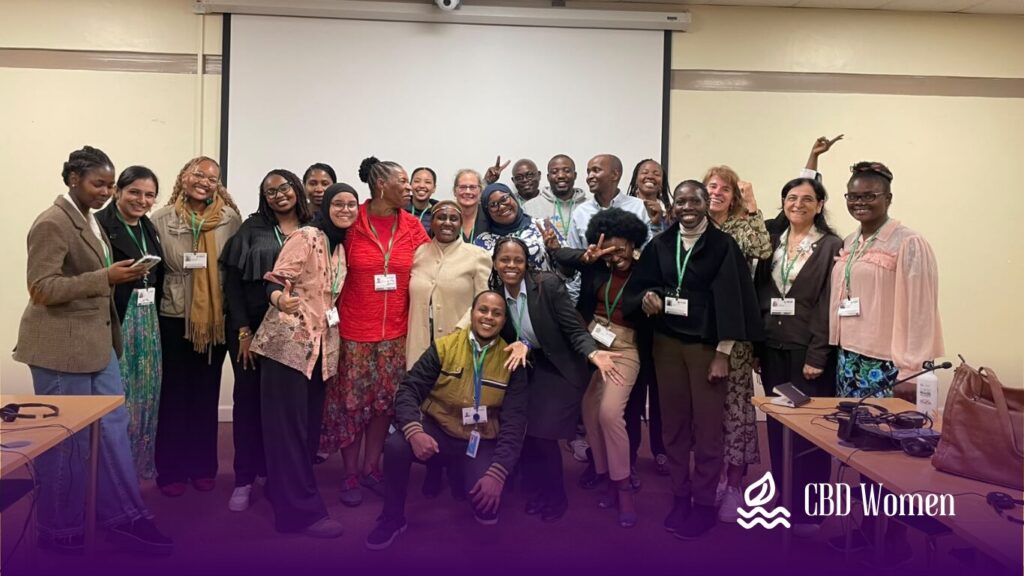
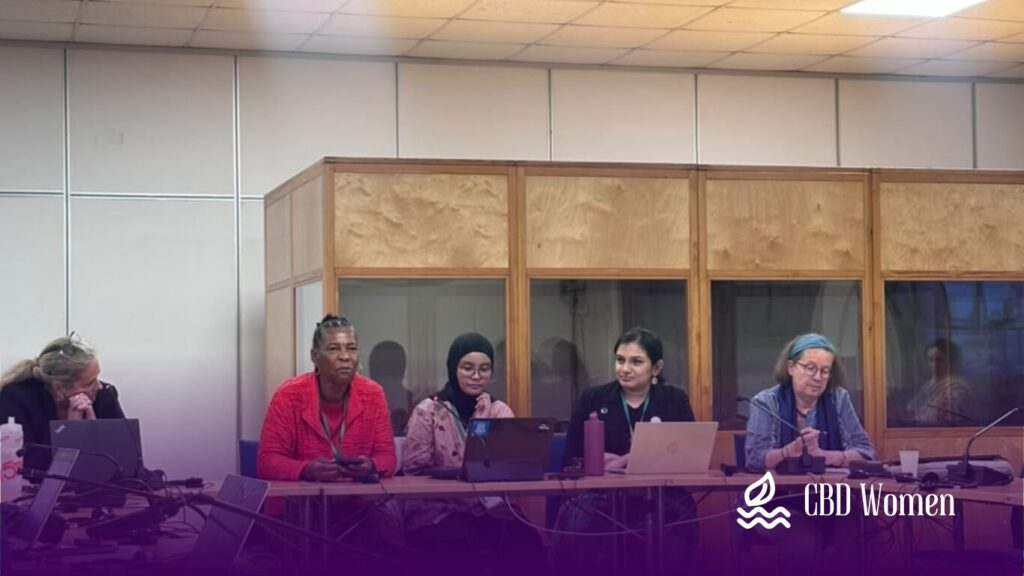
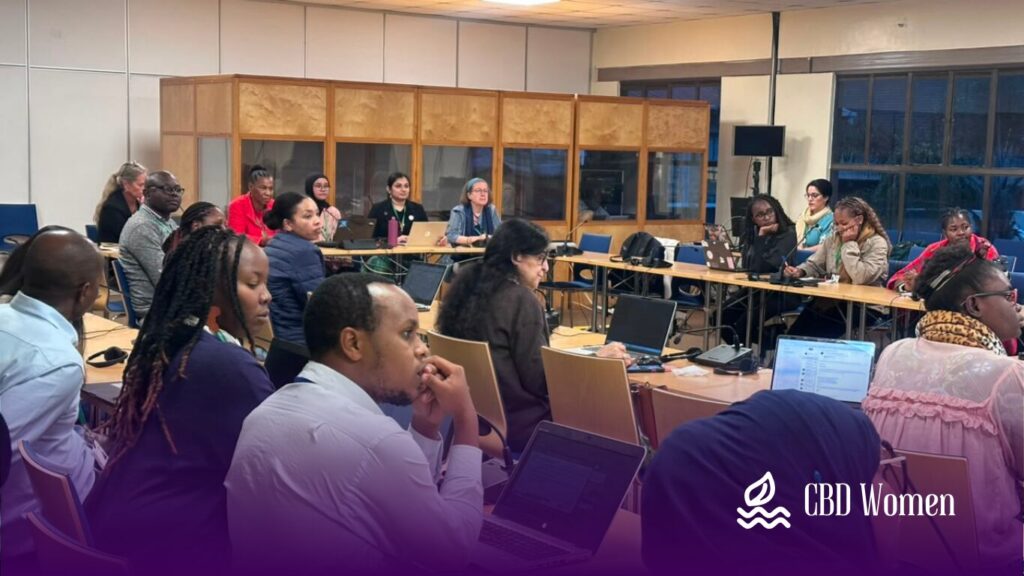
On 27 July, the CBD Women’s Caucus, in collaboration with Guatemala, UNEP-WCMC, IUCN-CEESP, IIED, and WEDO/GEDA, hosted a side event at SBSTTA-28 in Nairobi focused on one of the most persistent blind spots in biodiversity governance: the near-total absence of gender-responsive data in the systems meant to monitor and report on the Kunming-Montreal Global Biodiversity Framework (KM-GBF). The session brought together technical experts, government representatives, and community researchers to share evidence, identify gaps, and chart a path toward more inclusive monitoring.
Speakers underscored a shared message: without gender-disaggregated data and the meaningful participation of women in generating it, biodiversity monitoring will keep missing the people whose knowledge and labor sustain conservation on the ground and the policies built on that incomplete picture will remain less robust than they need to be.
About the Event
Setting the Scene: Current State of Monitoring and Data Gaps
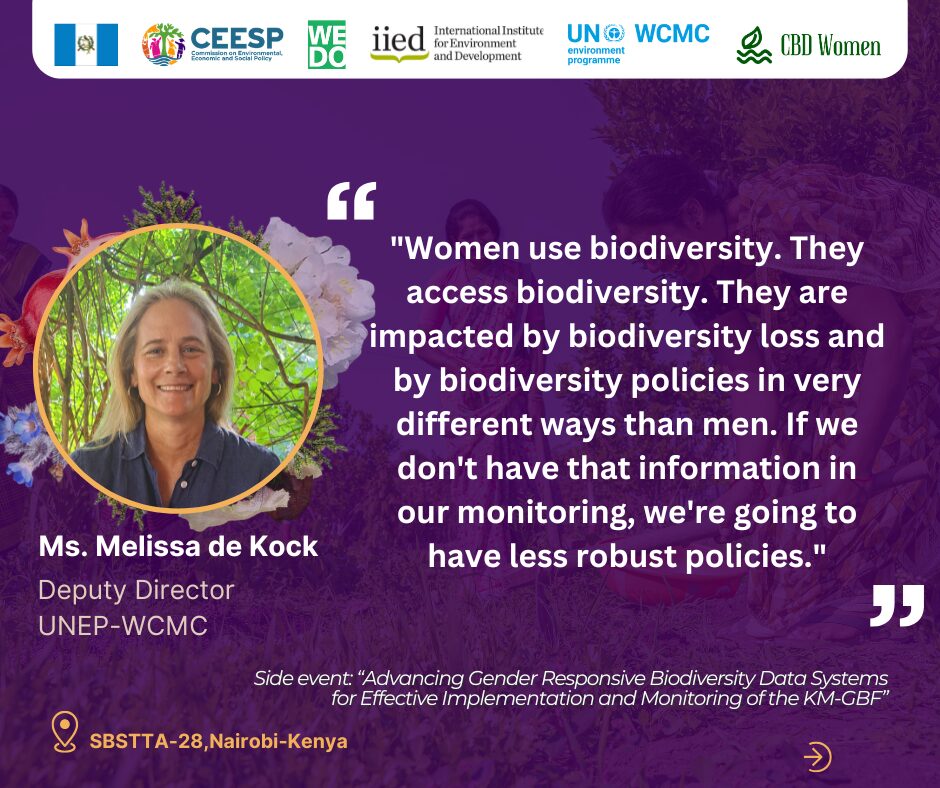
Ms. Melisa de Kock walked participants through the current state of gender-responsive monitoring under the Convention. She pointed to the Component Indicator on National Implementation of the Gender Plan of Action, whose methodology Parties acknowledged in Decision 16/31 as an important but underused tool, and noted that sex-disaggregated data remains largely absent not just from Target 23 reporting, but from nearly every people-related target across the KM-GBF.
Ms. Melisa stressed that closing this gap is not only about what gets reported, but how: national reports must draw on whole-of-government data collection and genuine whole-of-society input from women and women’s groups, not just the institution formally responsible for CBD reporting. She was direct about the consequences of inaction — without this information in national monitoring systems, biodiversity policy will continue to be built on an incomplete evidence base, at real cost to its effectiveness.
Government Experience: Closing the Silos Between Ministries
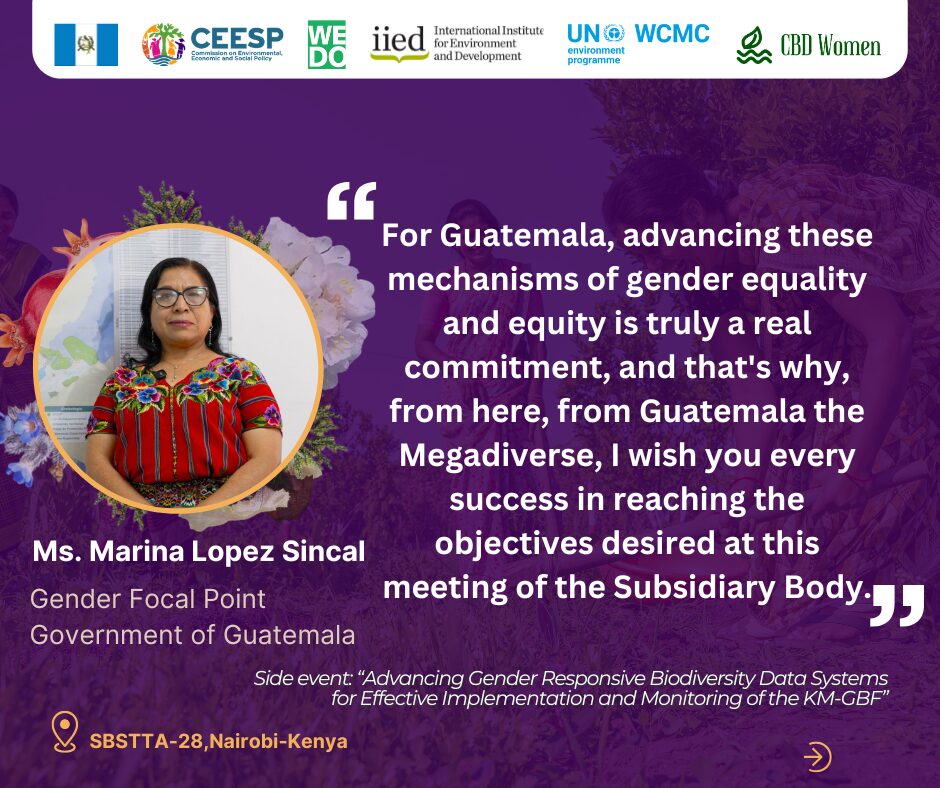
In a video message from Guatemala, Ms. Marina Lopez Sincal, the country’s Gender Focal Point, shared her government’s vision for a national biodiversity and gender information system capable of disaggregating data by sex, age, linguistic community, and people of origin. She described the core challenge as one of interoperability: without a coordinated system bringing environmental institutions together, efforts risk duplication, mechanisms remain isolated, and the evidence needed to demonstrate women’s, Indigenous Peoples’, and local communities’ contributions to conservation never fully materializes.
Ms. Marina was clear that this is not a peripheral initiative for Guatemala, but a strategic and foundational commitment one meant to ensure that decision-making no longer leaves behind the very people most engaged in biodiversity management. She closed with a call for stronger inter-institutional articulation, so that national systems genuinely reflect the collective vision the KM-GBF sets out.
Discussions also laid the groundwork for stronger collaboration among civil society organisations ahead of COP17, including joint messaging on key policy issues, movement-building beyond CBD spaces, and continued engagement around an emerging ecological justice agenda.
For the CBD Women’s Caucus, participation in the meeting reinforced the importance of ensuring that feminist perspectives remain embedded within broader biodiversity debates. As preparations continue towards COP17, the Caucus remains committed to working alongside allies to advance biodiversity governance that is equitable, rights-based and centred on the knowledge, leadership and lived experiences of Indigenous Peoples and local communities, Women and youth
Ms. Marina was clear that this is not a peripheral initiative for Guatemala, but a strategic and foundational commitment one meant to ensure that decision-making no longer leaves behind the very people most engaged in biodiversity management. She closed with a call for stronger inter-institutional articulation, so that national systems genuinely reflect the collective vision the KM-GBF sets out.
Discussions also laid the groundwork for stronger collaboration among civil society organisations ahead of COP17, including joint messaging on key policy issues, movement-building beyond CBD spaces, and continued engagement around an emerging ecological justice agenda.
For the CBD Women’s Caucus, participation in the meeting reinforced the importance of ensuring that feminist perspectives remain embedded within broader biodiversity debates. As preparations continue towards COP17, the Caucus remains committed to working alongside allies to advance biodiversity governance that is equitable, rights-based and centred on the knowledge, leadership and lived experiences of Indigenous Peoples and local communities, Women and youth
Ms. Marina was clear that this is not a peripheral initiative for Guatemala, but a strategic and foundational commitment one meant to ensure that decision-making no longer leaves behind the very people most engaged in biodiversity management. She closed with a call for stronger inter-institutional articulation, so that national systems genuinely reflect the collective vision the KM-GBF sets out.
Territorial Perspectives: Knowledge That Remains Invisible
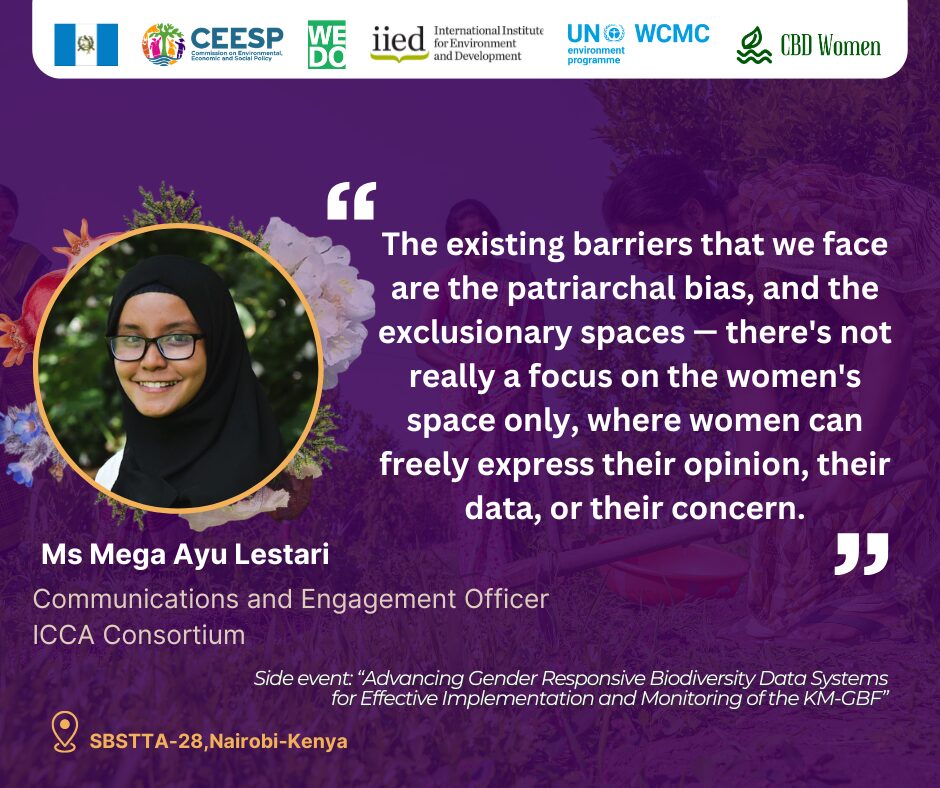
Speaking to the session’s territorial perspectives segment, Ms. Mega Ayu Lestari of the ICCA Consortium, drawing in part on her own family’s roots in Maluku, Indonesia laid out in detail the forms of knowledge that formal biodiversity reporting systems still fail to capture. She named the unpaid, unindexed labor of women who fetch water, preserve seeds, and maintain soil moisture; the technical expertise embedded in practices like gambir crafting in Sumatra and forest-based postpartum remedies; and the kinship systems — such as the Lorelindu philosophy of Mopahilolonga Katuvua, the harmony between people, nature, and the divine that resist conventional economic valuation altogether.
Ms. Mega Ayu Lestari also highlighted a hopeful development: ICCA’s new memorandum of understanding with Indonesia’s Ministry of Environment, enabling data-sharing with the national CBD focal point on the basis of free, prior and informed consent and community data sovereignty. She was equally candid about the barriers that remain — patriarchal bias, consultation spaces that leave little room for women to speak freely, and a global reality in which women shoulder over 75 percent of unpaid care labor. Her call was for governments to recognize customary and scientific knowledge as equally valid, and to invest directly in the collective, women-led initiatives already doing this work on the ground.
For the CBD Women’s Caucus, participation in the meeting reinforced the importance of ensuring that feminist perspectives remain embedded within broader biodiversity debates. As preparations continue towards COP17, the Caucus remains committed to working alongside allies to advance biodiversity governance that is equitable, rights-based and centred on the knowledge, leadership and lived experiences of Indigenous Peoples and local communities, Women and youth
Ms. Marina was clear that this is not a peripheral initiative for Guatemala, but a strategic and foundational commitment one meant to ensure that decision-making no longer leaves behind the very people most engaged in biodiversity management. She closed with a call for stronger inter-institutional articulation, so that national systems genuinely reflect the collective vision the KM-GBF sets out.
Methods and Evidence: Generating Gender-Responsive Biodiversity Data
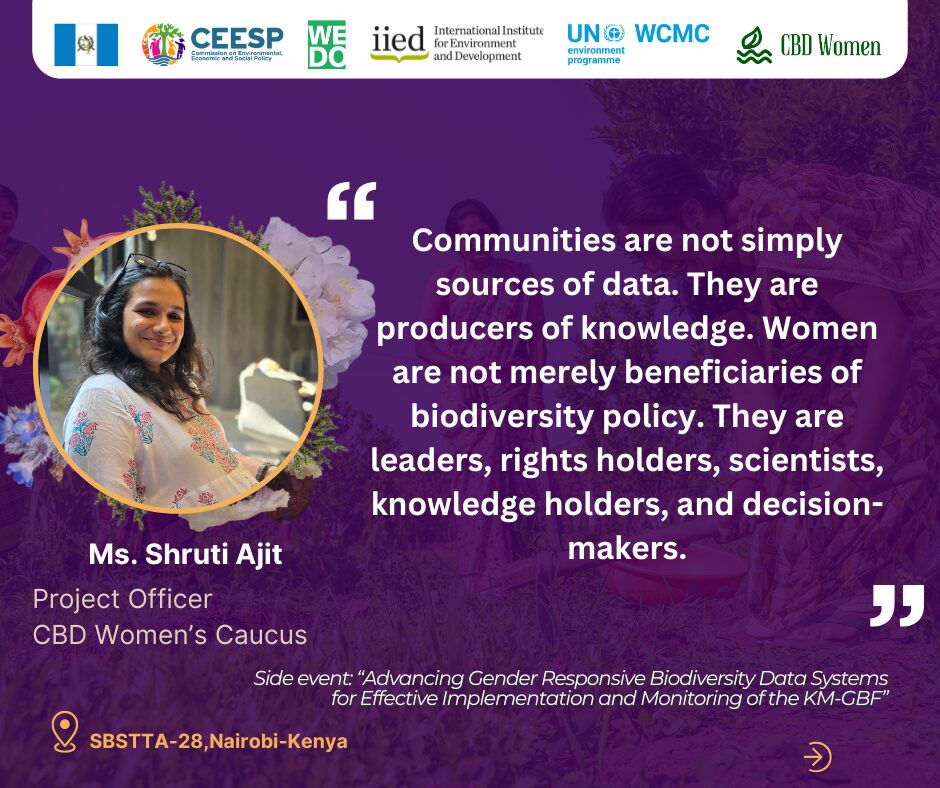
Closing the session, Ms. Shruti Ajit of the CBD Women’s Caucus presented Advancing Gender Justice in Biodiversity Data and Policy, a joint initiative with the International Institute for Environment and Development (IIED). She highlighted that while women play critical roles in biodiversity conservation, their knowledge and priorities remain largely invisible in the data that informs policy. Drawing on a global survey of women’s organisations, Indigenous Peoples and Local Communities, researchers, NGOs, and practitioners, she noted that valuable gender-responsive biodiversity data is already being generated through community monitoring and traditional knowledge systems. However, these efforts remain under-resourced, disconnected from national monitoring systems, and constrained by limited funding, technical capacity, and digital infrastructure. The survey also revealed a strong demand for peer learning and practical exchange.
In response, the CBD Women’s Caucus and IIED convened a global peer-to-peer learning series spanning the biodiversity data cycle, culminating in a practical handbook of methodologies and tools for gender-responsive biodiversity data to be launched ahead of CBD COP17. She concluded with a message that improving biodiversity data is fundamentally about improving governance, emphasizing that gender-responsive data goes beyond sex-disaggregated indicators to recognizing diverse knowledge systems and ensuring inclusive, participatory data processes. She called for greater investment in women-led organisations and Indigenous Peoples and Local Communities, and for embedding gender considerations throughout the entire biodiversity data lifecycle to strengthen implementation of the Kunming-Montreal Global Biodiversity Framework.
Moderated Dialogue: From Data to Policy Influence
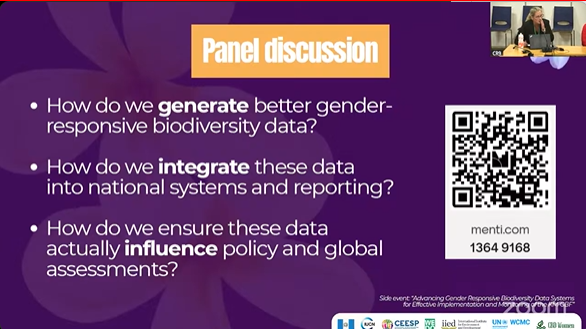
Following the presentations, the session moved into a moderated dialogue, facilitated by Ms Cristina Eghenter (Global Governance Policy Senior Expert (WWF International/CBD Women’s Caucus), bringing all speakers together to respond to three guiding questions: How do we generate better gender-responsive biodiversity data? How do we integrate these data into national systems and reporting? And how do we ensure these data actually influence policy and global assessments?