
By Ms. Daphné Esquivel-Sada, CBD Women’s Caucus member
Disclaimer: The views expressed in this blog are those of the author and do not necessarily reflect the official position or opinions of the CBD Women’s Caucus
Why This Matters to Us
The Ad Hoc Technical Expert Group (AHTEG) on Synthetic Biology brings together experts from Parties, civil society, and other stakeholders to provide technical and scientific advice on synthetic biology and its potential implications for biodiversity conservation.
For the CBD Women’s Caucus, the work of the AHTEG is not a peripheral technical debate it is deeply strategic. Synthetic biology discussions span fundamental questions about equity, participation, and the distribution of risks and benefits, where the inclusion of gender perspectives still requires sustained advocacy. More precisely, these discussions directly engage with gender-responsive biodiversity governance, inclusive participation in decision-making, and the recognition of diverse forms of knowledge and expertise — all at the heart of our mission.
The final meeting report provides recommendations that will inform future discussions, negotiations, and decision-making processes under the CBD on the broader implications of synthetic biology. Ensuring that the CBD Women’s Caucus is represented at the AHTEG is therefore crucial to guarantee that social justice concerns and the perspectives of women are meaningfully reflected in technical discussions that may shape the future of biodiversity governance, risk assessment, capacity-building, and benefit-sharing.
About the Meeting
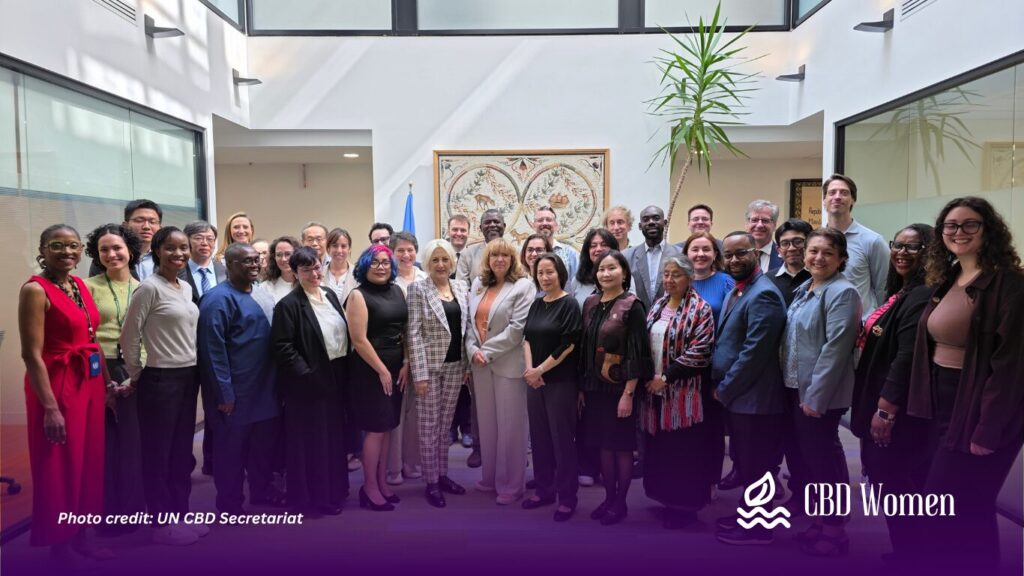
The AHTEG on Synthetic Biology took place from 19 to 22 May 2026 at the CBD Secretariat in Montreal, Canada.
The expert group brought together experts from 16 Parties, 1 representative from the non-Party USA, 1 from Indigenous Peoples, 1 from the CBD Women’s Caucus, 1 from the Global Youth Online Union, and 8 from observer organisations — including 3 from USA-aligned organisations and 1 from the biotechnology industry.
The meeting was mandated by CBD Decision 16/21, which tasked the 2026 AHTEG with four major objectives in relation to the three objectives of the Convention and the implementation of the Kunming-Montreal Global Biodiversity Framework:
- Identifying the current and potential benefits of synthetic biology
- Identifying the potential positive impacts of the most recent technological developments
- Identifying the potential negative impacts of the most recent technological developments
- Providing advice on how capacity-building, technology transfer, and knowledge-sharing in synthetic biology can be taken into account
The meeting focused primarily on the benefits and potential positive impacts of synthetic biology —covering biotechnological proposals for conservation tools, sustainable agriculture and consumption, and climate adaptation measures as well as how these benefits and their risks are assessed, and how benefit-sharing and capacity-building may be implemented.
The CBD Women’s Caucus was represented by Ms. Daphné Esquivel-Sada from Brazil, who has consistently emphasised that assessments of technological benefits must incorporate social and gender-responsive analyses of impacts, rather than focusing exclusively on technical performance. It is paramount to account for how synthetic biology developments can specifically affect women, given their central roles in natural resource management, food production, traditional livelihoods, and the health of women and children.
The CBD Women’s Caucus interventions at this meeting were grounded in the Caucus’s agreed positioning and priorities on synthetic biology our main goal was to contribute to balancing the CBD’s current positioning on synthetic biology based on the Caucus’s priorities, which insist on the importance of developing a responsible and multidisciplinary analysis of synthetic biology benefits and impacts, and of promoting gender-responsive analysis and socio-economic and cultural analytical frameworks as necessary approaches to inform policy and governance.
Key Highlights
The meeting’s major topics included:
- The Independent Scientific Study on Synthetic Biology
- Current and potential benefits of synthetic biology and its most recent technological developments — with special attention to artificial intelligence and computational biology, applications for conservation, artificial cells, synthetic genomics, microbiome engineering, and bioremediation and waste reduction
- Gender and inclusive decision-making — a particularly significant outcome of the meeting, with the conclusions of the report stating that the assessment of potential positive and negative impacts should be part of a multidisciplinary approach, in accordance with the precautionary principle and in consultation with Indigenous Peoples, local communities, women, and youth
This is a meaningful step forward — and one the CBD Women’s Caucus will continue to build on.
What Comes Next
The final meeting report will be made available shortly by the CBD Secretariat. It will then inform negotiations at the upcoming SBSTTA meeting in Nairobi, starting 27 July.
Given the high stakes involved in synthetic biology discussions under the CBD, we encourage all of you to stay attuned to the Caucus’s engagement on this issue — and to get involved in supporting the Convention’s related activities. Whether you are at the forefront or in the background, your expertise, talent, and energy are decisive towards a more just and gender-responsive future for all.