
By Esperance Pricille Noumbou Vehpoubouot member of the CBD Women’s caucus
Disclaimer: The views expressed in this blog are those of the author and do not necessarily reflect the official position or opinions of the CBD Women’s Caucus
From October to November 2025, Esperance Pricille Noumbou Vehpoubouot represented the CBD Women’s Caucus at the at the the online meetings of the «Informal Advisory Group on Ecologically or Biologically Significant Marine Areas», where she advocates for integrated approaches that combine scientific and Indigenous knowledge systems, policy implementation, and the active participation of local communities to achieve sustainable biodiversity management.
Ecologically or Biologically Significant Marine Areas
EBSAs descriptions provide scientific information about the ecological and biological features of specificmarine areas. They do not prescribe management measures, such as the establishment of marine protected areas, nor do they characterize threats or recommend specific restrictions on human activities.Decisions on any such measures or policies are purely a matter for States and competent intergovernmental organizations.
EBSAs are defined based on seven internationally agreed scientific criteria, designed to be applicable across a wide range of marine ecosystems:
- Uniqueness or rarity
- Special importance for life history stages of species
- Importance for threatened, endangered or declining species and/or habitats
- Vulnerability, fragility, sensitivity or slow recovery
- Biological productivity
- Biological diversity
- Naturalness
These areas can vary widely in scale and location, ranging from coastal zones to the high seas, and from surface waters to the deep seabed. They include diverse ecological features such as coral reefs, seamounts, hydrothermal vents, migratory corridors, spawning areas, and coastal upwellings.
Highlights
Following the establishment of the new IAG, four meetings were held in October and November 2025. These meetings were chaired by Joseph Appiott (CBD Secretariat), with support from Jacqueline Grekin.
The group consists of approximately 30 experts, including representatives from governments and observer organizations such as the Women’s Caucus.
Key topics discussed included:
- Review of EBSA modalities and terms of reference
- Status of EBSA submissions and identification of gaps
- Strategies to encourage new EBSA submissions
- Voluntary guidelines for peer review processes
- Alignment with related initiatives (e.g., IMMAs, ISRAs)
- Approaches for organizing future regional workshops
The discussions also addressed how EBSAs have been described historically and explored updated methodologies under the new modalities adopted at COP-16.
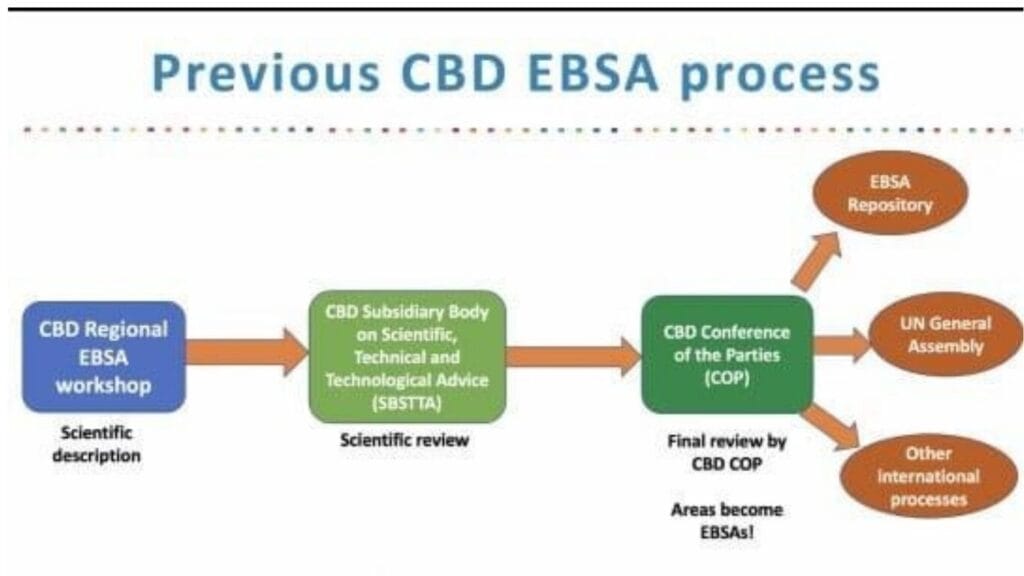
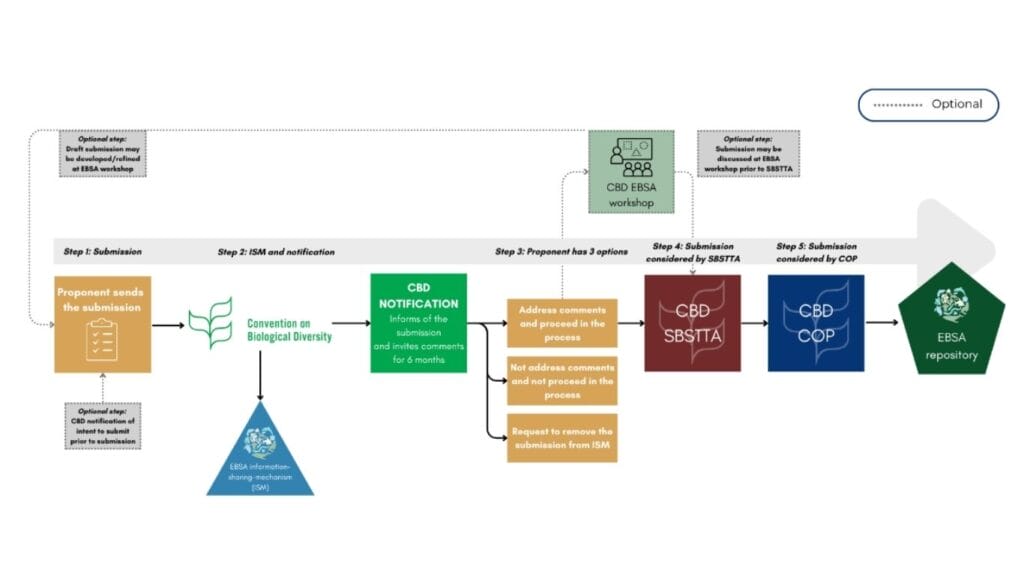
Previously, EBSAs were identified through regional workshops coordinated by the CBD Secretariat. Between 2011 and 2021, 15 workshops led to the description of over 300 EBSAs. While workshops remain central to the process, new modalities allow for more flexible approaches, including submissions outside workshop settings.
Outcomes and nexts steps
EBSA information provides an opportunity for prioritizing marine areas that would benefit from planning, conservation or management efforts to safeguard biodiversity and support sustainable use.
Using the latest science and knowledge, EBSA information aims to support planning across different spatial scales, from local to national, regional and global, and inform various types of management tools, including MPAs (Marine Protect Areas), other effective area-based conservation measures (OECMs), environmental impact assessments, and sectoral management measures, for example. It can also feed into scientific research and monitoring, or bring attention and awareness to these areas of importance.
EBSA information plays a key role in advancing the goals and targets of the KM-GBF, in particular Target 1 (spatial planning), Target 2 (ecosystem restoration) and Target 3 (area-based conservation).
EBSA information has not only been used at the national and sub-national levels by CBD Parties, but has also been used in a range of global and regional intergovernmental processes focused on issues related to the marine environment and sustainable development. Importantly, EBSA information contribute to the implementation of the Agreement under UNCLOS on the Conservation-Sustainable Use of Marine Biological Diversity of Areas beyond National Jurisdiction (BBNJ Agreement).
However, women—particularly in coastal and Indigenous communities—often experience differentiated impacts in terms of access to resources, decision-making, and benefits derived from these ecosystems. At the same time, they play critical roles as knowledge holders, resource managers, and agents of change.
Oceans are the planet’s primary carbon sinks and the largest reservoir of biodiversity. Ensuring their protection requires inclusive and gender-responsive approaches that recognize and strengthen women’s contributions. Safeguarding the oceans is not only an environmental imperative—it is fundamental to sustaining life and advancing equity for present and future generations.