
Four years after the Global Biodiversity Framework and its Target 23 and the CBD’s Gender Plan of Action were adopted, one question sits at the centre of the conversation: what does gender-responsive implementation of the Global Biodiversity Framework actually look like once policy meets practice?
That is the question «Policies in Practice: Learning from National Experiences for Gender-Responsive Implementation of the Global Biodiversity Framework» set out to answer, convened on 15 September 2026 by University College London (UCL), the UK Department for Environment, Food and Rural Affairs (DEFRA), and the CBD Women’s Caucus. The webinar brought together researchers, government focal points, and practitioners to present the report and provide an opportunity to hear directly from several of the practitioners whose experiences informed the publication, fostering peer learning and dialogue on advancing gender-responsive implementation.
Why this conversation, why now
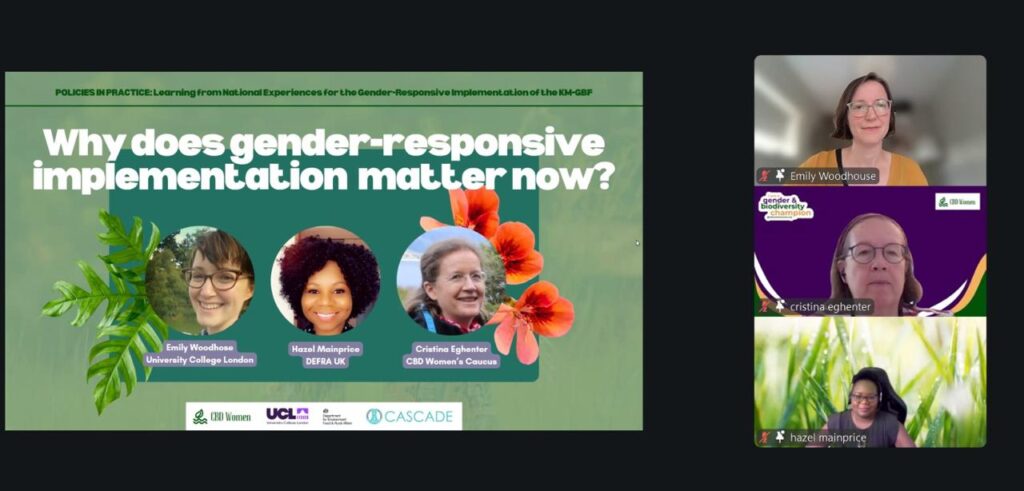
The webinar, moderated by Ms. Amelia Arreguin Prado, Coordinator of the CBD Women’s Caucus, aimed to present key findings from a synthesis of evidence on gender-responsive implementation across case study countries and to hear directly from practitioners on their experiences implementing Target 23 and the Gender Plan of Action. Exchange practical lessons, challenges and enabling factors across different national contexts. This will also strengthen peer learning and collaboration among governments, civil society and other biodiversity stakeholders.
Dr. Emily Woodhouse, Associate Professor at University College London, opened by noting that, nearly four years after Target 23’s adoption, the commitment exists on paper; what’s overdue is the shift to concrete, evidence-informed strategies. She framed the biodiversity crisis as, at its core, a crisis of power over who governs land and resources, meaning that raising women’s numerical representation without addressing structural power won’t be enough, though she closed on a note of hope, pointing to genuine, if under-reported, progress.
Ms. Hazel Mainprice, UK Gender Focal Point to the CBD at DEFRA, set out the UK’s approach around three pillars: evidence, participation, and enabling conditions (finance, capacity, inclusive governance), linking it to the «Principles for inclusive, gender responsive and locally-led biodiversity action» Inclusive Nature Principles launched at COP16. Her message: gender equality and biodiversity are mutually reinforcing agendas, and gender responsiveness must be part of the machinery of implementation, not a garnish.
Dr. Cristina Eghenter, member of the Board of Directors of the CBD Women’s Caucus, pointed to the Gender Plan of Action’s midterm review, concluding at COP17, which confirms that women’s contributions remain undervalued. Target 23 is still among the least-reported targets in national submissions, despite growing visibility in NBSAPs.
The evidence base: ten countries, what actually worked
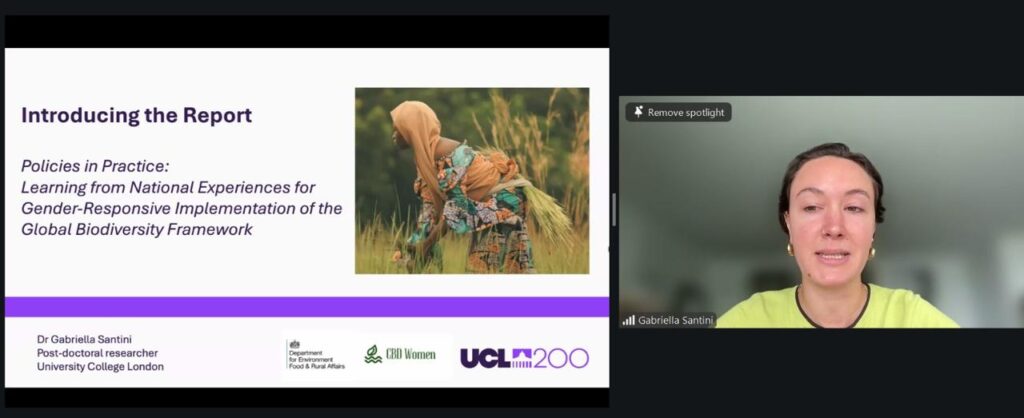
Dr Gabriella Santini, Post-doctoral Research Associate at University College London, opened with the gap the report set out to fill: four years after Target 23’s adoption, only 27% of Parties have committed to women’s equal land and resource rights, just 41% of those with strong targets report being on track, and only 1% say the target has been achieved. Global assessments show where progress is lagging, she noted, but far less about how it is being achieved where it is happening.
The findings, drawn from a review of 7th National Reports and GPA mid-term review’ submissions, an open call through CBD Women’s Caucus channels, and 18 interviews with focal points, officials, civil society and researchers across ten case-study countries (Canada, Costa Rica, the Dominican Republic, India, Indonesia, Kenya, Malawi, Mexico, Tajikistan and Sweden), point to clear patterns: gender mainstreaming isn’t only top-down, and government action alone was rarely enough; civil society, community organizations, paralegals, industry and international partners each played a distinct and decisive role. Connecting existing frameworks was often as effective as building new ones (Mexico’s COMGESA, Costa Rica’s five-institution alliance, Tajikistan’s accelerator-facilitated MOU).
Rights must accompany representation, since participation isn’t the same as influence, and formal legal rights are necessary but not sufficient without sustained investment and enforcement. Deep-rooted social norms resist policy alone, and monitoring/data systems and domestic financing remain the two biggest structural gaps across nearly every case. Intersectionality, meanwhile, is recognized in principle but rarely operationalized; women are still largely treated as a homogeneous category.
Three focal points, three journeys
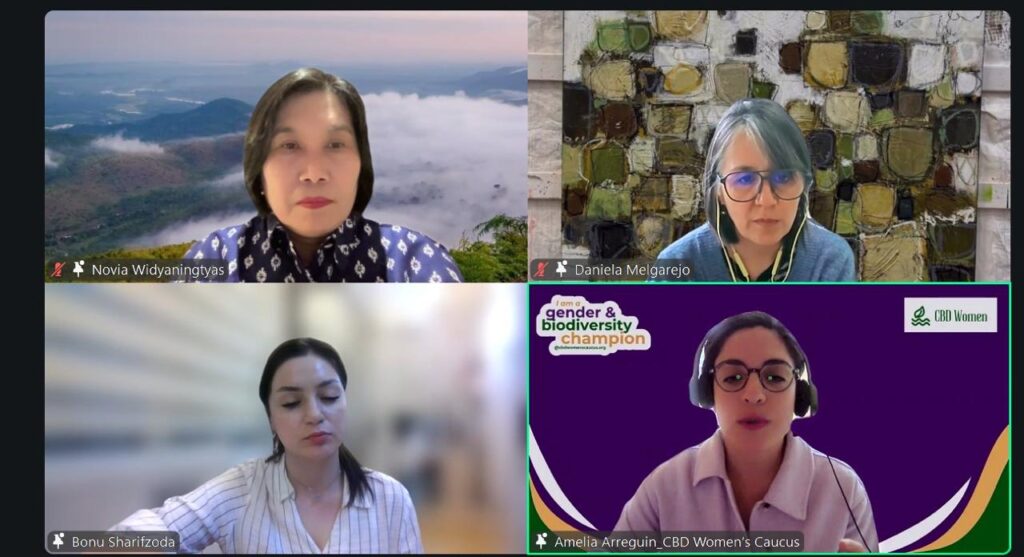
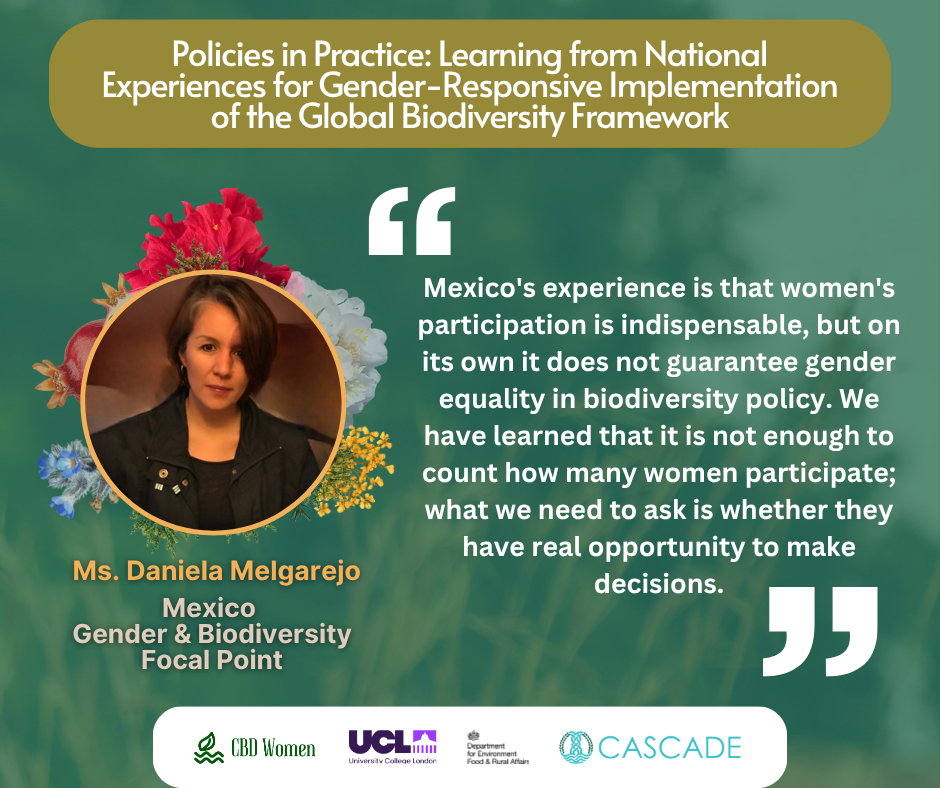
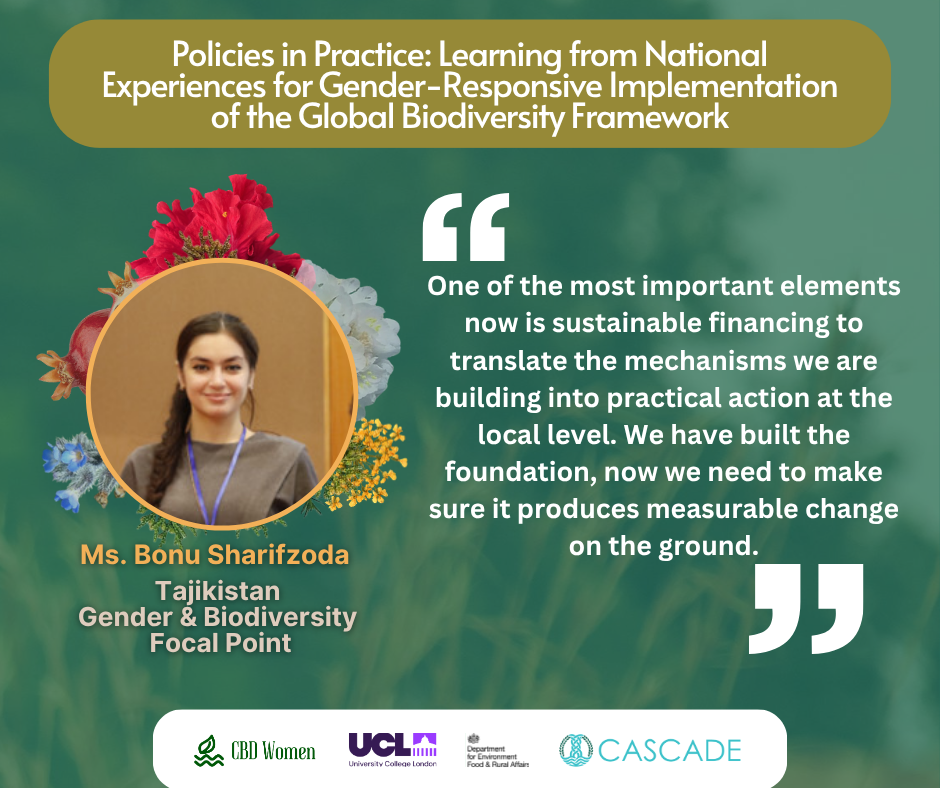
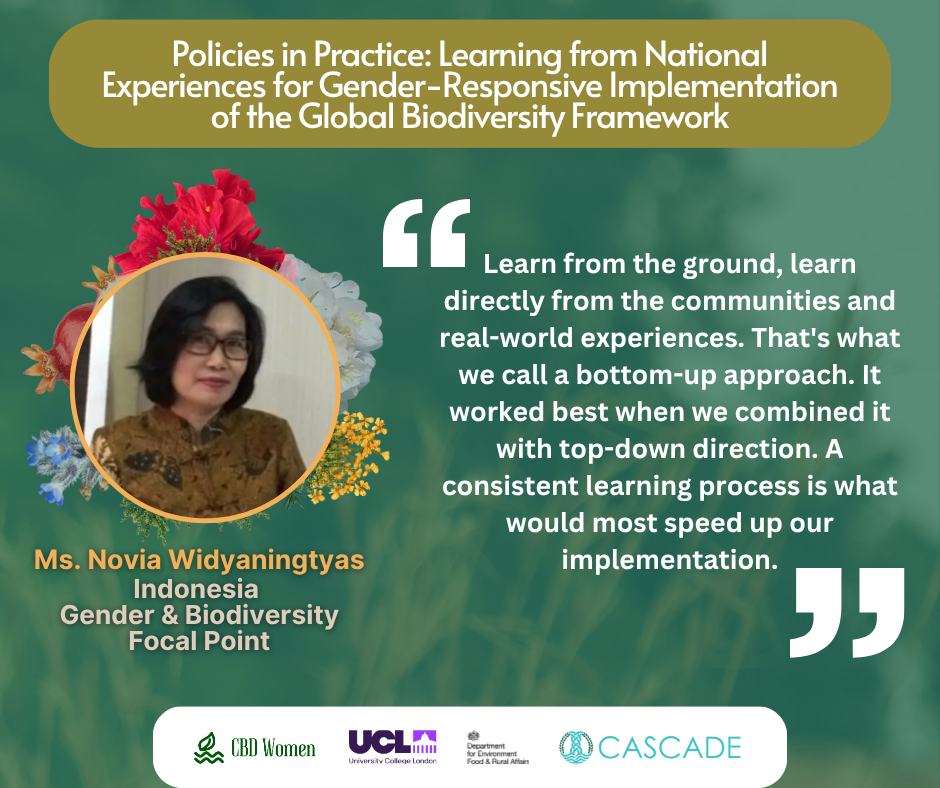
The roundtable brought together Ms. Daniela Melgarejo (Mexico’s CBD Gender Focal Point), Ms. Bonu Sharifzoda (Tajikistan’s Gender Focal Point) and Ms. Novia Widyaningtyas (Indonesia’s CBD Gender Focal Point) for a direct conversation about moving from commitment to practice.
Ms. Widyaningtyas pointed to formally anchoring gender mainstreaming in Indonesia’s biodiversity strategy (IBSAP 2025–2045), building on constitutional guarantees of women’s environmental rights dating back to 1945 and reflected in the IBSAP’s Strategy 3.2 on mainstreaming gender equity and inclusive participation. Ms. Melgarejo described Mexico’s harder-won lesson: women’s participation is indispensable but not sufficient on its own; it has to come with real decision-making capacity, land access, and the removal of the structural barriers that keep participation from translating into influence. Ms. Sharifzoda credited Tajikistan’s progress to listening first: consultations with women, local communities, youth, scientists, and local authorities surfaced practical barriers that national-level analysis alone had missed women already active in gathering medicinal plants or wild fruit, for instance, but lacking equipment, technical knowledge, or access to finance and markets.
Their advice to countries earlier in the journey converged on the same point: participation without influence isn’t enough. Ms. Melgarejo urged building a gender perspective into policy design from the outset and working across sectors agriculture, rural development, Indigenous affairs, finance, since gender-responsive biodiversity action is not the environmental sector’s job alone. Ms. Sharifzoda’s advice was blunt: listen first, co-create solutions, then write the policy, not the other way around. Ms. Widyaningtyas stressed binding commitments paired with genuine coordination across Indonesia’s many sectors and regions, recommending that bottom-up learning documenting the country’s many local women’s champions be combined with top-down direction rather than relied on alone.
On financing and monitoring, Ms. Sharifzoda pointed to the need for predictable resources to turn Tajikistan’s national roadmap and updated NBSAP (to 2040) into local action, citing new projects linking women’s economic empowerment to conservation, from beekeeping and pollinator conservation to native-fruit-tree nurseries and sustainable harvesting. Ms. Melgarejo agreed that Mexico’s challenge isn’t a lack of policy; the country has made real progress there, but converting existing policy into financed, monitored, institutionally accountable action, with indicators able to show whether inequality is actually shrinking rather than simply reaching more women. Ms. Widyaningtyas named capacity building as Indonesia’s single biggest lever, one that has to reach government, civil society, academia and communities equally and sustainably rather than all at once alongside financing and locally suited monitoring indicators, so that top-down commitments and ground-level knowledge can finally speak the same language.
What's next
The report will be shared through the CBD Women’s Caucus channels ahead of COP17 in Yerevan, Armenia this October. Designed as a practical guide for all actors involved in biodiversity conservation and implementation, it provides concrete guidance to help translate the commitments under Target 23 and the Gender Plan of Action into practice, including by supporting more inclusive and gender-responsive action that reaches all women and girls.
Missed the webinar? Don’t worry! Check out the recording in English, French, and Spanish. 👇