
By Pamela Tapia Díaz, CBD Women’s Caucus Project Officer
Disclaimer: The views expressed in this blog are those of the author and do not necessarily reflect the official position or opinions of the CBD Women’s Caucus
How are we going to measure the effectiviness of technical and scientific cooperation support centres? How and who is using the Long term strategic framework tfor capacity-building and development? These questions were at the centre of discussions during the sixth meeting of the Informal Advisory Group on Technical and Scientific Cooperation (TSC-IAG), held online from 27 to 29 April 2026, which brought together 29 of the Group’s 31 members, including government representatives, UN agencies, intergovernmental organizations, and civil society actors, to advance the implementation of the Kunming-Montreal Global Biodiversity Framework.
About the event
The IAG members met for three days online to address the following agenda items:
Items 3 and 4 — Clearing-House Mechanism: progress in the implementation of the programme of work for the clearing-house mechanism for the period 2024–2030 and the knowledge management strategy.
Item 5 — Technical and Scientific Cooperation Mechanism, which included: (a) Draft criteria for measuring the performance of the regional and subregional technical and scientific cooperation support centres and the global coordination entity (b) Programme priorities and workplan of the global coordination entity (c) Options for the mobilization of resources to support the work of the technical and scientific cooperation support centres
Item 6 — Progress in the implementation of the long-term strategic framework for capacity-building and development: preliminary findings of the survey on the use of the strategic framework.
As IAG members, we were specifically requested to pay particular attention to the methodologies for monitoring and tracking progress.
Items 3 and 4-New ways to share the knowledge, the Clearing House Mechanism and the knowledge Management
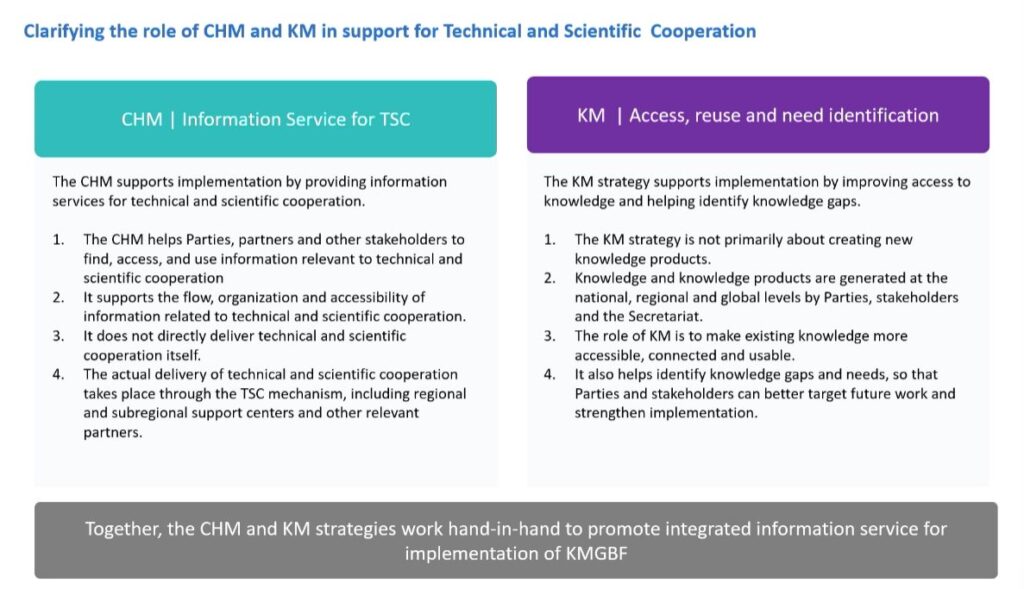
These two elements are closely interconnected and were therefore presented simultaneously. The Clearing-House Mechanism (CHM) provides information services to support data exchange and technical and scientific cooperation, while the Knowledge Management (KM) Strategy offers strategic guidance on objectives and actions to foster knowledge generation, synthesis, discovery, collection, and uptake. Importantly, the role of the KM Strategy is not to create new knowledge, but to facilitate access to existing knowledge — making it available, discoverable, and actionable for those who need it most.
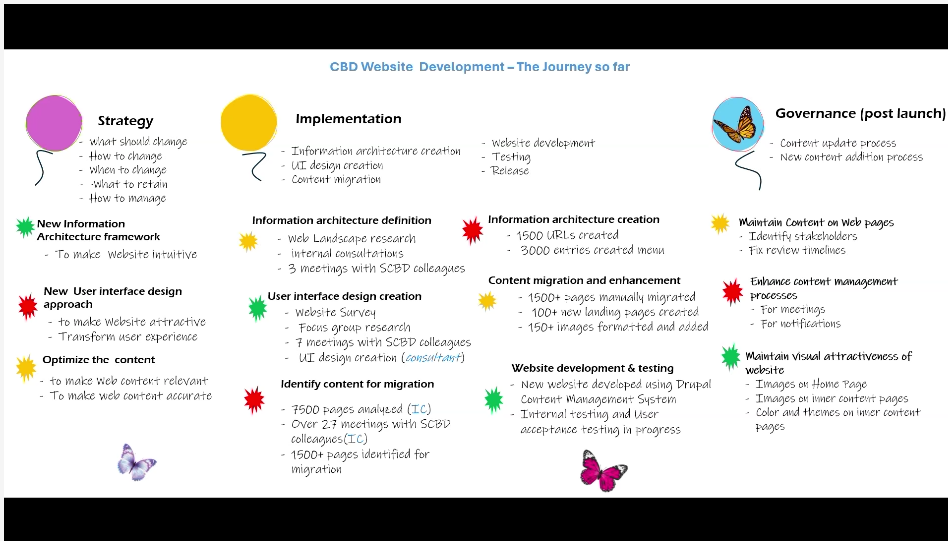
The implementation of both elements was explored through an initial review of the NBSAPs submitted by Parties, where references to the CHM and KM Strategy were only vaguely included, highlighting the need for stronger guidance to ensure their meaningful integration into national biodiversity planning. On the technical side, the Secretariat advanced an enhanced version of the CHM central portal, introducing a common code base and harmonized interface across the CHM, the Biosafety Clearing-House, and the Access and Benefit-sharing Clearing-House, along with updated user documentation to facilitate navigation of the new platform.
Item 6 — Progress in the implementation of the LTSF for capacity-building and development: preliminary findings.
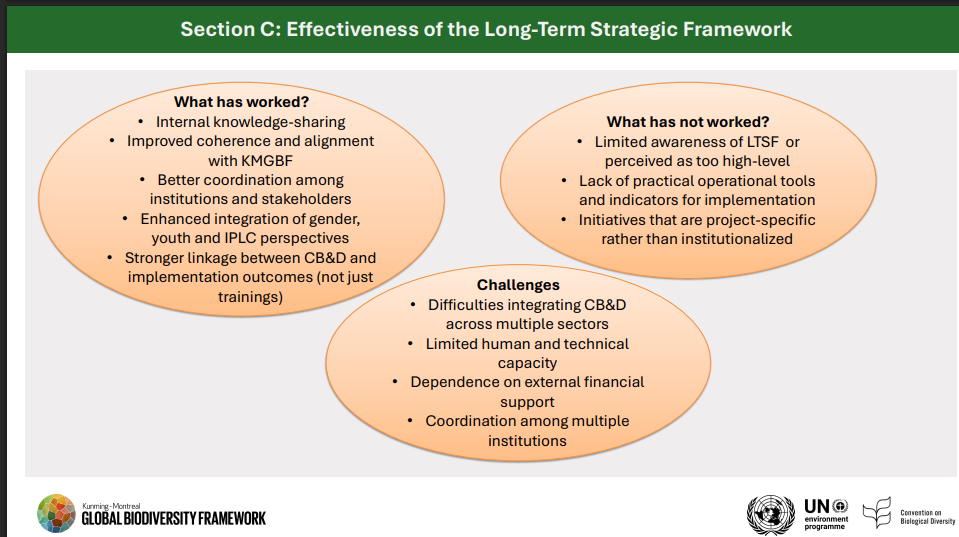
A preliminary report was presented on the contributions submitted by Parties and other non-governmental actors, including those of the CBD Women’s Caucus. In this context, emphasis was placed on the importance of disaggregating results by region, rights-holders, and Parties, in order to better understand the different ways in which the Long-Term Strategic Framework has been used and applied across diverse contexts.
Overall, these findings show that the framework is primarily being used as a planning tool to support capacity‑building at the systemic and institutional levels, consistent with the framework’s intended purpose and objectives
The 62% of survey respondents, reported not having used the guidance provided in the strategic framework cited a lack of practical guidance on how to apply the framework.
During the online forum discussions, comments were submitted directly on the document emphasizing the importance of reporting the findings of non-government actors — either in a dedicated section or consistently throughout each point of the analysis. It was also highlighted that future discussions should focus on translating findings into concrete next steps, ensuring that the results of the survey lead to actionable recommendations rather than remaining as descriptive observations.
Item 5 Technical and Scientific Cooperation Mechanism
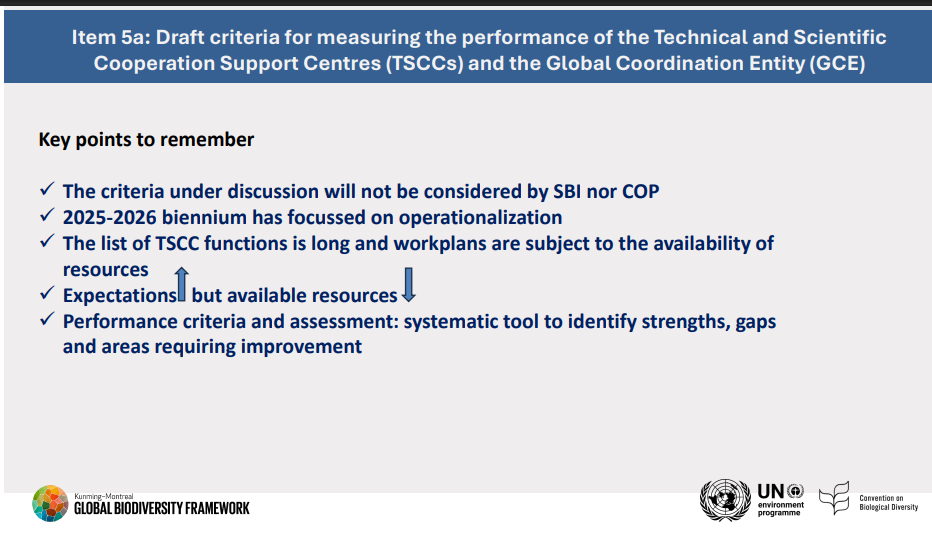
a) Draft criteria for measuring the performance of the regional and subregional technical and scientific cooperation support centres and the global coordination entity
During the meetings, the varying capacities of TSCCs were emphasized, highlighting the importance of reflecting these differences when designing a performance assessment framework. It was also noted that while expectations for TSCCs are high, their ability to deliver is closely tied to the availability of adequate and predictable funding. Furthermore, it was acknowledged that TSCCs operate at different scales — with some centres supporting only a few countries while others serve a significantly larger number — underscoring the need for a flexible assessment framework that accounts for this diversity
IAG members were invited to submit comments through the online discussion forum. Our contributions focused on the importance of keeping sight of the quality, inclusiveness, and alignment of TSCC processes with the Kunming-Montreal Global Biodiversity Framework. We also highlighted the importance of evidence of sustained capacity beyond the completion of TSCC-supported projects — ensuring that the skills, tools, and institutional arrangements developed through TSCC support remain functional and impactful in the long term.
(b) Programme priorities and workplan of the global coordination entity
The Global Coordination Entity (GCE) is mandated to facilitate coordination, synergies, and collaboration among TSCCs; support the sharing of experiences and standardized tools; mobilize resources; operate a global helpdesk; and assist TSCCs in aligning their work with the KMGBF and reporting to COP. Its performance is assessed against four criteria: coordination and coherence across the TSCC network; development of shared tools and support services; knowledge sharing and peer learning; and resource mobilization with equitable access across regions.
Of particular relevance to the CBD Women’s Caucus is the explicit inclusion among GCE modalities of guidelines for ensuring the active engagement of IPLCs, women, youth, and other relevant stakeholders.
c)Options for the mobilization of resources to support the work of the technical and scientific cooperation support centres
While the Mechanism’s 18 TSCCs are expected to develop resource mobilization strategie as part of their workplans, they contend with fragmented funding environments, uneven donor access, and differing fundraising capacities.
The approaches identified for securing financing centre on strong linkages with the Convention’s programmes of work and project-based funding aligned with the KMGBF. However, the lack of adequate and predictable financing for TSCCs was made clear throughout the meetings. IAG members were invited to share options and identify potential donors to help address this critical gap.
Next steps
the Secretariat will update the CHM/KM progress report and continue exploring options for a regional Knowledge Management for Biodiversity workshop for Central and Eastern Europe.