
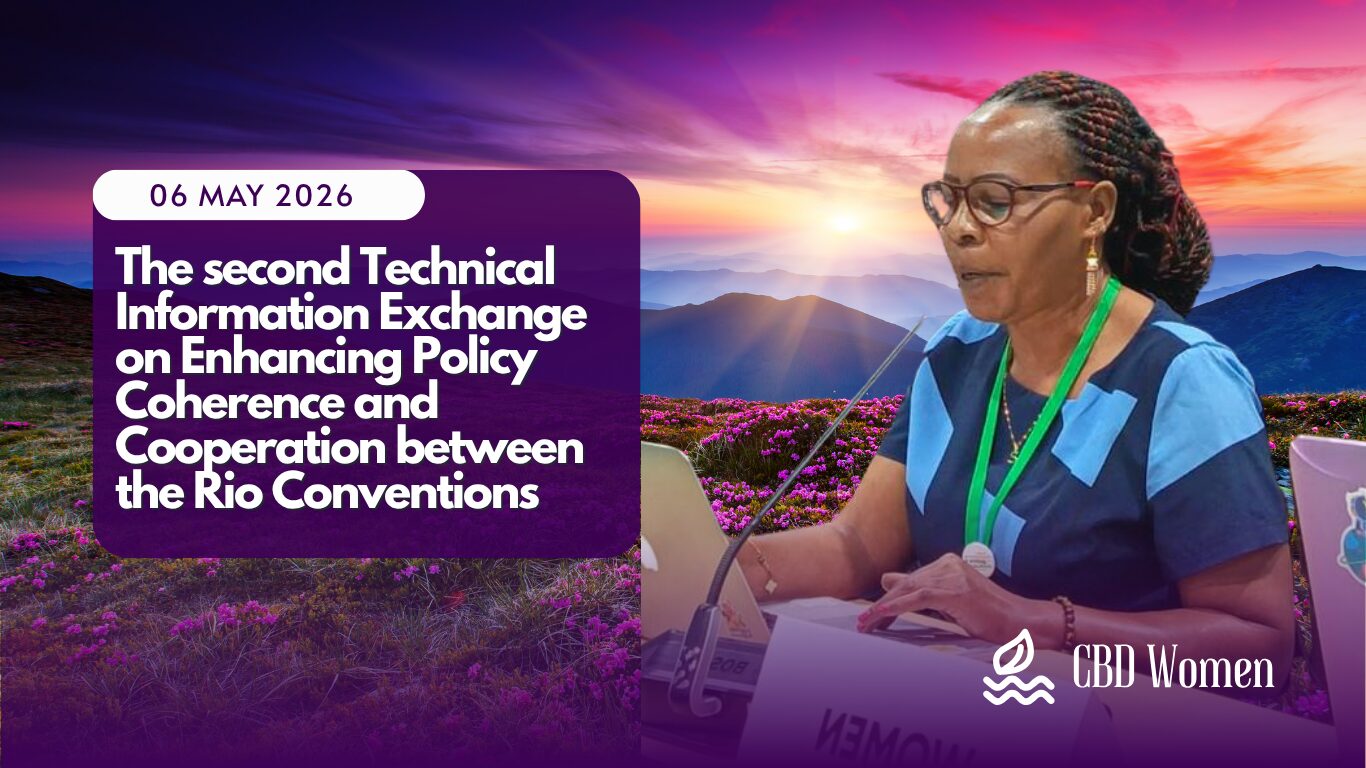
By Ms.Marie Salvatrice Musabyeyezu, Managing Director/ Go Green&Rstore Africa Action (GGRAA)
Disclaimer: The views expressed in this blog are those of the author and do not necessarily reflect the official position or opinions of the CBD Women’s Caucus
The interconnected crises of climate change, biodiversity loss, and land degradation continue to challenge governments and communities worldwide. For the CBD Women’s Caucus, these crises also highlight a deeper governance imperative: policy coherence across the Rio Conventions must be grounded in gender justice, the full implementation and alignment of Gender Action Plans, and the meaningful participation of women in all scientific, technical, and policy processes.
Within this context, stakeholders convened on 6 May 2026 for the second Technical Information Exchange on Enhancing Policy Coherence and Cooperation between the Rio Conventions. The exchange forms part of an ongoing process under the Convention on Biological Diversity (CBD), the United Nations Framework Convention on Climate Change (UNFCCC), and the United Nations Convention to Combat Desertification (UNCCD) to strengthen collaboration, align knowledge systems, and prepare inputs for the upcoming June technical meeting.
Building on discussions held on 22 April 2026, the May exchange focused on two key areas: the role of scientific assessments and evidence-based policy, and knowledge management and capacity-building for integrated implementation across the Rio Conventions.
From a gender justice perspective, a central message emerged: alignment of Gender Action Plans across the Rio Conventions must be integrated into scientific assessments, data systems, and knowledge governance frameworks, not treated as a parallel or optional consideration. Without this alignment, gender justice and women’s participation risks remaining disconnected from the evidence base that shapes environmental decision-making.
The discussions reinforced that policy coherence is not only about institutional coordination among the three conventions, but also about ensuring that knowledge systems, participation structures, and capacity-building processes are inclusive, equitable, and transformative.
Scientific Assessments, Evidence-Based Policy, and Gender-Responsive Knowledge
Participants emphasized the essential role of scientific assessments in informing environmental decision-making across biodiversity, climate change, and land degradation agendas. Scientific evidence supports governments in understanding complex ecological trends, identifying solutions, and tracking progress toward global environmental goals.
However, participants strongly noted that evidence-based policy must go beyond conventional scientific systems. A key concern raised was the insufficient integration of Indigenous Peoples’ and Local Communities’ (IPLCs) knowledge systems into scientific assessments and policy frameworks.
From a gender justice standpoint, participants stressed that women’s knowledge, experiences, and leadership must also be systematically integrated into environmental data and scientific processes. Gender-responsive science requires more than sex-disaggregated data; it requires women’s meaningful participation in defining research priorities, indicators, methodologies, interpretation of findings, and policy application of evidence.
A critical issue identified was that those designing and collecting data often shape assumptions about what “gender justice” means, without sufficient participation of women themselves. This creates gaps where lived realities,, especially for women from the grassroots, remain invisible in environmental assessments.
Women participants highlighted that their direct engagement is essential to identifying these gaps, particularly in relation to capacity needs, access to resources, and structural barriers. They emphasized that when women participate meaningfully in knowledge generation, they help ensure that scientific systems reflect real-world inequalities rather than assumptions.
Representation Gaps, Civic Space, and Structural Barriers
A recurring concern throughout the exchange was the persistent challenge of representation and meaningful participation in Rio Convention processes.
Participants highlighted several interconnected barriers:
- Limited representation of Indigenous Peoples, Local Communities, and women in scientific and policy spaces
- Shrinking civic space for civil society organizations in environmental governance
- Language barriers that restrict access to technical discussions and documentation
- Digital divides are limiting participation in virtual and hybrid processes
- Cultural and gender norms that continue to restrict women’s leadership and engagement
- Limited integration of traditional knowledge into formal scientific systems
- Financial and logistical constraints that limit sustained participation
The discussions emphasized that participation must go beyond presence in meetings. Meaningful participation means influence over agenda-setting, decision-making, knowledge production, and implementation processes.
From a gender justice perspective, this also requires ensuring that women are not only represented but are able to shape outcomes and contribute to all stages of scientific and policy development.
Capacity-Building as a Foundation for Gender Justice and Inclusion
A preliminary report was presented on the contributions submitted by Parties and other non-governmental actors, including those of the CBD Women’s Caucus. In this context, emphasis was placed on the importance of disaggregating results by region, rights-holders, and Parties, in order to better understand the different ways in which the Long-Term Strategic Framework has been used and applied across diverse contexts.
Overall, these findings show that the framework is primarily being used as a planning tool to support capacity‑building at the systemic and institutional levels, consistent with the framework’s intended purpose and objectives
The 62% of survey respondents, reported not having used the guidance provided in the strategic framework cited a lack of practical guidance on how to apply the framework.
During the online forum discussions, comments were submitted directly on the document emphasizing the importance of reporting the findings of non-government actors — either in a dedicated section or consistently throughout each point of the analysis. It was also highlighted that future discussions should focus on translating findings into concrete next steps, ensuring that the results of the survey lead to actionable recommendations rather than remaining as descriptive observations.
Aligning Gender Action Plans, Data Systems, and the Rio Conventions
A key outcome of the discussions was the need to strengthen alignment between Gender Action Plans and scientific data systems across the Rio Conventions.
Participants noted that while biodiversity, climate change, and land degradation are deeply interconnected, data systems and reporting frameworks often remain fragmented. This fragmentation limits the ability to understand differentiated impacts and responses, particularly from a gender perspective.
Strengthening alignment requires:
- Mainstreaming Gender Action Plans into scientific assessments and monitoring systems
- Ensuring systematic collection and use of gender-responsive and sex-disaggregated data
- Harmonizing indicators and reporting frameworks across the three conventions
- Integrating women’s knowledge and experiences into official environmental data systems
- Strengthening accountability for gender equality commitments within scientific processes
Participants emphasized that no single convention should dominate the others, and that climate change must not overshadow biodiversity conservation and land degradation neutrality. Instead, all three Rio Conventions must be treated as equally important, interdependent pillars of sustainable development.
From a gender justice lens, this also means ensuring that women’s contributions, leadership, and knowledge systems are visible and valued across all three conventions equally.
Toward a Gender-Just and Inclusive Rio Conventions Framework
The 6 May Technical Information Exchange, building on the 22 April discussions and informing the upcoming June meeting, reinforced a clear and consistent message: policy coherence across the Rio Conventions cannot be achieved without gender justice, and gender justice cannot be achieved without transforming how knowledge, participation, and capacity-building systems function.
For the CBD Women’s Caucus, the pathway forward requires a shift from consultation to co-production of knowledge, data, and policy.
A truly coherent and just Rio Conventions framework must:
- Fully integrate Gender Action Plans into scientific and policy systems
- Ensure meaningful participation and leadership of women, IPLCs, and civil society
- Recognize and elevate Indigenous and traditional knowledge systems alongside science
- Address structural barriers, including language, digital access, and financial constraints
- Strengthen capacity-building as a long-term foundation for equity and inclusion
- Treat biodiversity, climate, and land degradation as equally important and interconnected