
Disclaimer: The views expressed in this blog are those of the author and do not necessarily reflect the official position or opinions of the CBD Women’s Caucus
On 4 August, the CBD Women’s Caucus — in collaboration with RCMRD, CARICOM, SPREP, UNEP-WCMC and IUCN CEESP — hosted a side event at SBI-7 in Nairobi on one of the most underexplored questions in biodiversity governance: how can regional and subregional support centres within the Technical and Scientific Cooperation (TSC) Mechanism become genuine partners for gender-responsive KM-GBF implementation? The session was livestreamed on the CBD Women’s Caucus YouTube channel, reaching participants both in Room CR-11 and online. Throughout the evening, a live Mentimeter ran in parallel — giving everyone in the room and joining remotely a direct channel to contribute their perspectives on the challenges, opportunities and practical measures needed to strengthen gender-responsive TSC implementation.
The event brought together representatives from regional support centres, women’s organisations, Parties and technical partners to exchange regional experiences, identify gaps and generate practical recommendations ahead of COP17 in Yerevan, Armenia. Speakers underscored a shared message: the question is not whether gender should be integrated into technical and scientific cooperation — it is how to make the cooperation itself inclusive, from knowledge generation to access to technology, to decision-making and policy implementation.
Opening: Why This Conversation Matters
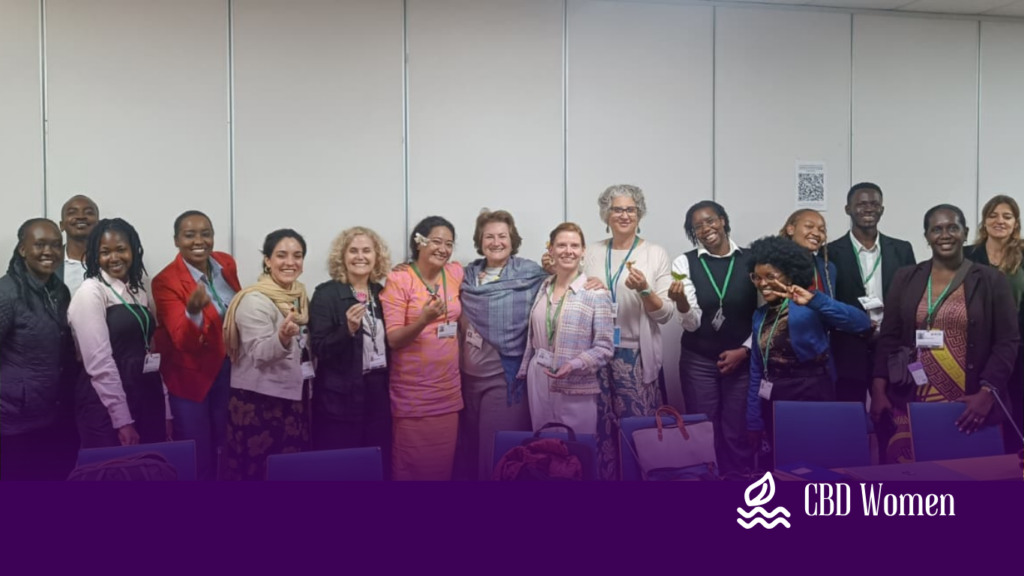
Ms. Edda Fernández Luiselli, Chair of the CBD Women’s Caucus Board of Directors, opened the session by setting the scene — and the urgency. She noted that despite the clear relevance of women’s roles and rights to biodiversity implementation, there had been limited discussion on how the TSC Mechanism could integrate gender-responsive approaches into its mandates, programming, technical assistance, partnerships and implementation support. Grounded in the principle that global goals mean little if they do not foster national implementation, she outlined two key messages from the Caucus: first, that TSCs can play an important role by facilitating capacity-building, peer-learning and cooperation on gender-responsive implementation at the regional level; and second, by mobilising and engaging a regional network of women’s organisations to support implementation through a whole-of-society approach. This conversation, she stressed, was a starting point — not a conclusion.
The TSC Mechanism: Where Are We Now?
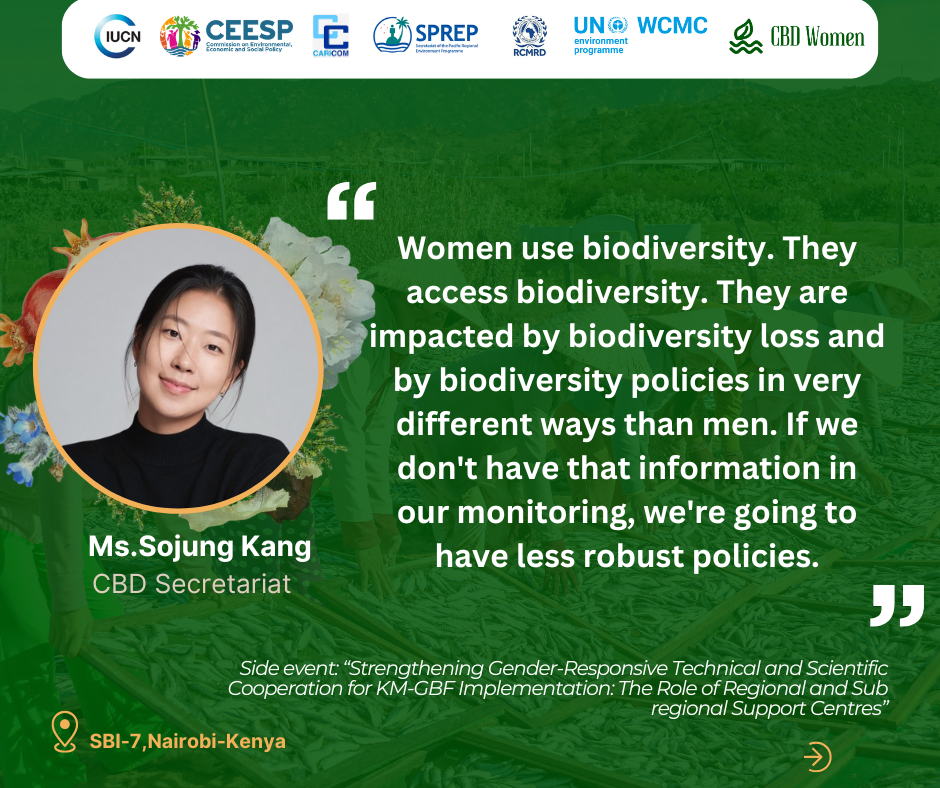
Ms. Sojung Kang, Associate Expert at the CBD Secretariat, presented an overview of the TSC Mechanism via video — where it stands, what it does, and how gender considerations are being addressed. She explained that the mechanism, established at COP15 and operationalised at COP16 with 18 regional and subregional support centres, operates as a network of networks — connecting countries with the knowledge, expertise, technologies and partners they need across Africa, Americas, Asia and the Pacific, and Europe and Central Asia. The centres act as connectors and facilitators: promoting demand-driven cooperation, serving as one-stop service centres, mobilising resources and facilitating matchmaking, sharing knowledge and lessons learned, and maximising synergies with existing mechanisms.
On gender, Ms. Kang was candid: the Global Coordination Entity is mandated under COP Decision 16-3 to develop guidelines to ensure gender-responsive approaches and the active engagement of women, youth and Indigenous Peoples and local communities — but this work had not yet been taken forward due to resource constraints, and the gender position at the Secretariat had been vacant for some time. She nonetheless announced a clear commitment for the next biennium: the development of gender guidelines will be included among the Secretariat’s priorities, as a gender specialist is expected to join the team. She called on Parties and organisations to review TSC work plans, identify opportunities to integrate gender-responsive approaches, partner with TSC centres on capacity development, and work with the Global Coordination Entity to develop the gender guidelines collectively.
Setting the Scene for the Panel
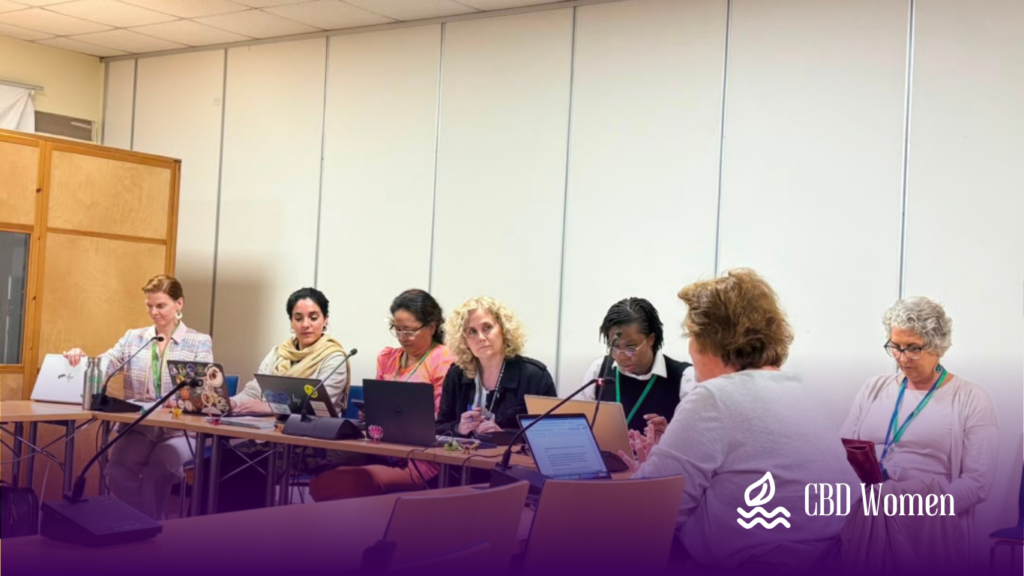
Ms. Tiffany Straza, International Policy and Conventions Lead at UNEP-WCMC, introduced the panel and framed the moment. She highlighted the strong political mandate for gender-responsive KM-GBF implementation and the particular relevance of the TSC Mechanism as a vehicle for cooperation — not just with countries, but between TSC centres themselves and with the Global Coordination Entity. She acknowledged the difficult context in which the work is taking place — where organisations are being asked to do more with less — and noted that a whole-of-society approach and genuine cooperation are among the most effective responses. She reminded participants that the Mentimeter was available for those in the room and online to share their perspectives throughout the session.
CARICOM: Technical Cooperation as a Necessity, Not a Luxury
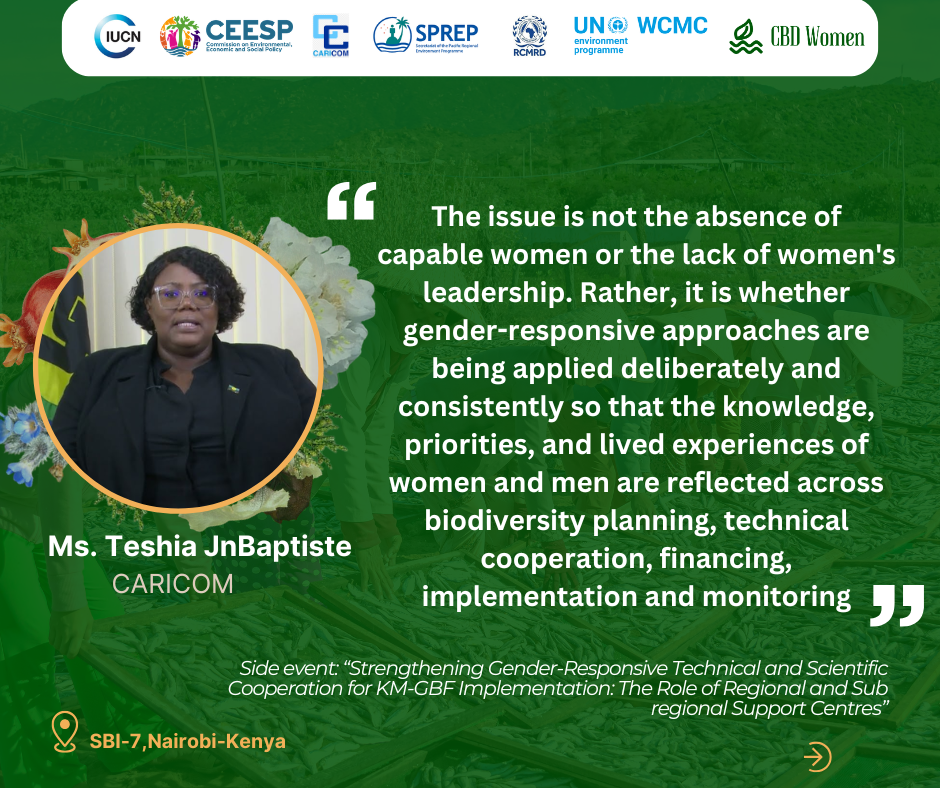
Ms. Teshia Jn Baptiste, Senior Project Officer at CARICOM, offered a Caribbean small island developing states perspective via video. She highlighted that women across the Caribbean are scientists, researchers, farmers, natural resource managers, entrepreneurs, indigenous knowledge holders, community leaders and environmental advocates — highly visible in tertiary education, public sector leadership and international environmental negotiations including BBNJ and the CBD. The challenge is not the absence of capable women or of women’s leadership, but whether gender-responsive approaches are being applied deliberately and consistently across biodiversity planning, technical cooperation, financing, implementation and monitoring.
Ms. Jn Baptiste highlighted the CARICOM TSC Five-Year Work Plan as a concrete example of what is possible — with provisions for a regional roster of experts that could systematically include women scientists and indigenous women knowledge holders, a Caribbean-wide biodiversity data hub, regional biodiversity monitoring frameworks, and regional guidelines for gender-disaggregated data production. She also noted the CARICOM TSC Action Plan’s recognition of traditional knowledge, free, prior and informed consent, and engagement with Indigenous Peoples and local communities — creating opportunities to recognise indigenous women as partners in biodiversity governance. She was direct about what is still missing: dedicated gender expertise, weak monitoring frameworks, insufficient resources for gender analysis, and engagement with women’s organisations that is frequently ad hoc rather than systematic. Better data, she stressed, will lead to better policies and more effective interventions.
RCMRD: Gender-Blind Data and the Limits of Event-Driven Partnerships
Ms. Abigael Sum, Communications Specialist at RCMRD, delivered one of the most candid and resonant interventions of the evening — bringing an African regional perspective that captured both what is working and what is not. She reframed the central question: the issue is not whether gender should be integrated into technical and scientific cooperation, but how to make the cooperation itself inclusive — from knowledge generation to access to technology, to decision-making and policy implementation.
She was honest about RCMRD’s gaps. Capacity needs assessments across the countries the centre serves show that support is needed not just in technical areas — GIS, earth observation, biodiversity monitoring, spatial planning, biodiversity reporting and data management — but also in inclusive planning approaches and stronger integration of women, youth and IPLCs. The data pipeline is not systematically disaggregated. Partnerships with women’s organisations tend to be event-driven, built around specific activities rather than sustained over time — meaning there is no long-term relationship with these organisations, and this remains a significant challenge.
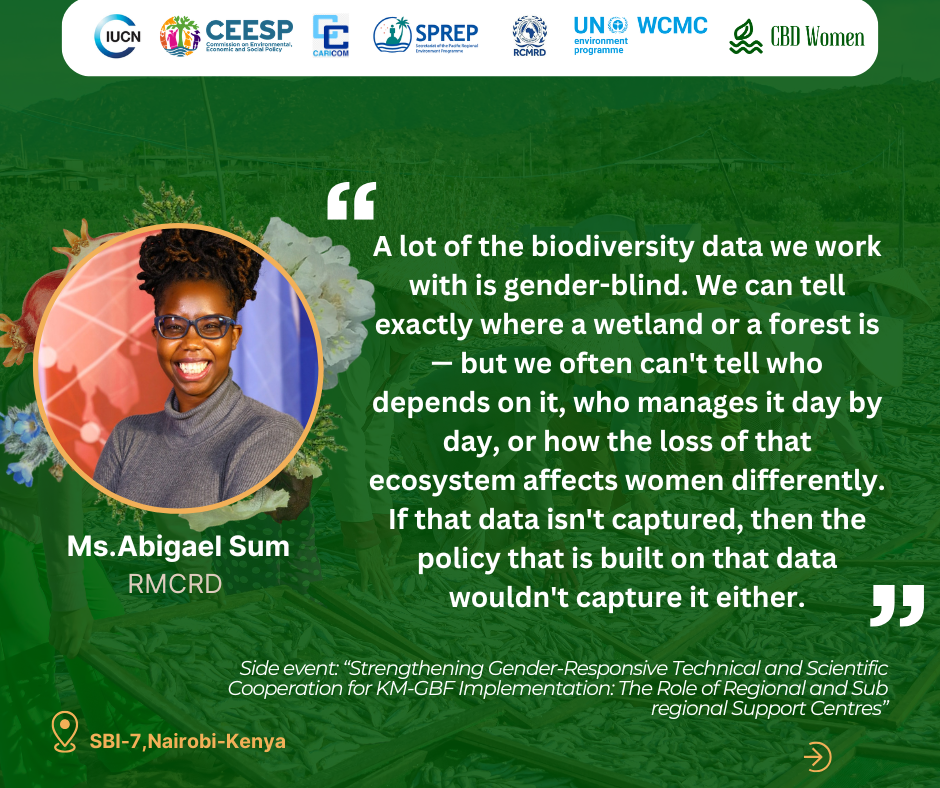
She also named the fundamental data problem: a lot of the biodiversity data RCMRD works with is gender-blind. The centre can map exactly where a wetland or a forest is, or where restoration is happening — but it often cannot tell who depends on it, who manages it day by day, or how the loss of that ecosystem affects women differently. If that data is not captured, the policy built on it will not capture it either. And underlying all of this: the demand for gender-responsive technical support already outstrips what is being delivered.
SPREP: Staying Real to the Ground
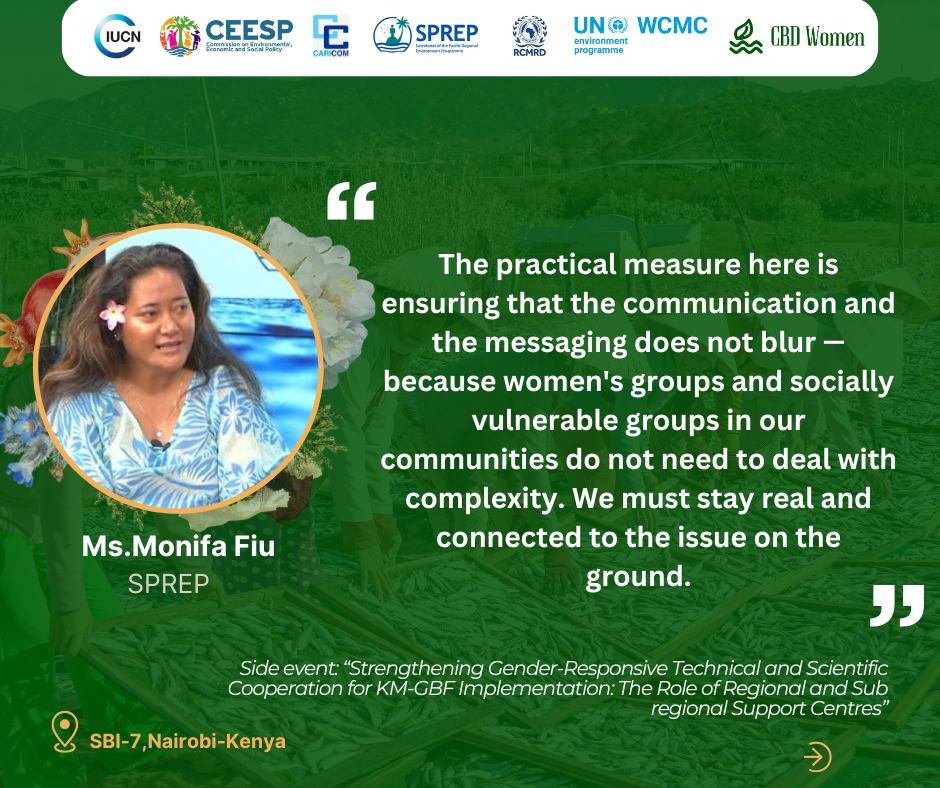
Ms. Monifa Fiu, Biodiversity and Ecosystems Adviser at SPREP, spoke on behalf of the Pacific Small Island Developing States — a region where SPREP hosts the TSC but is operating with no dedicated resources. Despite this constraint, SPREP is leveraging existing projects, bilateral partnerships and the Pacific Islands Roundtable for Nature Conservation to advance inclusive biodiversity action. She highlighted the Pacific Islands Conference for Nature Conservation — now in its 11th edition, to be held with the Government of New Caledonia — as a key space for amplifying voices from the ground up, including through a Global Youth Biodiversity Network chapter and a Pacific Nature First Indigenous Voices Dialogue. Her practical message for the TSC network: ensuring that communication and messaging does not blur is essential — because women’s groups and socially vulnerable groups in Pacific communities do not need to deal with complexity. The work must stay real and connected to the issues on the ground.
IUCN : Embedding Gender from the Start
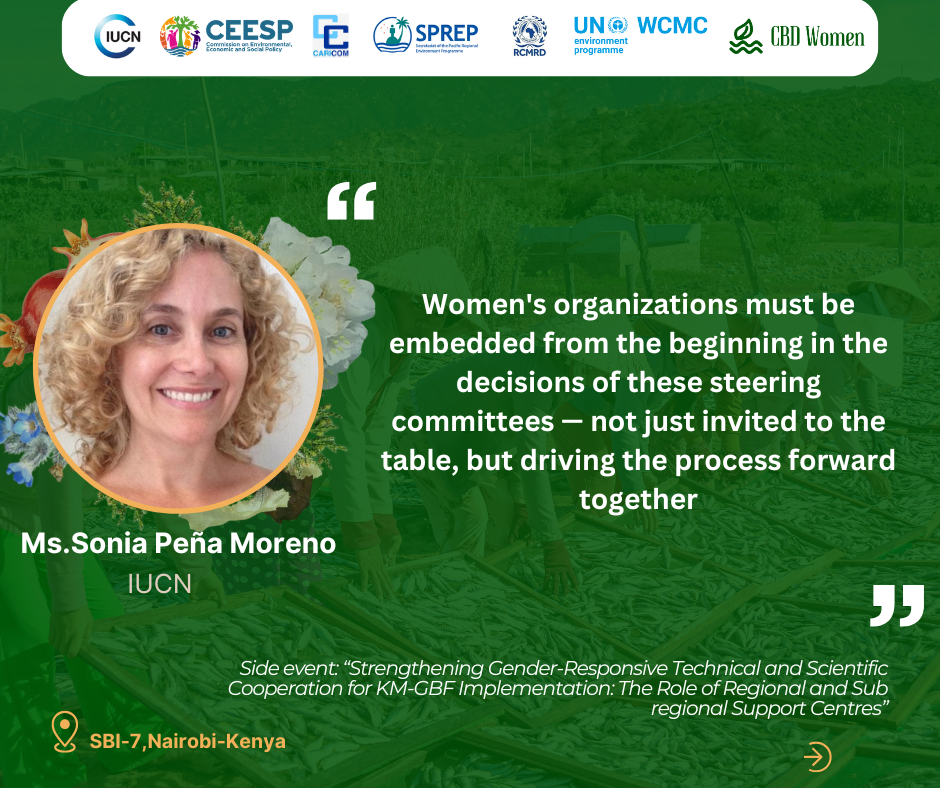
Ms. Sonia Peña Moreno, Director of the IUCN Centre for Policy and Law, spoke on behalf of IUCN, which hosts four regional TSC centres across Eastern Europe and Central Asia, the Mediterranean, Asia and West Asia. She shared concrete examples of gender-responsive action already underway. The IUCN Asia Regional Office held its first two steering committee meetings in April and June 2025 — and for both, invited Indigenous Peoples’ Rights International and Women for Biodiversity to the table, ensuring women’s organisations were embedded in decision-making from the very beginning, not just consulted. The same approach will be followed for the first in-person steering committee meeting, planned for Bangkok in December.
The Asia Regional Office is also working jointly with the Asia Protected Areas Partnership, the International Ranger Federation, the Asia Ranger Federation and Women for Biodiversity to produce the first-ever publication on Asia’s Women Rangers: Voices from the Frontlines of Conservation — compiling stories from Nepal’s anti-poaching units, Bhutan’s high-altitude patrols and Sri Lanka’s elephant conflict officers. This publication will be launched at next year’s World Protected and Conserved Areas Congress in Panama. Meanwhile, the IUCN West Asia Regional Office has published the first-ever gender-sensitive protected area management effectiveness tool for Jordan, and in Egypt and Saudi Arabia is aligning national protected area management plans with gender criteria through the IUCN Green List Standard
The Secretariat's Role: Coordination as a Vehicle for Gender Integration
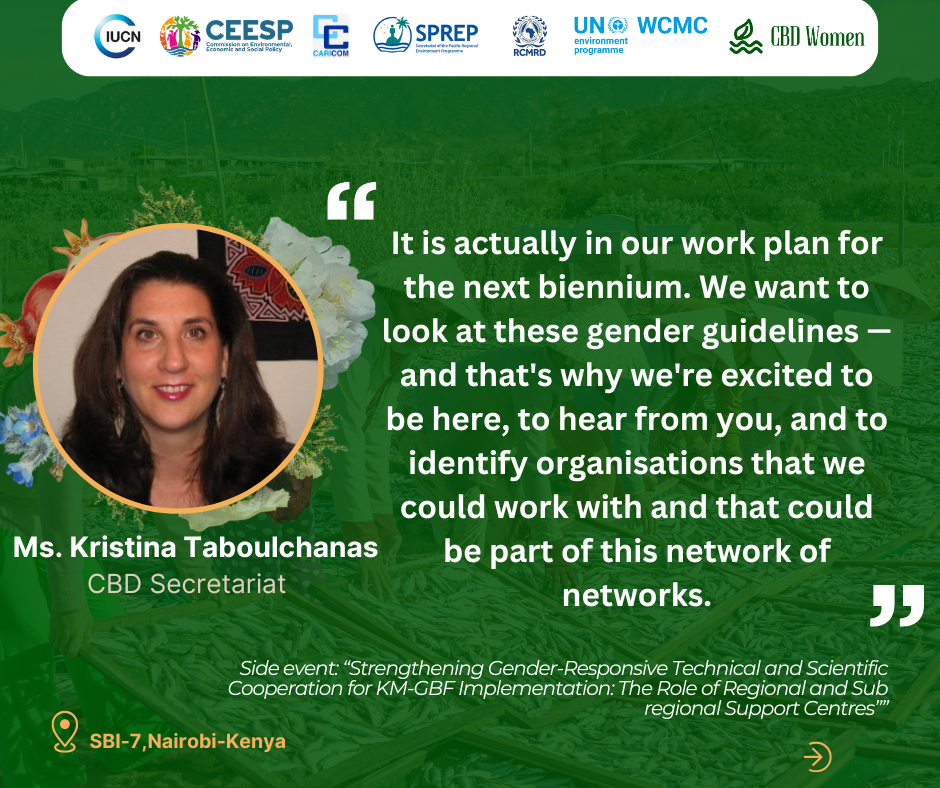
Ms. Kristina Taboulchanas, Programme Manager at the CBD Secretariat, brought the perspective of the Global Coordination Entity — the body responsible for facilitating coordination, communication and collaboration across the TSC network. She welcomed the conversation and expressed genuine excitement at hearing what the different centres are already doing on gender — noting that many centres have not yet been reached out to, and that this remains an area to work on. She confirmed that the development of gender guidelines is included in the Secretariat’s work plan for the next biennium, and that the Secretariat is actively looking to identify organisations that could contribute to and become part of the network of networks. She highlighted the monthly and annual coordination meetings as concrete vehicles for mainstreaming gender integration across centres — spaces where centres already learn from each other, share good practices and tools. This, she stressed, is the Secretariat’s core role: bringing everyone together to share.
CBD Women's Caucus: Intentionality, Guidelines and the Network of Networks
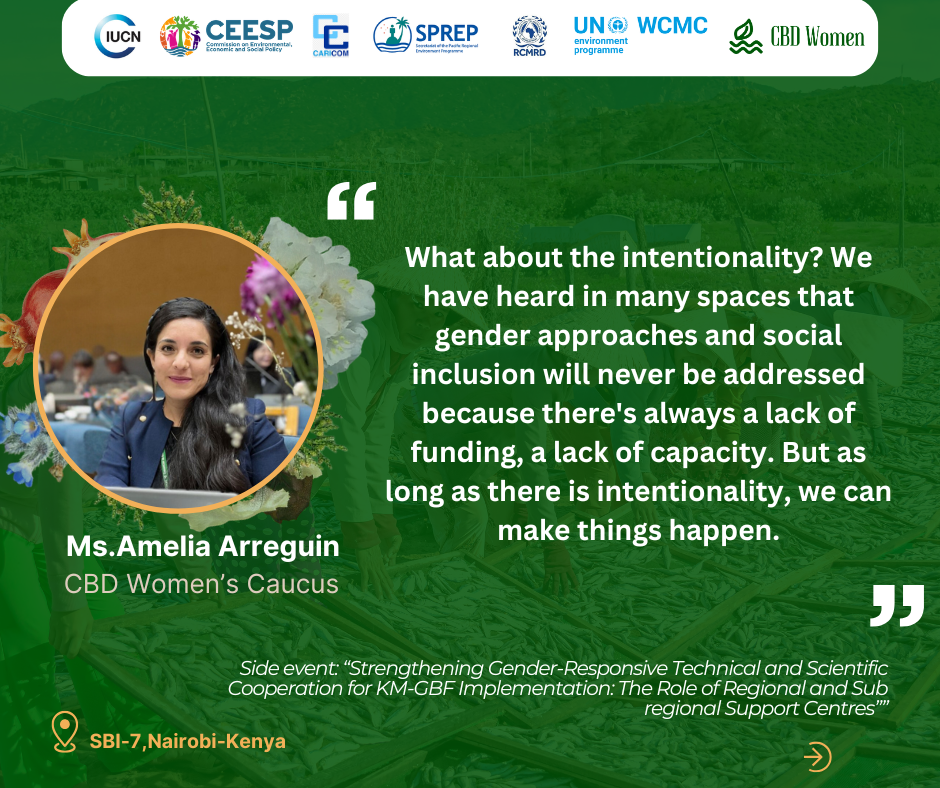
Ms. Amelia Arreguín Prado, Coordinator of the CBD Women’s Caucus, closed the panel with three key messages. First, she welcomed the conversation itself — noting that from the Caucus’s perspective, bringing together the TSC centres to discuss what the gender mandate actually means in practice was something that had been missing. She called on all participants to learn from each other and to build on what is already working.
Second, she addressed the recurring claim that gender approaches cannot be implemented due to lack of funding or capacity — arguing that what matters above all is intentionality. Even small actions, when deliberate, can shift practice. She pointed to the decisions being taken at SBI-7 and heading into COP17 as the moment to embed that intentionality into concrete commitments. Third, she issued a direct call to Parties: request the gender guidelines from the Secretariat and TSC centres, because if they are not requested, they will not be developed.
She closed with a vision of collective action — naming gender focal points as superpowered allies, eager to support and to be supported — and calling on everyone to see what they can contribute. The CBD Women’s Caucus, with its 900+ members and the Gender and Biodiversity Focal Points Network, stands ready to partner.
Closing: Three Key Messages
Ms. Edda Fernández Luiselli closed the session by distilling the evening’s discussion into three core messages: the strong political mandate for gender-responsive implementation must be grounded in regional cooperation; the TSC Mechanism is a necessity — not a luxury — for gender justice, environmental justice and the exchange of diverse knowledge systems; and intentionality is the common strength that will carry the work forward. The CBD Women’s Caucus, she reaffirmed, is open and ready to engage with all centres — on the ground and throughout the negotiations leading to COP17.
Key Messages
The side event generated the following key messages:
- The TSC Mechanism has a clear political mandate for gender-responsive implementation — but work on gender guidelines has not yet been taken forward due to resource constraints. This must change in the next biennium.
- The question is not whether gender should be integrated — it is how to make the cooperation itself inclusive, from knowledge generation to decision-making.
- Biodiversity data remains largely gender-blind — we can map ecosystems but cannot tell who depends on them, who manages them, or how their loss affects women differently.
- Partnerships with women’s organisations must be long-term, sustained and institutionalised — not event-driven.
- Good practices are already underway across regions and must be systematically shared across the network of networks.
- Parties must actively request gender-responsive guidelines from the CBD Secretariat and TSC centres — because if they are not requested, they will not be developed.
- The Gender and Biodiversity Focal Points Network and the CBD Women’s Caucus — with its 900+ members — stand ready to partner with TSC centres.