

Advancing gender justice in biodiversity data and policy
Women and girls, including those from Indigenous, Afro-descendant, and local communities, play critical roles in biodiversity conservation. However, much of the existing data is gender-blind, leading to policies that fail to recognize their contributions, address their needs, or respect their rights.
Against this backdrop, the CBD Women’s Caucus established a collaboration with the International Institute for Environment and Development (IIED), and embarked on a journey to support women’s organisations to generate and use gender-responsive data to influence biodiversity policy and action.
Our objectives are
- Strengthen the capacities of women’s organisations to generate and use gender-responsive data in biodiversity conservation.
- Facilitate the co-creation of evidence to influence global and national biodiversity policy.
- Share project progress and results in key global policy platforms
and we will deliver by
1. Needs & Capacities Inventory
The first phase of this process was to build a baseline understanding of the capacity needs and opportunities within women's organisations who are generating data that accounts for gender and social inclusion. This was carried out through an assessment, finding of which, can be used by various stakeholders to inform their process around gender and biodiversity data.
2. Peer-to-peer
Learning process
This process aims to bring women-led and community-based organisations together to strengthen gender-responsive biodiversity data. It will facilitate shared learning, dialogue, and collective evidence-building grounded in lived experience and community knowledge.
3. Gender & Biodiversity Data Handbook
Find examples of women's organisations and collectives who are pioneering the integration of gender justice within biodiversity data and policy at grassroot level and a Global Report synthesizing the common threads that emerges from them all.
1. Needs & Capacities Inventory
SURVEY: Advancing Gender Justice in Biodiversity Data and Policy
The survey aimed to understand the extent and nature of women organisation’s engagement with data, particularly data that are gender-responsive and/or women-led. It seeks to explore how such data are collected, managed, and used, the barriers encountered at each stage, and the types of support and capacity-building that may be required. It was launched during SBSTTA27/SB8J01 in Panama in October 2025 and was open for a month for participants to contribute in three languages(ENG/FR/ESP).

FINDINGS REPORT : Advancing Gender Justice in Biodiversity Data and Policy
The assessment explores how women-led and community-based organisations working on biodiversity generate and use gender-responsive data, and the barriers they face in doing so. Based on responses from 70 organisations, it highlights strong community-rooted data practices alongside critical gaps in resources, systems, and policy access. The findings inform next steps for peer learning, capacity strengthening, and advocacy within the CBD Women’s Caucus network.
POLICY BRIEF: Advancing Gender Justice in Biodiversity Data and Policy
PRESS CONFERENCE: Advancing Gender Justice in Biodiversity Data and Policy
During the 6th meeting of the Subsidiary Body on Implementation of the UN Convention on Biodiversity, the CBD Women’s Caucus and the International Institute for Environment and Development (IIED) convened a press conference at SBI-6 in Rome to launch a new global study on women-led organisations and biodiversity data. The findings reveal persistent gender data gaps, while showing that women and girls in all their diversity are already generating critical biodiversity knowledge across 33 countries. The event called on Parties to recognise, resource, and partner with women-led organisations as essential actors for effective and accountable implementation of the KM-GBF.
2. Peer-to-Peer Learning Process
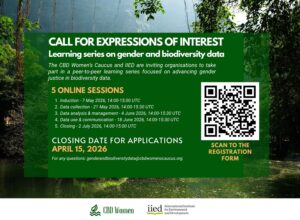
EXPRESION OF INTEREST
This peer-to-peer learning is designed to strengthen the capacities of women-led, community-based organisations, local civil society, and individual experts across the biodiversity data value chain: collection, management and analysis, and use and communication.
- Session 1: Induction – 7th May 2026, 2pm- 3pm UTC (Mandatory Attendance)
- Session 2: Data collection – 21st May 2026, 2pm-330pm UTC
- Session 3: Data analysis & management -4th June 2026, 2pm-330pm UTC
- Session 4: Data use & communication -18th June 2026 , 2pm-330pm UTC
- Session 5: Closing – 2nd July 2026, 2pm-3pm UTC (Mandatory Attendance).
About the Partners:
The CBD Women’s Caucus (CBD WC) is the women’s constituency within the Convention on Biological Diversity (CBD). It stands as a self-organised global platform, supporting women and girls worldwide to advocate for their rights within biodiversityrelated decision-making processes across all levels.
The International Institute for Environment and Development (IIED) is a global policy and research organization that works to promote sustainable development, social justice, and environmental protection. IIED collaborates with governments, communities, and civil society to generate evidence-based solutions, influence policy, and support marginalized groups, including women and Indigenous communities, in addressing environmental and development challenges.