
By Fatima El-aaraby, Project Officer at the CBD Women’s Caucus.
When we talk about education for biodiversity, we cannot do so without addressing the role of women and girls. Education, whether formal through schools and universities, non-formal through community programmes and training, or informal through cultural practices and intergenerational knowledge, shapes how societies understand and protect biodiversity. Yet access to these forms of education remains deeply unequal. Globally, around 129 million girls are out of school, driven by gender inequality, poverty, and early marriage. Furthermore, according to UNESCO data.
These inequalities extend into environmental sectors despite women being key holders of traditional knowledge, face disproportionate barriers to education, and are significantly more likely to be excluded from formal schooling systems. This persistent gap between the lived realities of women and girls and the policies shaping biodiversity governance highlights the urgent need for frameworks such as the Global Plan of Action for Education on Biodiversity (GPA-EB) to adopt a genuinely gender-responsive and inclusive approach.
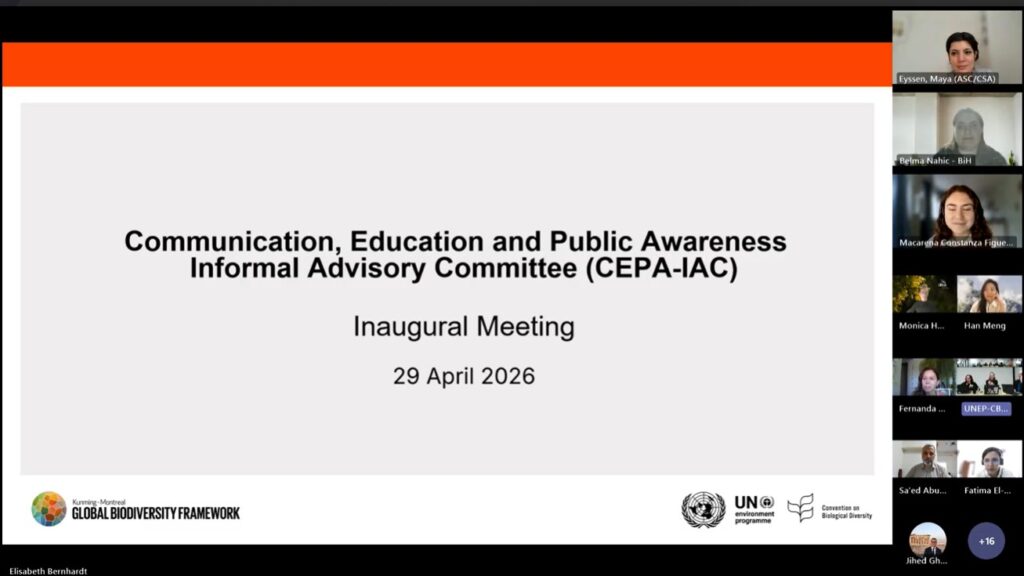
About the meeting
On 29 April 2026, I had the honour of representing the CBD Women’s Caucus at the meeting of the Informal Advisory Committee on Communication, Education and Public Awareness (CEPA-IAC), convened online by the CBD Secretariat. This first gathering marked an important milestone in the implementation of Decision 16/10 from COP16 in Cali, Colombia, which recognizes communication, education, and public awareness (CEPA) as essential tools for halting biodiversity loss and achieving the goals of the Kunming–Montreal Global Biodiversity Framework (KMGBF).
The CBD Women’s Caucus’s participation is critical to align the process with the gender plan of action, and target 23 in this meeting ensures that gender perspectives, women’s and girls’ leadership and participation at all levels, and the voices of those most closely connected to biodiversity at the community level are present from the very outset of this global process
Setting the Scene: Decision 16/10 and the Road to SBI-7
The meeting opened with an overview of Decision 16/10 and the two key deliverables it requests ahead of the Seventh Meeting of the Subsidiary Body on Implementation (SBI-7) and COP17:
- A Global Plan of Action for Education on Biodiversity (GPA-EB), to be developed through a collaborative, participatory process led by UNESCO with CBD Secretariat support.
- A Progress Report on CEPA Implementation, reflecting actions by Parties, the Secretariat, and stakeholders in line with Section K of the KMGBF.
- The timeline is ambitious. The GPA-EB must be ready for SBI-7 in August 2026, and it must fit along with the progress report, which is a constraint; we quickly learned that shapes every choice about what goes in and what must wait.
Introducing the Global Plan of Action: Logic, Structure, and Scope
A highlight of the meeting was the presentation and walkthrough of the draft GPA-EB by Mr. Sean Southey, the lead consultant. The document is structured around three expected outcomes:
Expected Outcome 1: Strengthening people’s understanding of and connection with biodiversity
Expected Outcome 2: Strengthening educator and system capacity
Expected Outcome 3: Strengthening enabling conditions for implementation
These outcomes are supported by five priority areas for action — spanning human–nature connectedness, pluralistic and equitable education, capacity-building for educators, platforms and coordination, and policy and curriculum integration — and by three cross-cutting enabling conditions: lifelong learning, whole-of-society engagement, and sustainable financing.
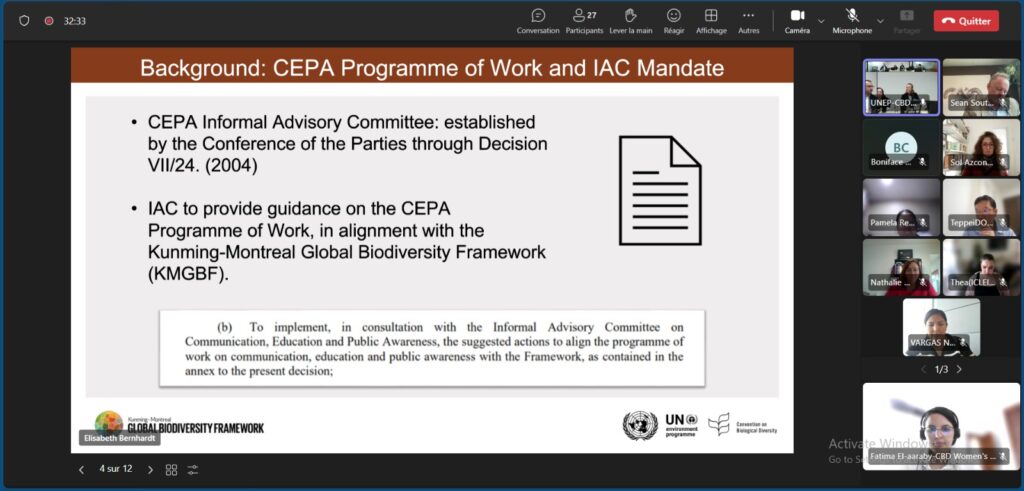
Why the GPA-EB Must Centre Women and Girls
The GPA-EB does not exist in isolation. It sits alongside a broader architecture of gender-responsive commitments under the KMGBF, most notably the CBD Gender Plan of Action (2023–2030), adopted at COP15 under Decision 15/11. This landmark framework sets out concrete actions to ensure that all women and girls have equal opportunity and capacity to contribute to the three objectives of the Convention (Expected Outcome 1 of the Gender Plan of Action), that biodiversity policy and planning address equally the perspectives, interests and human rights of all (Expected Outcome 2), and that enabling conditions are created for gender-responsive implementation of the KMGBF (Expected Outcome 3). The GPA-EB, as a key implementation tool of the KMGBF, must be fully coherent with and actively advance these commitments.
For the GPA-EB to deliver transformative change, it must recognize women and girls not as passive beneficiaries of education programmes, but as knowledge holders, community educators, and drivers of intergenerational impact. A plan that treats gender justice as an add-on rather than a foundational principle will fall short of the ambition of the KMGBF and its own Gender Plan of Action.
As I emphasized in my introduction to the committee:
«We need to move from text to action — and for that, the plan needs to be actionable and gender-responsive at all levels.»
This means embedding gender-responsive approaches across all five priority areas for action. The GPA-EB’s cross-cutting enabling conditions — lifelong learning, whole-of-society engagement, and sustainable financing — are only meaningful if they reach directly the women and girls who are too often left outside of formal proesses and funding.
Looking Ahead
The CEPA-IAC will meet quarterly, and the coming months offer a series of high-stakes moments:
- Before SBI-7 (August 2026): Review of the revised GPA-EB draft; possible working sessions in Nairobi.
- SBI-7 (August 2026, Nairobi): Formal submission and consideration of the GPA-EB.
- UNESCO Side Event on Education for Biodiversity – 5 August 2026, Nairobi.
- Education Day at COP17 – 27 October 2026, Yerevan, Armenia.
- COP17 – October 2026, Yerevan: Final adoption and next steps.
The CBD Women’s Caucus will remain actively engaged throughout. We will continue to monitor the integration of gender responsive education principles, contribute to the shaping of the GPA-EB’s structure and content, and ensure that the experiences and knowledge of women and girls across the globe are woven into the future of biodiversity communication and education.
For more information on the CBD women’s caucus contribution in the Drafting Committee for the Global Plan of Action (GPA) on Education for Biodiversity, please click here.