
Armenian Women Taking Action for Nature: Preparations for CBD COP17
The Women’s Roadmap to CBD COP17 continues…
When the CBD Women’s Caucus set out to support Armenian women’s preparations for CBD COP17, the goal was clear and ambitious: make sure that when the world’s biodiversity negotiators gather in Yerevan this October, Armenian women and gender justice advocates walk in not as observers, but as informed, connected, and organised participants ready to shape the outcome.
Over two months, that intention became the Armenian Women Taking Action for Nature: Preparations for CBD COP17, a four-part training series co-created with the COP17 Armenian Presidency, the CBD Secretariat, and the Raoul Wallenberg Institute. What unfolded was more than a training programme. It became a genuine community: 60+ participants from across Armenia, 15+ expert speakers, four partner organisations, and more than 20 presentations and resources shared and revisited through a living Miro Board all built on countless questions, discussions, and connections that outlasted every session.
This is the story of that journey, session by session, and where it leads next.
Session 1: Laying the Foundation — Understanding Biodiversity Governance
27 May 2026
Every journey needs a map, and Session 1 gave participants theirs. The launch opened with remarks from H.E. Ambassador Mher Margaryan (COP17 Armenian Presidency), Ms. Edda Fernandez (Chair of the Board, CBD Women’s Caucus), Mr. Olivier Rukundo (CBD Secretariat), and Ms. Laura Milne (Country Director, Armenia, Raoul Wallenberg Institute) — a lineup that signalled, from the very first minutes, just how many institutions stood behind this initiative.
The session then turned to substance, with Ms. Claudia Ituarte-Lima (Raoul Wallenberg Institute), Mr. Olivier Rukundo (CBD Secretariat), and Ms. Amelia Arreguín Prado (CBD Women’s Caucus) walking participants through the Convention on Biological Diversity itself — its structure, protocols, and governance processes, and, crucially, the many entry points through which women and civil society can engage with it.
For a group ranging from first-time newcomers to biodiversity policy to seasoned advocates, this session struck the right balance: demystifying a famously technical process while making clear that it is, at its core, a space open to their participation. It set the tone for everything that followed: collective learning, built together.
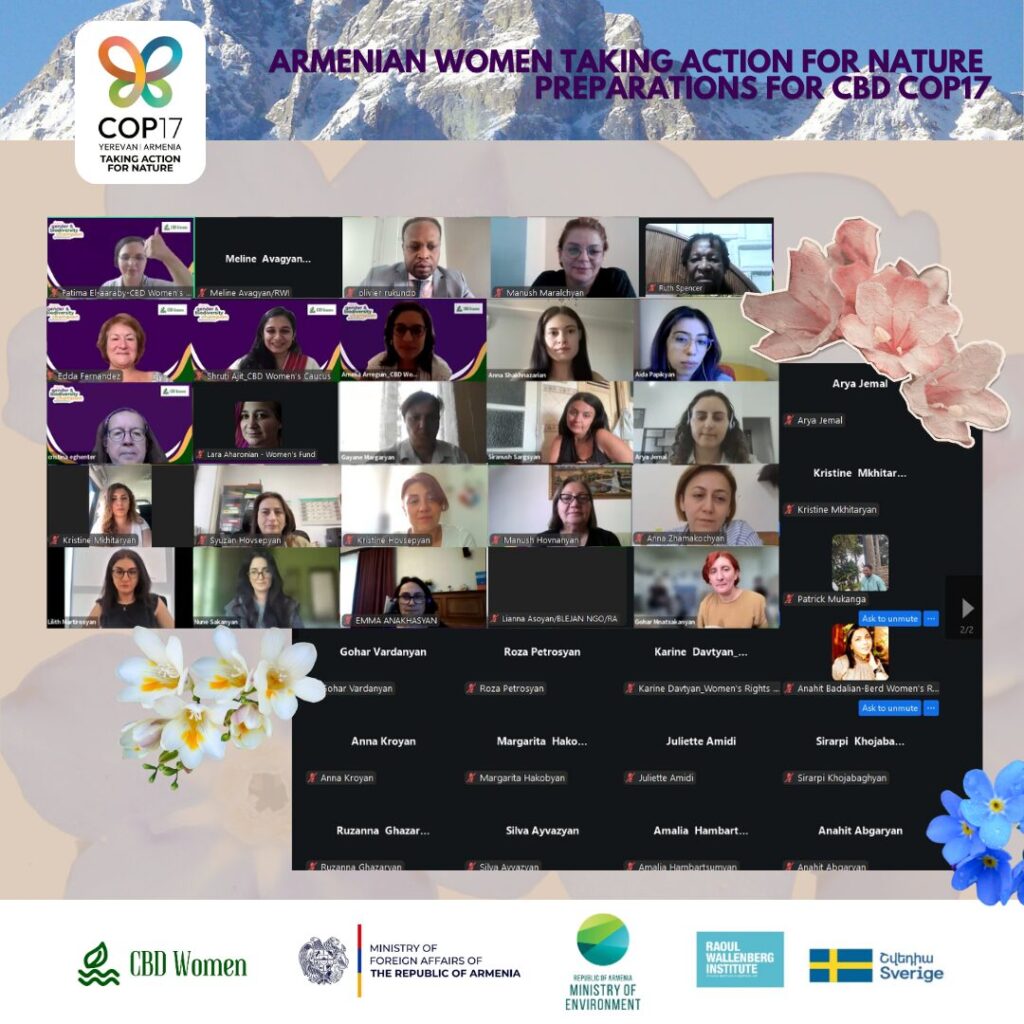
Session 2 – Implementation, Monitoring and Reporting
Ms. Cicilia Wangari Githaiga (Lawyer & Advocate, Kenya) opened with the architecture of the Kunming-Montreal Global Biodiversity Framework, Targets 22 and 23, and the Gender Plan of Action.
Ms. Ana Di Pangracio (Fundación Ambiente y Recursos Naturales, Argentina) unpacked National Biodiversity Strategies and Action Plans (NBSAPs) and the concrete ways women’s organisations can engage with them.
Ms. Tiffany Estrada (UNEP-WCMC) introduced the GBF Monitoring Framework, showing how non-state actors can feed directly into the global review of collective progress.
And Ms.Laura Bermudez (Environmental Attorney, Colombia) closed the session with a walkthrough of the 7th National Report, making the case for why women’s contributions belong in national reporting from the start.
The conversation that followed was as valuable as the presentations: participants compared notes on Armenia’s own NBSAP process, asking sharp questions about monitoring, reporting, and how to ensure diverse women’s voices are truly heard before COP17.
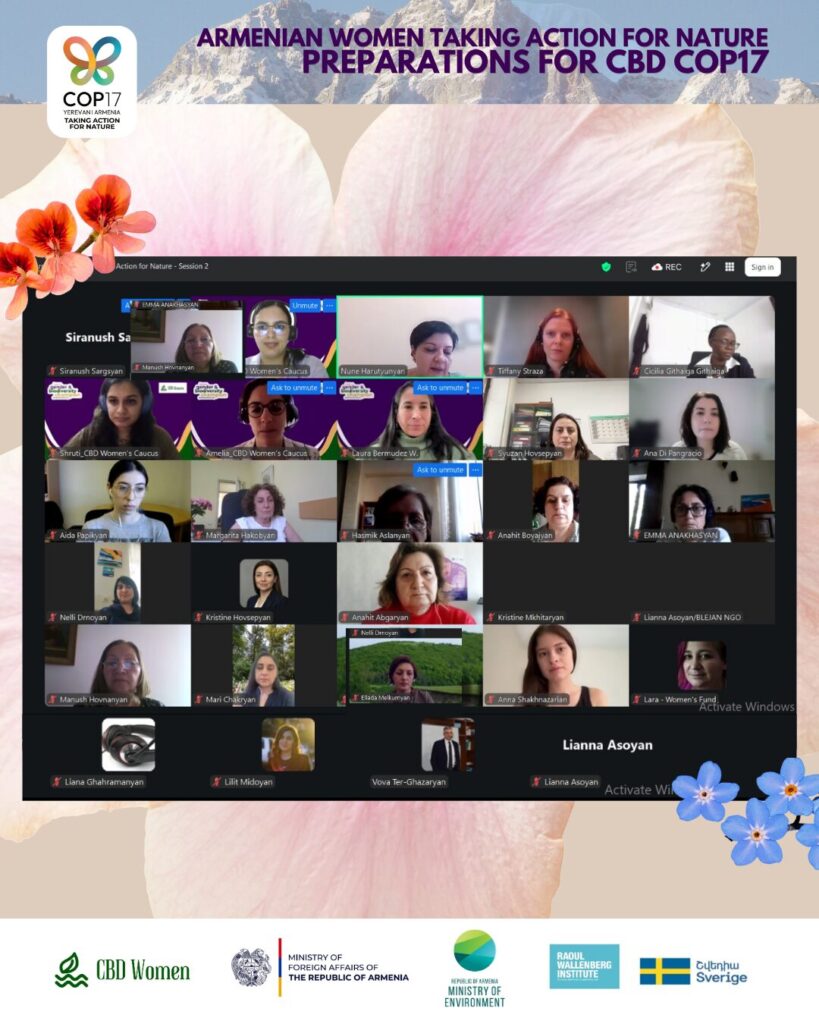
Session 3: Gender in CBD
24 June 2026
Session 3 turned inward, asking a foundational question: where does gender actually sit within the CBD?
Ms. Amelia Arreguín Prado (CBD Women’s Caucus) traced the answer back to 1992, showing how gender has evolved within the Convention and how it now shows up in the KM-GBF’s Section C and Targets 22 and 23.
Ms. Shruti Ajit (CBD Women’s Caucus) walked participants through the CBD’s Gender Plans of Action, from the first GPA in 2008 to the current 2023–2030 plan and its three outcomes for gender-responsive implementation.
Ms. Annabel Kennedy (WECF) brought the story up to the present with the GPA Mid-term Review, highlighting real progress from SBI-6 evidence alongside the gaps, particularly on funding commitments and focal point mechanisms that still need strengthening before Yerevan.
Closing the session, Mr. Karen Khachatryan (Ministry of Environment, Republic of Armenia) offered a national lens on gender justice within NBSAPs, speaking directly from Armenia’s experience preparing to host COP17.
Participants left this session with more than facts: they left with a shared vocabulary for talking about gender in biodiversity policy, and no shortage of questions about participation indicators and women-led conservation successes worldwide.
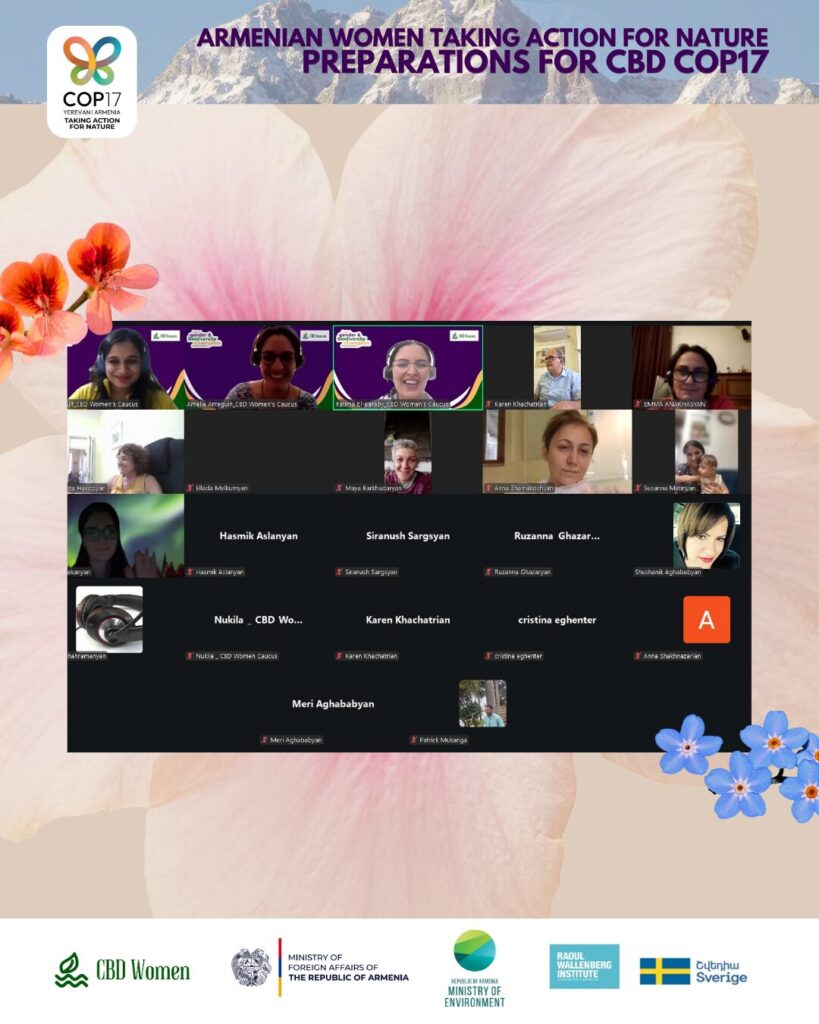
Session 4 – Understanding the COP17 Agenda & Key Technical Topics
8 July 2026
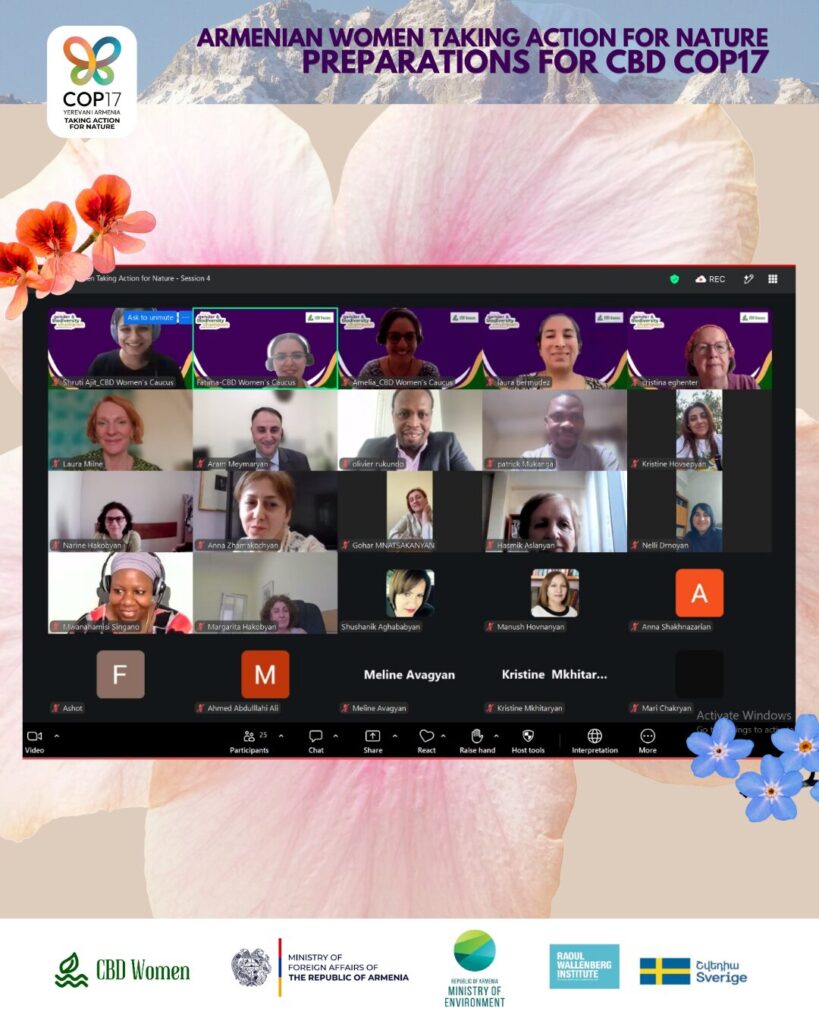
The final session was where everything came together. Understanding a CBD COP means understanding how it actually works — so Mr. Olivier Rukundo (CBD Secretariat) opened by explaining how negotiations are organised, and how an agenda item travels from plenary to contact group and back. Mr. Karen Khachatryan then introduced the COP17 agenda itself: 31 substantive items, including the Global Review of Collective Progress, Resource Mobilisation, and the implementation of Article 8(j).
Ms. Cristina Eghenter (WWF International & CBD Women’s Caucus Board) unpacked what may be the meeting’s defining moment, the first-ever Global Review of collective progress, and what the draft global report reveals. Ms. Laura Bermudez turned to Article 8(j) and the SB8J agenda items, covering traditional knowledge, Indigenous Peoples’ rights, and resource mobilisation strategies for Indigenous Peoples and local communities. And Ms. Amelia Arreguín Prado closed with Resource Mobilisation and the Financial Mechanism, making a clear case: direct access to funds for women, Indigenous Peoples, and local communities must be non-negotiable at COP17.
The session and the series closed with words that will stay with participants long after Yerevan. Mr. Aram Manoukyan (Republic of Armenia) called inclusive participation essential to the Convention’s goals, reaffirming Armenia’s commitment to a COP17 legacy built on inclusion. Mr. Olivier Rukundo (CBD Secretariat) commended the initiative for levelling the playing field ahead of the negotiations, pledging the Secretariat’s continued partnership with the CBD Women’s Caucus. Ms. Laura Milne (Raoul Wallenberg Institute) spoke to civil society’s role in keeping biodiversity policy inclusive, rights-based, and gender-responsive. And Ms. Mwanahamisi Singano (CBD Women’s Caucus Board) left participants with a challenge: to treat this training not as an ending, but as proof of what meaningful participation looks like — and to carry that knowledge, those connections, and that network into national and global advocacy.
What This Journey Built
Strip away the agendas and the acronyms, and what this series really built was a community. Sixty-plus women, four partner organisations, fifteen-plus speakers, and a shared conviction that biodiversity governance is stronger when women help write it. What made the programme genuinely special were not only the thematic presentations but the questions asked after them, the experiences exchanged in between, and the connections formed that will long outlast the four sessions themselves.
The learning doesn’t stop here. As CBD COP17 draws closer, the real work of engaging, advocating, and shaping outcomes is just getting started.
To every Armenian woman and organisation who joined this journey: thank you for your energy, your questions, and your commitment to gender justice.
This is not the end. It is just the beginning.
See you in Yerevan!