
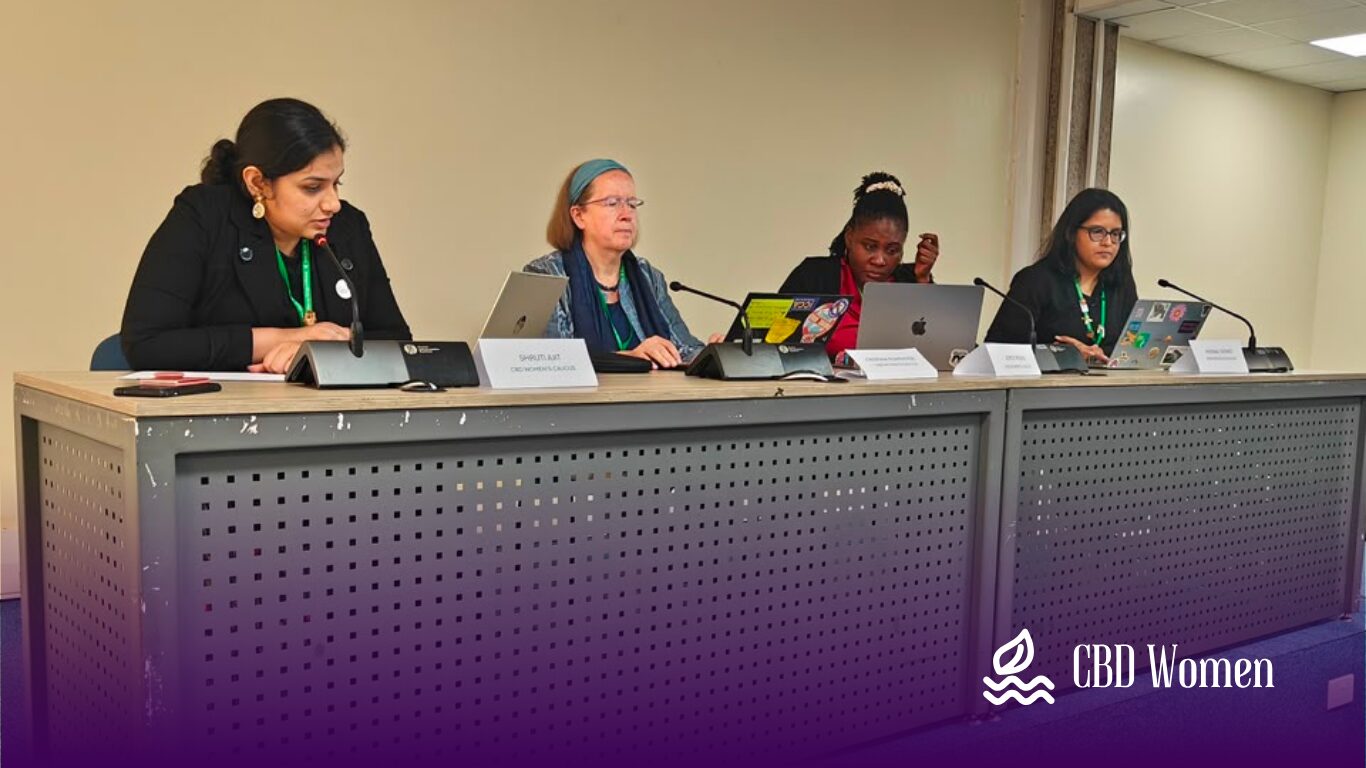
Nairobi, 27 July 2026 — As the 28th meeting of the Subsidiary Body on Scientific, Technical and Technological Advice of the Convention on Biological Diversity continues, the CBD Women’s Caucus held a press conference to present its key recommendations on the items under discussion, reaffirming the central role of women, girls, Indigenous Peoples, and local communities in the implementation and review of the Kunming-Montreal Global Biodiversity Framework.
Moderated by Ms. Shruti Ajit, Project Officer at the CBD Women’s Caucus, the press conference brought together women experts and advocates who provided insights on key agenda items on behalf of the Caucus, from monitoring and review to sustainable wildlife management and protected areas. The Caucus, a self-organized global platform of more than 900 members across 110 countries, used the session to stress the need for gender-disaggregated data, equitable benefit-sharing, and direct, accessible financing that reaches women-led and grassroots organizations, ahead of the seventeenth Conference of the Parties to the Convention on Biological Diversity in Yerevan, Armenia.
Closing the Gaps in Monitoring, Reporting and Review
Addressing Agenda Item 3 on planning, monitoring, reporting and review, Ms. Cristina Egenther, speaking on behalf of the CBD Women’s Caucus, identified three fundamental gaps echoed in the Global Report on Collective Progress: the need for a stronger whole-of-society approach, a significant scale-up in the means of implementation, and improved monitoring, data analysis, and disaggregation.
Ms. Egenther noted that rights holders — including Indigenous Peoples, local communities, women, and youth — are already contributing substantially to biodiversity outcomes, but that these contributions remain undervalued and poorly resourced. «It’s not a matter of commitments, it’s a matter of longstanding contributions,» she said, adding that data disaggregation is essential to reveal both the scale of women’s contributions and the gender-differentiated impacts of biodiversity loss.
She called for well-resourced technical and research support centers to help translate whole-of-society engagement from principle into institutionalized practice at national and regional levels.
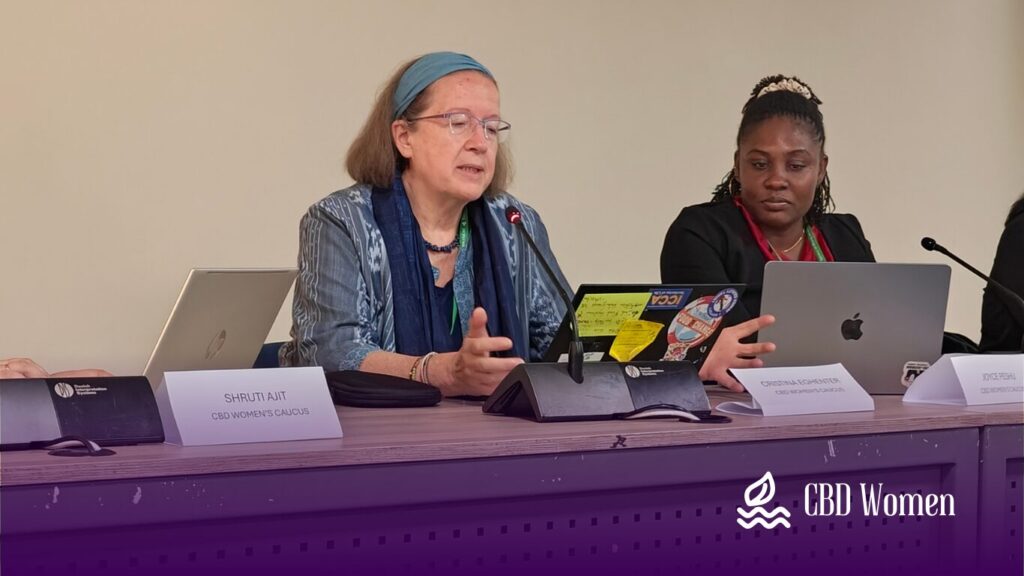
Closing the Gaps in Monitoring, Reporting and Review
Addressing Agenda Item 3 on planning, monitoring, reporting and review, Ms. Cristina Egenther, speaking on behalf of the CBD Women’s Caucus, identified three fundamental gaps echoed in the Global Report on Collective Progress: the need for a stronger whole-of-society approach, a significant scale-up in the means of implementation, and improved monitoring, data analysis, and disaggregation.
Ms. Egenther noted that rights holders — including Indigenous Peoples, local communities, women, and youth — are already contributing substantially to biodiversity outcomes, but that these contributions remain undervalued and poorly resourced. «It’s not a matter of commitments, it’s a matter of longstanding contributions,» she said, adding that data disaggregation is essential to reveal both the scale of women’s contributions and the gender-differentiated impacts of biodiversity loss. She called for well-resourced technical and research support centers to help translate whole-of-society engagement from principle into institutionalized practice at national and regional levels.
Making Sustainable Wildlife Management Guidelines Gender-Responsive
Turning to Agenda Item 6, Ms. Joyce Peshu, leading the Caucus’s work on sustainable wildlife management, stated that such management cannot be truly sustainable if it overlooks gender justice and equitable governance. She stressed that the guidance being developed by the Convention must be firmly grounded in Targets 22 and 23 of the Kunming-Montreal Global Biodiversity Framework, Section C, and the Gender Plan of Action to be genuinely gender-responsive.
Ms. Peshu outlined three priorities: ensuring women’s meaningful, rather than tokenistic, participation in conservation decision-making; recognizing gender-differentiated knowledge and experience of wildlife; and securing equitable distribution of the benefits and costs of conservation, noting that women who coexist with wildlife often bear disproportionate costs without receiving commensurate benefits. «Gender-responsive wildlife management is not about giving women special treatment,» she said, adding that it is instead about removing the barriers that prevent everyone from contributing their knowledge and sharing in the benefits of conservation.
Discussions also laid the groundwork for stronger collaboration among civil society organisations ahead of COP17, including joint messaging on key policy issues, movement-building beyond CBD spaces, and continued engagement around an emerging ecological justice agenda.
For the CBD Women’s Caucus, participation in the meeting reinforced the importance of ensuring that feminist perspectives remain embedded within broader biodiversity debates. As preparations continue towards COP17, the Caucus remains committed to working alongside allies to advance biodiversity governance that is equitable, rights-based and centred on the knowledge, leadership and lived experiences of Indigenous Peoples and local communities, Women and youth
Ms. Marina was clear that this is not a peripheral initiative for Guatemala, but a strategic and foundational commitment one meant to ensure that decision-making no longer leaves behind the very people most engaged in biodiversity management. She closed with a call for stronger inter-institutional articulation, so that national systems genuinely reflect the collective vision the KM-GBF sets out.
Discussions also laid the groundwork for stronger collaboration among civil society organisations ahead of COP17, including joint messaging on key policy issues, movement-building beyond CBD spaces, and continued engagement around an emerging ecological justice agenda.
For the CBD Women’s Caucus, participation in the meeting reinforced the importance of ensuring that feminist perspectives remain embedded within broader biodiversity debates. As preparations continue towards COP17, the Caucus remains committed to working alongside allies to advance biodiversity governance that is equitable, rights-based and centred on the knowledge, leadership and lived experiences of Indigenous Peoples and local communities, Women and youth
Ms. Marina was clear that this is not a peripheral initiative for Guatemala, but a strategic and foundational commitment one meant to ensure that decision-making no longer leaves behind the very people most engaged in biodiversity management. She closed with a call for stronger inter-institutional articulation, so that national systems genuinely reflect the collective vision the KM-GBF sets out.
Embedding Human Rights and Gender Equity in Protected Areas Governance
On Agenda Item 7, concerning the review of the Programme of Work on Protected Areas, Ms. Meenal Tatpati addressed one of the most contentious issues before the Convention: human rights in protected and conserved areas. She called for the renewed Programme of Work to reflect the human rights-based elements of the Kunming-Montreal Global Biodiversity Framework, particularly Target 22 and Target 3’s requirement of free, prior and informed consent in the creation or expansion of protected areas. Ms. Tatpati emphasized the need to recognize diverse governance systems, ensure the full and equal participation of women, youth, and other rights holders including Indigenous Peoples and local communities, and eliminate gender-based violence linked to protected area governance. She further urged Parties to direct dedicated finance to women, Indigenous Peoples, and local communities, and to build accountability mechanisms into the monitoring of protected area governance. «Women are key stakeholders in the way protected areas are governed across the world,» she said.
Engaging with Journalists and Civil Society
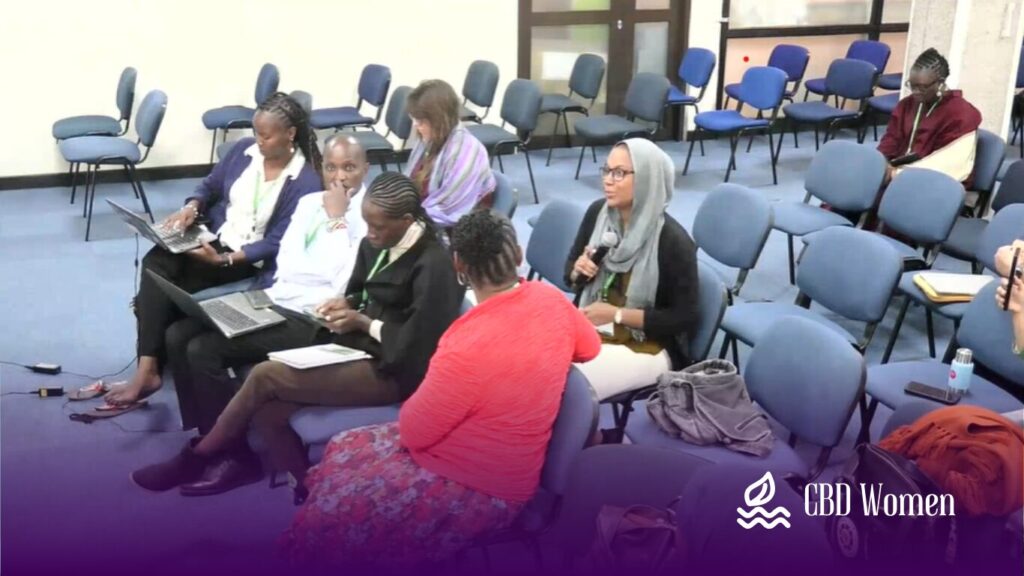
The question-and-answer session surfaced additional priorities from the floor. A representative from the disability rights community reminded panelists that categories such as «women» and «youth» are not homogeneous, calling for disability inclusion — currently referenced but largely invisible in implementation of the Kunming-Montreal Global Biodiversity Framework — to become the standard rather than an afterthought.
A journalist from Abos African News Agency asked the panel to identify the Caucus’s single most important priority; speakers pointed to accelerating the means of implementation alongside implementation itself, so that finance, capacity, and technical support keep pace with commitments. Representatives of grassroots and community-based organizations, including from Mombasa, Kenya, described a persistent gap between gender commitments on paper and enforcement at the national and local level. In response, speakers pointed to the value of collective advocacy — including connecting national women’s networks, such as women in conservation in Kenya, to the global Caucus — and to the two-way flow of knowledge between local realities and global policy processes as central to closing that gap.
A founder of a freshwater-focused non-governmental organization asked what mechanisms exist to track the benefits women bring to conservation work. Speakers pointed to ongoing Caucus initiatives to build a stronger evidence base, including the forthcoming Women Biodiversity Outlook and work tracking the gender-responsiveness of national biodiversity policies, alongside the Gender Plan of Action as a guiding framework for Parties and stakeholders.
Key Messages
Across the three interventions and the exchange with journalists and civil society, the recommendations of the CBD Women’s Caucus were distilled into several consistent messages to Parties and stakeholders:
- Stronger governance and accountability are needed across every item under discussion at this meeting, from monitoring and reporting to sustainable wildlife management and protected areas.
- The knowledge, leadership, and contributions of women, Indigenous Peoples, local communities, people of African descent, and youth must be formally recognized, not merely acknowledged.
- Increased investment in enabling conditions — finance, capacity, monitoring, data, and technical cooperation — is essential to equitable and transformative implementation of the Kunming-Montreal Global Biodiversity Framework.
- Gender-disaggregated data must go beyond biodiversity indicators to capture social, economic, and political dimensions of participation and benefit-sharing.
- Free, prior and informed consent must be upheld as a non-negotiable requirement in the governance of protected and conserved areas.
- Direct, accessible financing must reach women-led and grassroots organizations, rather than being routed solely through intermediaries.
📢Check out our full recommendations in English, French, Spanish, Arabic, and Portuguese: [LINK]