
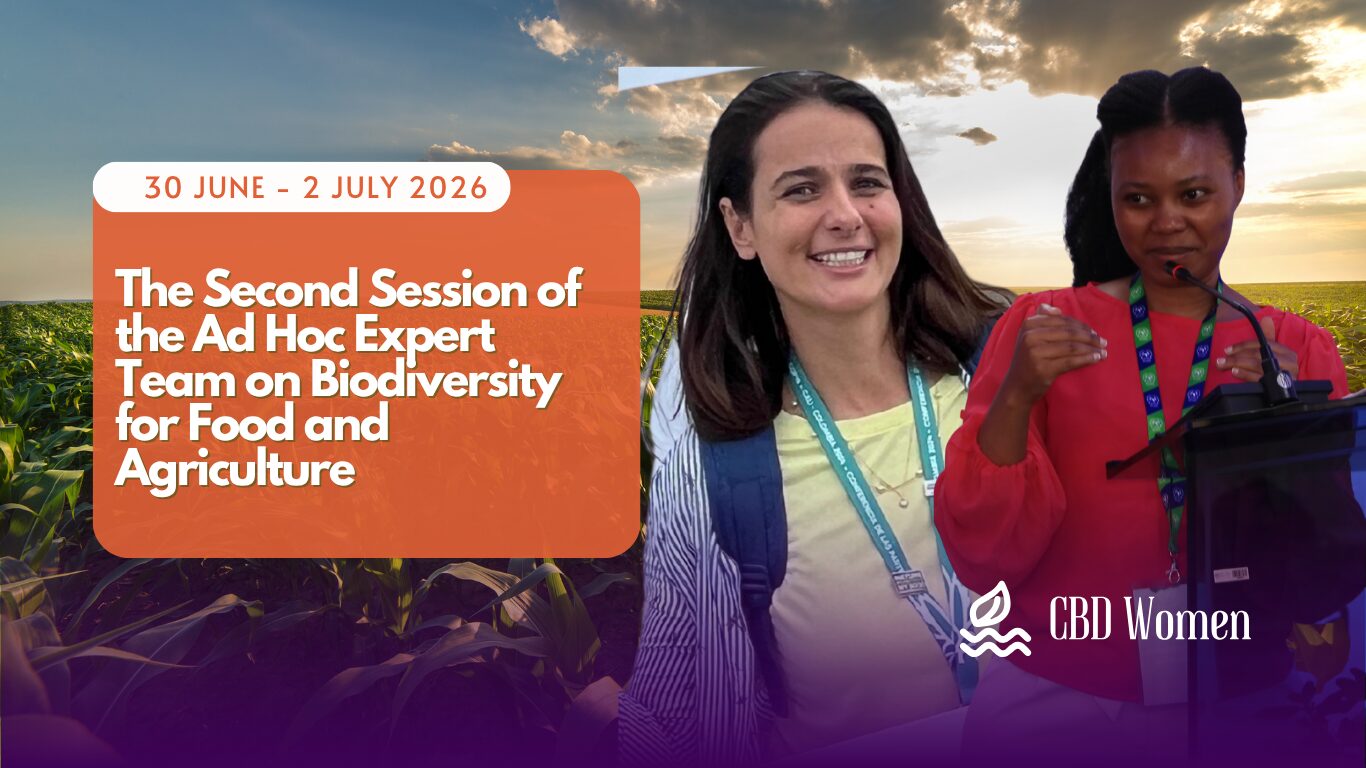
By Ms.Nondumiso Londeka Dumakude and Ms. Larissa Silvestri , CBD Women’s Caucus members
Disclaimer: The views expressed in this blog are those of the author and do not necessarily reflect the official position or opinions of the CBD Women’s Caucus
When Women's Voices Enter the Room, Biodiversity Policy Changes
The CBD Women’s Caucus took part in the Second Session of the Ad Hoc Expert Team on Biodiversity for Food and Agriculture, held from 30 June to 2 July 2026 in Rome, Italy, with both in-person and virtual participation. The meeting created an important space to engage in global conversations on biodiversity for food and agriculture, especially as work continues on the Second Report on The State of the World’s Biodiversity for Food and Agriculture.
For the CBD Women’s Caucus, being present in these discussions matters. Biodiversity policies and reporting processes need to reflect the lived realities, knowledge, leadership of women including women from Indigenous Peoples and local communities. The Caucus’s participation helped keep attention on the people who are already caring for, restoring and sustaining biodiversity in their daily lives.
It is precisely to address this gap that the Women’s Land Rights Initiative (WLRI) was established, a dynamic community dedicated to the systematic integration of women’s land rights across the three Rio Conventions: the Convention on Biological Diversity (CBD), the United Nations Framework Convention on Climate Change (UNFCCC), and the United Nations Convention to Combat Desertification (UNCCD).
About the Event
Rome, July 2026: Where Food, Nature and Policy Converge
The Second Session of the Ad Hoc Expert Team on Biodiversity for Food and Agriculture was convened under the Commission on Genetic Resources for Food and Agriculture. It took place from 30 June to 2 July 2026 in Rome, Italy, and allowed for hybrid participation so that people could join both in person and online.
The meeting covered a number of important agenda items. These included the implementation of the Framework for Action on Biodiversity for Food and Agriculture, preparations for the Second Report on The State of the World’s Biodiversity for Food and Agriculture, the links between climate change and biodiversity for food and agriculture, and the review of the Commission’s Strategic Plan and Multi-Year Programme of Work.
Participants included government representatives, experts, national focal points and stakeholders working across biodiversity, agriculture, genetic resources, food systems, climate change and related policy areas. For the CBD Women’s Caucus, the discussions were especially relevant because they touched on issues that directly shape whether women’s contributions are seen and valued — including reporting, indicators, policy coherence, gender justice, Indigenous and local knowledge, implementation, resource mobilisation, climate adaptation and community-based stewardship.
CBD Women's Caucus Representation and Key Interventions Two Women. Two Countries. One Clear Message.
The CBD Women’s Caucus was represented by Ms. Larissa Silvestri from Brazil and Ms. Nondumiso Dumakude from South Africa.
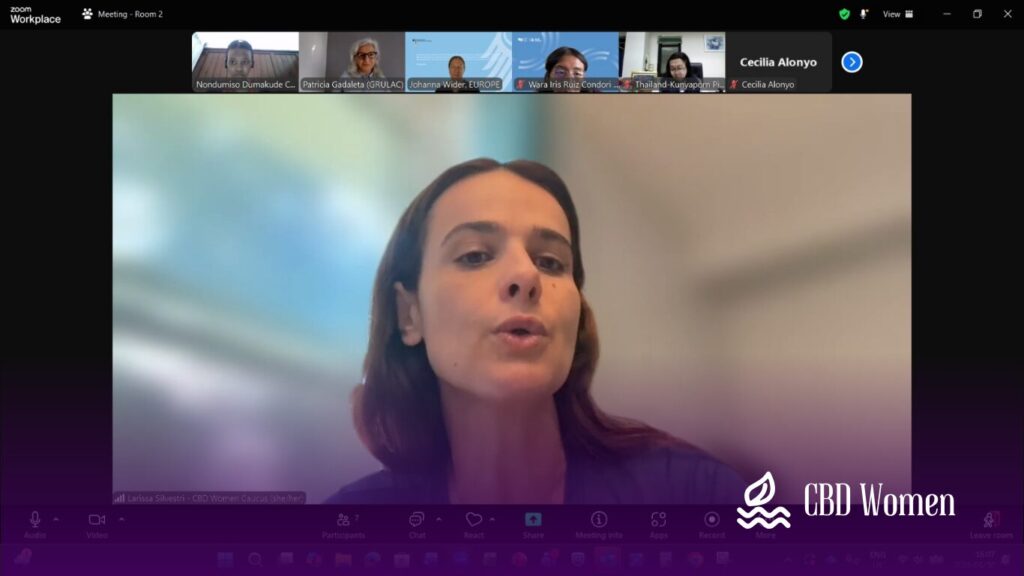
Ms. Larissa Silvestri represented the CBD Women’s Caucus and joined a panel discussion on the first day of the meeting. In her contribution, she helped bring women and girls into focus as knowledge holders, leaders and stewards of biodiversity for food and agriculture. She reminded participants that biodiversity reporting should not only describe what is happening to biodiversity, but also ask who is conserving, managing, restoring and sustaining it.
Ms. Nondumiso Dumakude contributed to discussions on the preparation of the Second Report. Her intervention focused on the importance of ensuring that the country reporting questionnaire clearly asks for sex-disaggregated and gender-responsive information. She emphasised that when gender is not asked about directly, women’s contributions to biodiversity for food and agriculture can easily remain invisible.
A key message from the Caucus engagement was:«If gender is not clearly reflected in the questionnaire, countries may not report on it. What is not asked may remain invisible in the final report.»
Key Area of Engagement
What You Don’t Ask, You Won’t Know — And What You Don’t Know, You Can’t Fix
A major area of engagement was Agenda Item 4, which focused on the preparation of the Second Report on The State of the World’s Biodiversity for Food and Agriculture. The discussions looked at the draft annotated outline, existing indicators and processes, data gaps, and the draft country reporting questionnaire.
On the first day, Larissa Silvestri joined a panel discussion where she highlighted the need for biodiversity reporting to better recognise women’s roles, knowledge, agency and leadership in conserving and sustainably using biodiversity for food and agriculture.
During the discussions on the Second Report, one of the key gender messages was clear: women’s contributions may remain hidden if the reporting questionnaire does not ask the right questions. Women are central to conserving local seed varieties, managing home gardens, supporting small-scale agriculture and fisheries, sustaining food security, restoring ecosystems and contributing to climate adaptation. Yet these contributions are often missed when reporting only looks at households, communities or countries as a whole.
The discussions also showed why indicators and reporting processes need to look beyond ecological data alone. They should also capture the social and institutional conditions that make biodiversity conservation possible — including women’s leadership, access to land and natural resources, finance, extension services, technology, decision-making spaces, Indigenous and local knowledge, and community-based stewardship.
Outcomes and Next Steps
The Questionnaire is Just the Beginning
A major area of engagement was Agenda Item 4, which focused on the preparation of the Second Report on the State of the World’s Biodiversity for Food and Agriculture. The discussions looked at the draft annotated outline, existing indicators and processes, data gaps, and the draft country reporting questionnaire.
On the first day, Larissa Silvestri joined a panel discussion where she highlighted the need for biodiversity reporting to better recognise women’s roles, knowledge, agency and leadership in conserving and sustainably using biodiversity for food and agriculture.
During the discussions on the Second Report, one of the key gender messages was clear: women’s contributions may remain hidden if the reporting questionnaire does not ask the right questions. Women are central to conserving local seed varieties, managing home gardens, supporting small-scale agriculture and fisheries, sustaining food security, restoring ecosystems and contributing to climate adaptation. Yet these contributions are often missed when reporting only looks at households, communities or countries as a whole.
The discussions also showed why indicators and reporting processes need to look beyond ecological data alone. They should also capture the social and institutional conditions that make biodiversity conservation possible — including women’s leadership, access to land and natural resources, finance, extension services, technology, decision-making spaces, Indigenous and local knowledge, and community-based stewardship.