
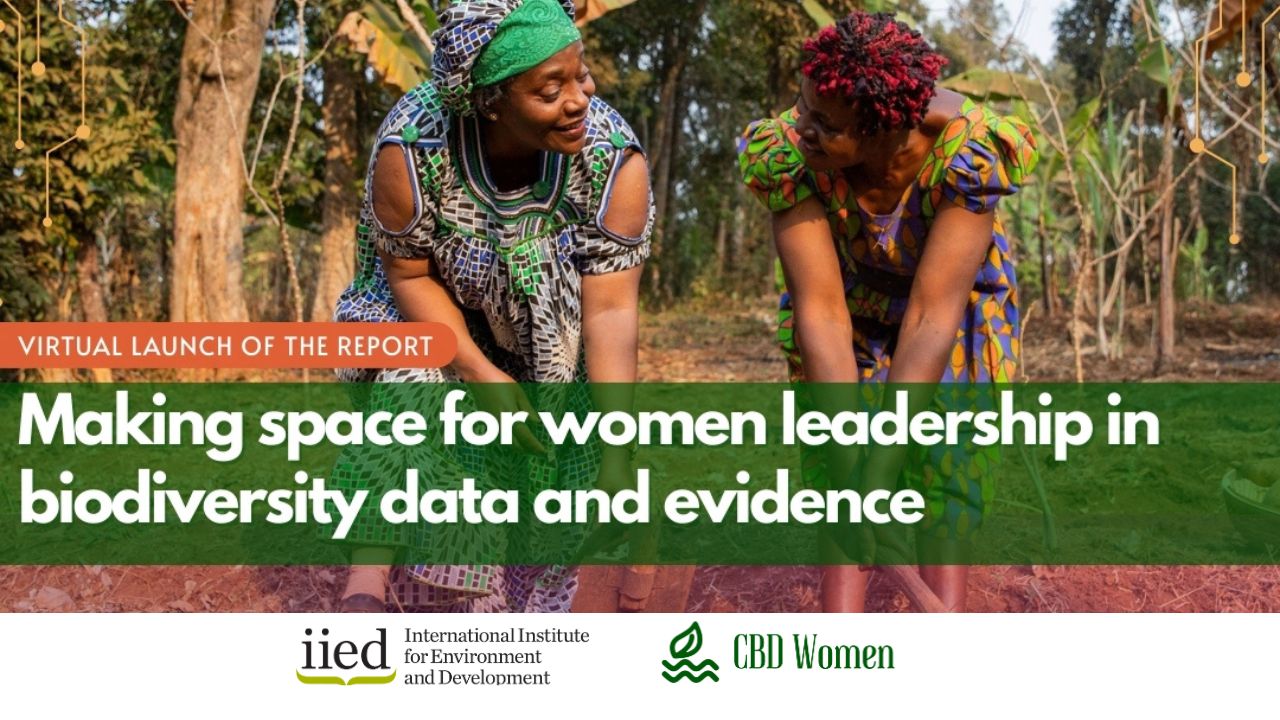
On 5 March, ahead of 70th Session of the Commission on the Status of Women (CSW70), the CBD Women’s Caucus, in collaboration with International Institute for Environment and Development (IIED), convened a virtual launch of its «Findings Report: Advancing Gender Justice in Biodiversity Data and Policy». The session brought together voices from across regions and institutions to reflect on a shared challenge: how to ensure that biodiversity monitoring is not only technically robust, but also rights-based, inclusive, and grounded in the lived realities of women.
About the event
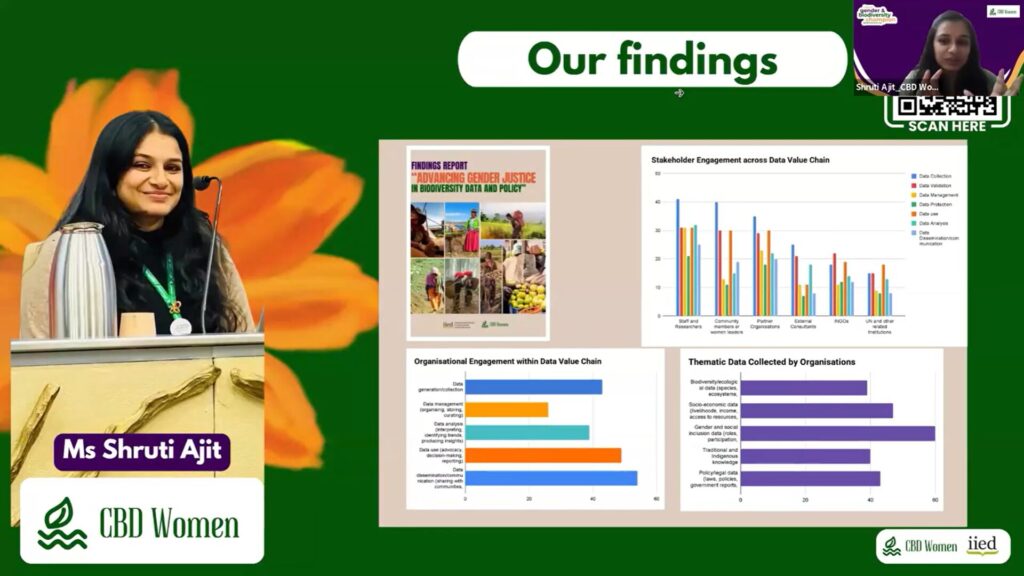
The session opened with Ms Shruti Ajit, Project Officer at the CBD Women’s Caucus, who presented the key findings from the assessment. Her remarks set the tone by highlighting a critical disconnect, while women-led, community-based organisations are already generating rich and nuanced biodiversity data, this knowledge continues to remain under-recognised in formal policy and monitoring systems.
Drawing from both the report and complementary insights from expert engagements, the presentation underscored a central paradox. Across countries, women-led and community-based monitoring systems are producing valuable data on biodiversity trends, traditional knowledge, and rights. Yet, governments,often constrained by incomplete datasets,are not fully leveraging these contributions. This represents a missed opportunity to adopt a truly whole-of-society approach to monitoring the Kunming-Montreal Global Biodiversity Framework (KMGBF).
The discussion was further enriched through a 20-minute segment featuring expert reflections from Ms Ciere Booth (Programme Officer, Policy Innovation Area, UNEP-WCMC), Mr Venge Nyirongo (Intergovernmental Specialist- Climate Change, Sustainable Development and the Rio Conventions, UN Women), Ms Charlotte (Lotty) Clare (Advocacy and Research Officer, Karen Environmental and Social Action Network), and Ms Marina López Sincal (Gender and Biodiversity Focal Point, Government of Guatemala). Together, they brought institutional, community, and policy perspectives into conversation,grounding the report’s findings in practice.
"It is not only about what we measure, but also how we measure it"
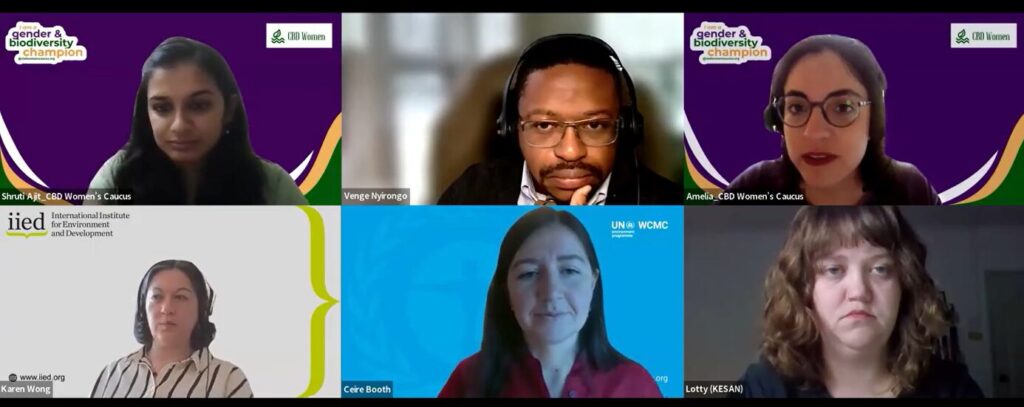
Building on the assessment, Ms Ciere Booth emphasised that rights-based monitoring is not only about what we measure, but also how we measure it. It requires examining whose knowledge is valued, who participates in monitoring processes, and what systems are in place to enable meaningful inclusion. She pointed to the potential of community-based monitoring systems to complement national datasets, while also noting that institutional recognition remains a key barrier.
Mr Venge Nyirongo reinforced this by highlighting that the challenge is not a lack of evidence, but a lack of recognition. Community organisations are actively engaged in data collection, analysis, use, and communication, yet gaps in data management create bottlenecks that limit long-term usability and policy uptake. He further underscored the importance of strengthening the gender-responsive data value chain,recognising that data systems are shaped by power, participation, and social norms.
Grounded insights from Ms Charlotte Clare illustrated how these dynamics play out on the ground. Through community-led research initiatives, Indigenous Karen communities are generating critical biodiversity knowledge,ranging from ethnobotanical studies to wildlife monitoring and ecosystem restoration. Women play a central role in these processes, blending traditional knowledge with scientific approaches, while also strengthening leadership and decision-making within their communities. At the same time, challenges related to funding, human resources, and data organisation continue to limit the scale and sustainability of these efforts.
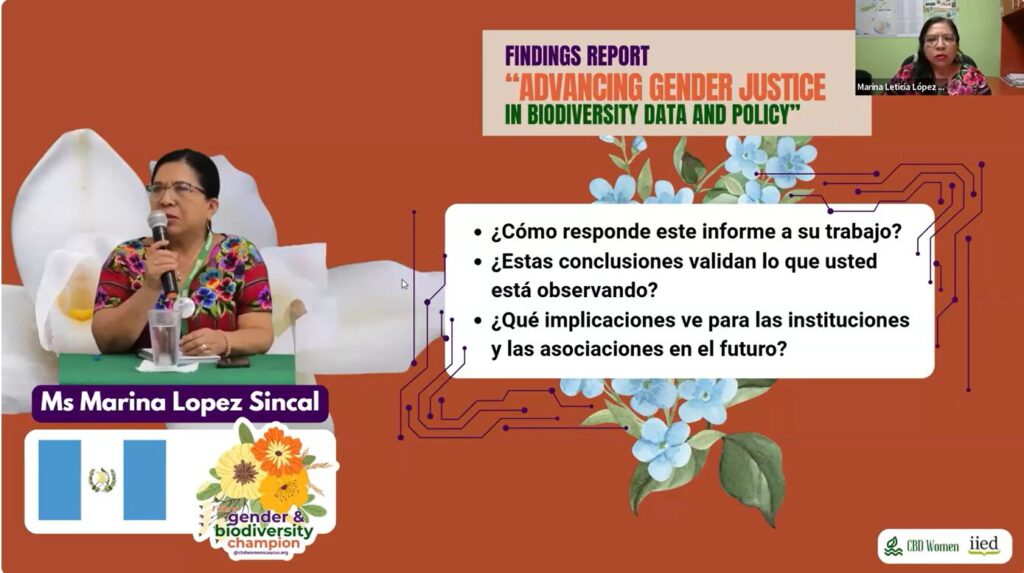
From a government perspective, Ms Marina López Sincal reflected on ongoing efforts in Guatemala to institutionalise gender-responsive approaches within biodiversity governance. The establishment of a dedicated Gender Unit and the development of strategies to promote women’s participation signal important progress. She also highlighted the role of disaggregated data in informing inclusive policies, and the need for stronger governance frameworks to integrate community-generated data into national systems.
The session concluded with reflections from Ms Karen Wong Pérez, Senior Researcher at IIED, who outlined key next steps.The next phase will focus on a peer-to-peer learning journey, directly responding to the needs identified in the assessment. This will bring together women’s organisations to exchange experiences, share methods, and strengthen collaborative learning. Planned between April and June, the formative process will engage women working at national and regional levels, particularly those working with Indigenous Peoples, local communities, and Afro-descendant groups, through targeted modules. These efforts will culminate in the co-creation of a Gender and Biodiversity Data Methods Handbook, ensuring that the evidence generated actively informs policy and practice.