
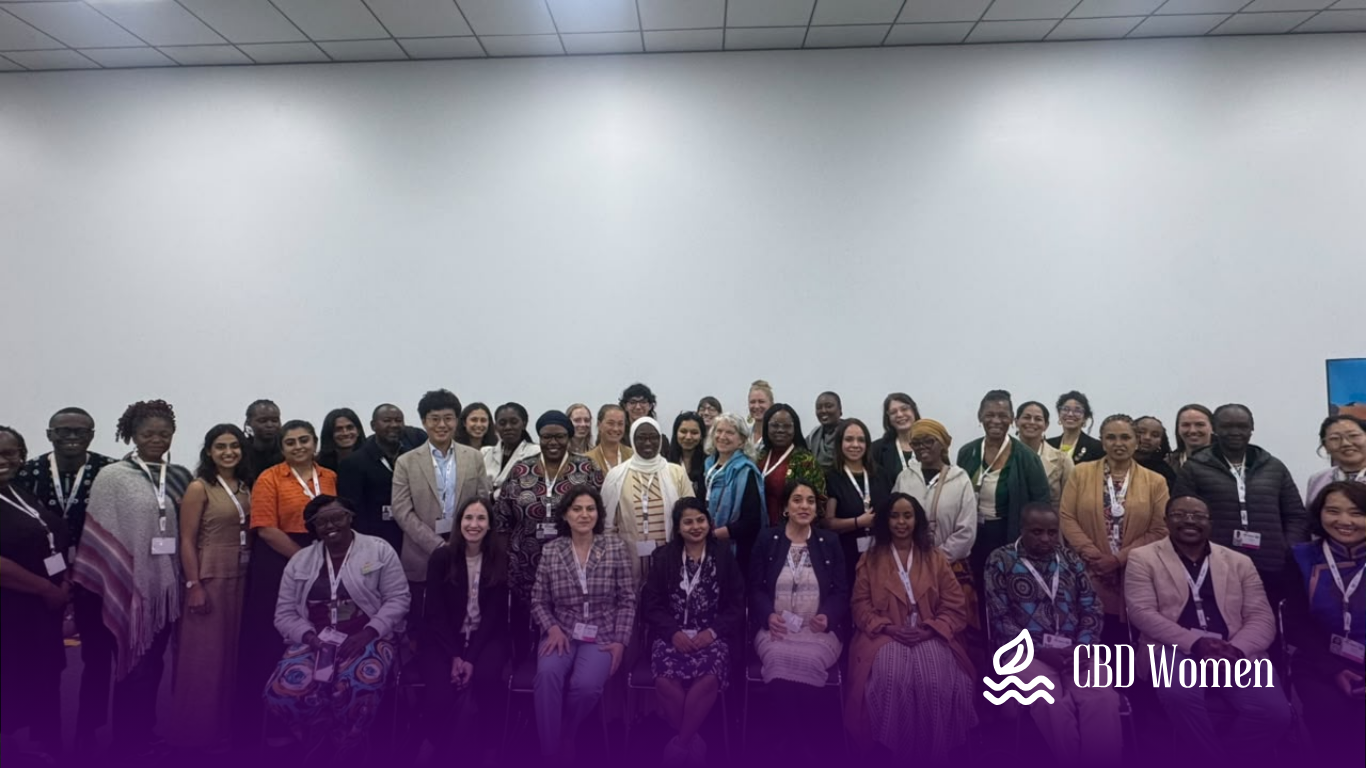
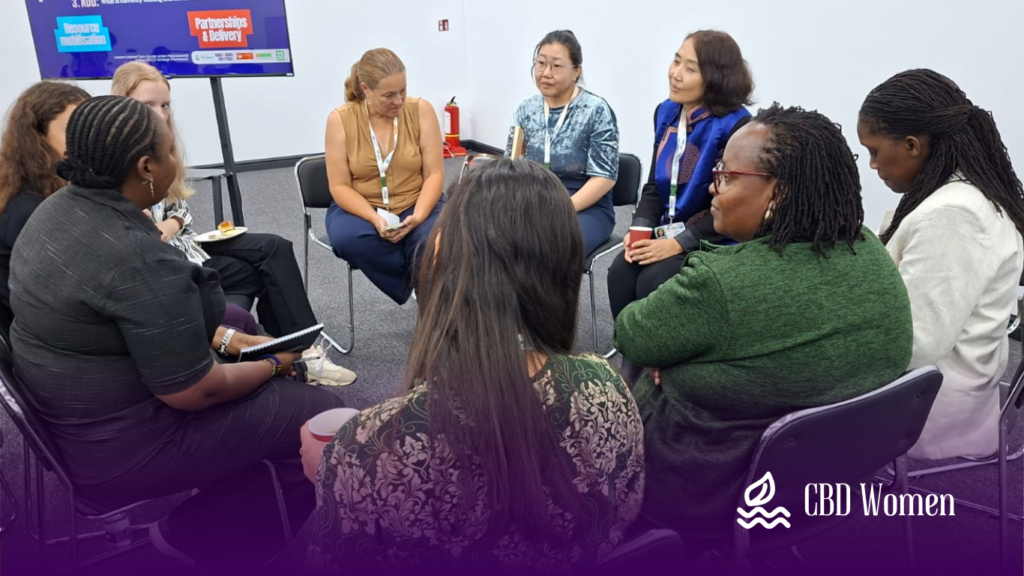
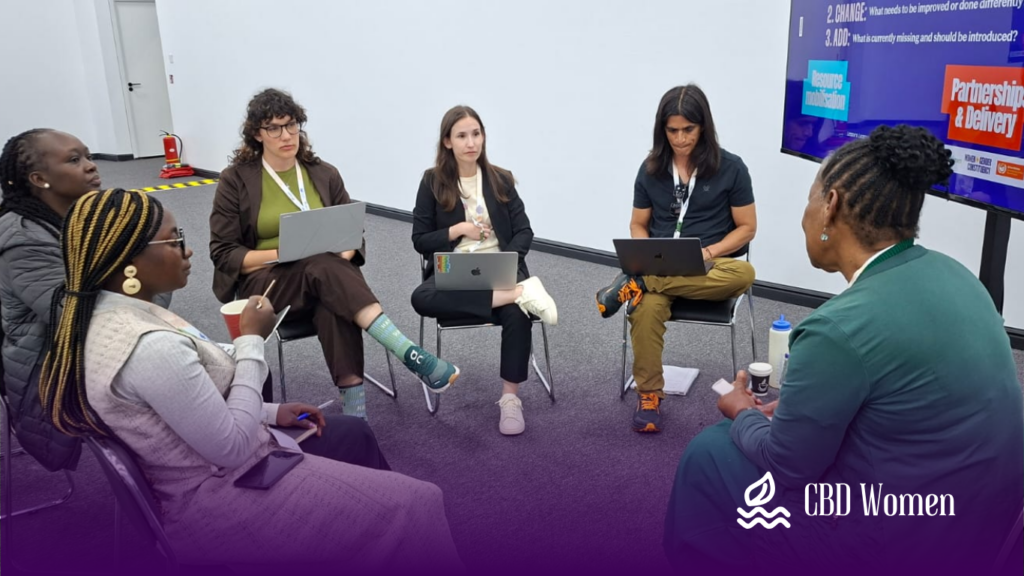
On 19 August 2026, while gender, synergies across the Rio Conventions, civil society engagement, and the Future Strategic Framework itself remained blocked from the negotiating floor at the 17th Conference of the Parties to the United Nations Convention to Combat Desertification (UNCCD COP17), the CBD Women’s Caucus, Fundación Ambiente y Recursos Naturales (FARN), Women’s Environment and Development Organization (WEDO), and the Women and Gender Constituency (WGC) for the United Nations Framework Convention on Climate Change (UNFCCC) convened to compare experience across all three Rio Conventions: what has worked in implementing their respective gender action plans, what hasn’t, and what the new UNCCD Strategic Framework needs to get right. The side event offered one answer: bring the conversation into a room that parties can’t block, and use it to build the evidence base for the work ahead.
The panel: four perspectives across the Rio Conventions
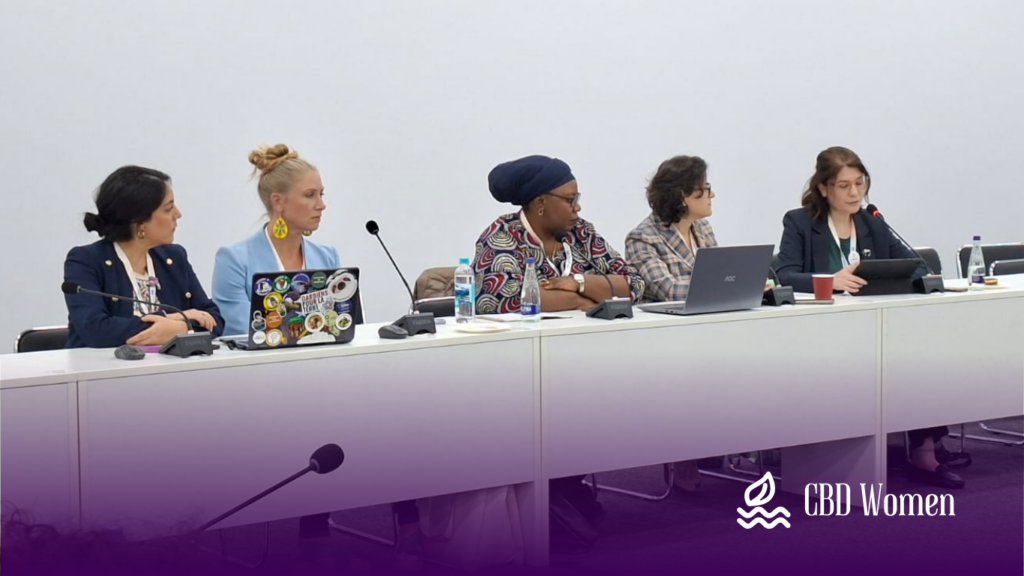
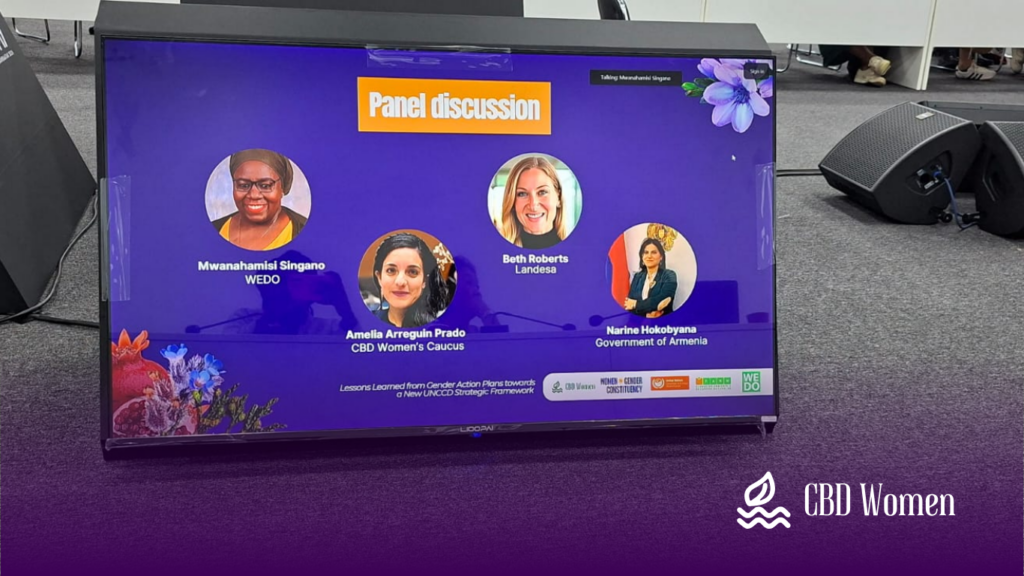
The panel brought together Ms. Amelia Arreguin Prado (CBD Women’s Caucus), Ms. Beth Roberts (Landesa), Ms. Narine Hokobyana (Government of Armenia), and Ms. Mwanahamisi Singano (WEDO), who stepped in to present the UNFCCC portion directly rather than only moderating.
CBD: an operational tool for Target 23, still short on resources
Ms. Amelia Arreguin Prado presented the CBD Gender Plan of Action, the operational tool for Target 23 of the Kunming-Montreal Global Biodiversity Framework (KM-GBF), adopted at COP15 in 2022 (Decision 15/11) and building on predecessor plans from 2008 and 2012. Its structure moves from commitment to implementation across three outcomes: equal opportunities and capacities (covering land and resource rights, access to resources and technologies, economic empowerment, and gender-based violence and defenders); gender-responsive policy and decision-making; and enabling conditions such as data, financing, and institutional capacity.
She then walked through the SBI-6 evidence base, which was sobering: policies and programmes exist but remain weakly implemented, cross-sectoral mainstreaming is limited, women’s organisations remain undervalued and under-resourced, and gender-biodiversity data remains fragmented or unavailable at the national level. The decision recommended for COP17 does push on participation, data, and institutional capacity, and mandates a final review before COP19, but with real caveats: no strong commitment on dedicated funding, language weakened toward «national circumstances,» and still no concrete mechanism for resourcing gender and biodiversity focal points.
Armenia: what national implementation actually looks like
Ms. Narine Hokobyana, representing the Government of Armenia, which will host CBD COP17 in Yerevan this October, grounded the discussion in national experience: a 2025–2028 gender policy strategy naming climate change as a priority area, and a national biodiversity strategy and action plan identifying barriers to women’s participation in biodiversity governance. Her clearest point echoed what the CBD evidence base already showed: a gender-neutral legal framework isn’t enough on its own; without sex-disaggregated data, legal equality doesn’t reliably translate into rural women’s real participation in decision-making.
UNFCCC: a named plan, with real gains and real losses
Ms. Mwanahamisi Singano presented the UNFCCC’s newly named Belém Gender Action Plan, the implementing framework for the Enhanced Lima Work Programme, adopted at COP29 in 2024 (Decision 7/CP.29), with the Belém GAP itself adopted at COP30 in 2025. It’s the third iteration of the Lima Work Programme, running 2026–2034 with a mid-term review in 2029, and carries 27 activities and 98 deliverables across five priority areas.
The gains are real: explicit recognition of structurally excluded groups, a mandate to develop guidelines protecting women environmental defenders, and gender- and age-disaggregated data built into the framework throughout. The losses are real too — foundational human rights language didn’t survive negotiation, and an intersectional lens was diluted into a reference to «multidimensional factors» rather than explicit recognition of gender-diverse people.
Most relevant to this room: Activity C.4 explicitly mandates cooperation between the Rio Conventions’ secretariats via the Joint Liaison Group and their gender focal points, including a dedicated in-session dialogue on Gender Day at each COP. Activity B.4 commits to regional and international workshops on the safety and protection of women environmental defenders. And Activity A.3 opens the door to national assessments on issues like health, violence against women, and care work in the context of gender and climate.
UNCCD: the convention still catching up
Ms. Beth Roberts closed out the panel content with the hardest read of the three. The UNCCD’s Gender Action Plan, built around five objectives, from strengthening women’s land rights to mobilising adequate resources, predates the stronger gender decisions, tools, and guidance the other two conventions now rely on. The 2024 GAP evaluation found real progress: 85% of respondents reported better awareness and 92% reported stronger capacity to integrate gender, and nearly all Land Degradation Neutrality country profiles now mention gender. But structurally, the challenges remain steep: no dedicated core funding for gender capacity, no clear accountability mechanism, and a current Strategic Framework that names gender explicitly in only one of five Strategic Objectives.
Her recommendations for the Future Strategic Framework (FSF) were direct: name secure, gender-equitable tenure rights as an enabling condition across every Strategic Objective, integrating land tenure indicators aligned with the Sustainable Development Goals (SDGs) and KM-GBF Target 22,; develop the next GAP in parallel with the FSF process rather than after it; and build a next-generation gender action plan that mirrors the UNFCCC and CBD plans comprehensive, time-bound, and costed.
- The full policy brief co-produced by the WGC and the CBD Women’s Caucus on gender action plan implementation across the conventions, available on the CBD Women’s Caucus website
- The joint civil society letter to the Rio Conventions’ Presidencies, signed by over 340 organisations and networks, on gender equality, civil society engagement, Rio Convention synergies and the UNCCD Future Strategic Framework, including matters related to Indigenous Peoples and civil society engagement. — read it here