By Ms. Whitelocke-Ballingsingh, University of Technology, member of the CBD Women’s Caucus.
Disclaimer: The views expressed in this blog are those of the author and do not necessarily reflect the official position or opinions of the CBD Women’s Caucus
From December 2-4, 2025, a subregional dialogue was held in Paramaribo, Suriname, convening selected Caribbean countries. The primary focus of this meeting was biodiversity monitoring and reporting, intending to support the national implementation of the Kunming-Montreal Global Biodiversity Framework (GBF) and prepare for the Seventh National Reports.
Key areas of discussion included:
- Revision of National Biodiversity Strategies and Action Plans (NBSAPs).
- Development of national monitoring plans.
- Alignment of national indicators with the GBF.
- Guidance for the preparation of national reports.
- Identification of next steps and strengthening coordination mechanisms.

The CBD women’s caucus engagements
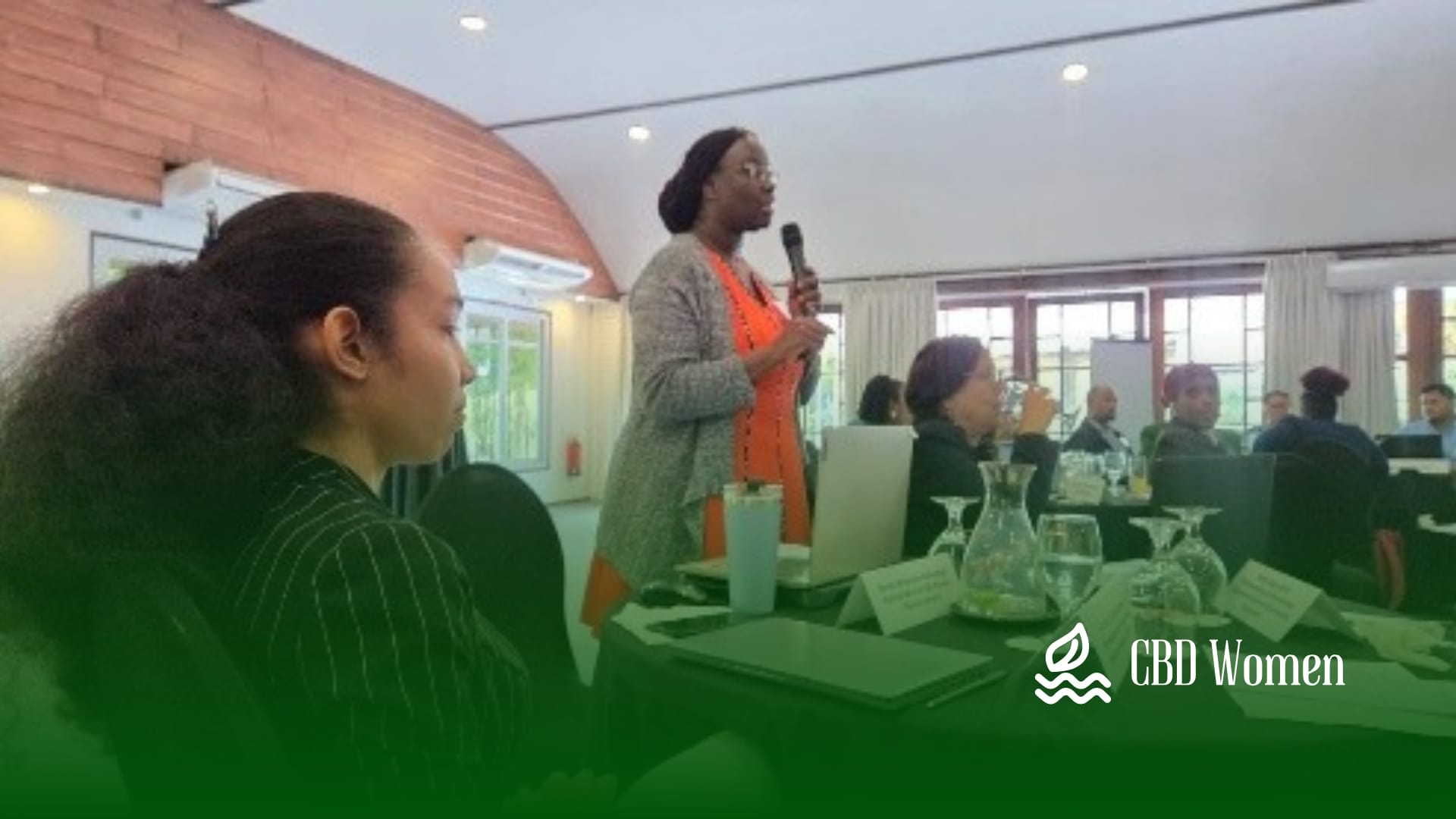
Ms. Sherika Whitelocke-Ballingsingh from Jamaica, represented the CBD women’s caucus in the event. Two days of engaging discussions involved all stakeholders, focusing on the status of National Biodiversity Strategies and Action Plans (NBSAPs) within countries and ensuring the inclusiveness of all people and governments. The CBD Women’s caucus engagements focused on integrating Gender Justice and Human Rights
The call for action to:
- Strengthen arguments by adopting a gender-responsive and rights-based perspective.
- Ensure the implementation framework fully embeds principles of gender justice and human rights.
- Actively address and dismantle structural barriers and power dynamics.
- Operationalise gender justice by incorporating it into planning, budgeting, and monitoring processes.
Highlits from the events
The event highlighted a range of practical support opportunities available to countries to strengthen biodiversity monitoring, reporting, and implementation of National Biodiversity Strategies and Action Plans (NBSAPs) under the Kunming-Montreal Global Biodiversity Framework (KMGBF). UNDP emphasized the role of the NBSAP Accelerator Partnership, which connects countries with tailored technical and financial solutions through a matchmaking support system open to both governmental and non-governmental organizations with a minimum of ten permanent staff. This mechanism links national indicators and reporting needs with partners capable of providing targeted expertise and resources. UNEP-WCMC introduced the Target Tracker, an online knowledge hub that visualizes progress toward GBF goals at global, regional, and national levels, with particular emphasis on the “30×30” target, supporting evidence-based planning and decision-making. Additional regional and technical support was highlighted through UNEP ROLAC, which outlined assistance to accelerate KMGBF implementation across the Caribbean, alongside presentations introducing the Global Ecosystems Atlas as a global reference for ecosystem data and practical guidance on developing effective national biodiversity monitoring systems. Together, these sessions underscored the importance of accessible tools, regional collaboration, and targeted support in helping countries translate global biodiversity commitments into measurable national action.
A total of eleven countries, including two participating online, delivered country presentations during the event. These included Antigua & Barbuda, The Bahamas, Belize, Grenada, Guyana, Jamaica, Saint Lucia, Saint Vincent and the Grenadines, and Suriname, with Trinidad & Tobago an,d Barbados joining virtually. Countries shared key milestones in their National Biodiversity Strategies and Action Plans (NBSAP) processes, offering valuable insights into the challenges they face, the successes achieved, and the best practices emerging across the region. These presentations fostered peer learning, encouraged regional collaboration, and highlighted practical lessons for advancing biodiversity planning and implementation.
Challenges and Successful Approaches
Countries highlighted several challenges affecting the effective implementation and monitoring of their National Biodiversity Strategies and Action Plans. These challenges include:
- Lack of a dedicated system for data recording: Countries currently rely on spreadsheets and other manual methods for data collation.
- Absence of measurable indicators: Existing practices lack clearly defined and measurable indicators, in contrast to the comprehensive monitoring and evaluation typically used in biodiversity and conservation projects.
- Financial and logistical challenges for Indigenous community engagement: Consultations required significant extensions of funds to cover longer engagement periods. Language barriers necessitated translation services, and budgets had to be expanded up to five times to accommodate interpreters, including travel costs. Accessibility issues and the need for face-to-face interactions further complicated engagement efforts.
- Challenges with funding and procurement through the United Nations Development Programme: Inadequate communication, delays in processing, and difficulties accessing funds caused implementation delays and stakeholder fatigue.
- Time constraints and limited capacity: Tight deadlines made it challenging to ensure full government-wide and community engagement. Many staff faced heavy workloads and repeated participation in multiple meetings, resulting in burnout. Timely feedback from validation sessions was noted as a positive outcome amidst these challenges.
Despite these obstacles, countries shared several successful approaches and good practices. These included integrating projects using a ridge-to-reef approach, employing remote sensing for mapping, conducting forest cover assessments using geographic information systems, and fostering regional partnerships with organizations such as the Organization of Eastern Caribbean States, the University of the West Indies, and the Caribbean Disaster Emergency Management Agency. Countries also highlighted the integration of biodiversity, climate change, and disaster risk reduction, system integration to include biodiversity in climate and disaster planning, and ongoing efforts to improve data management by consolidating stakeholder data into centralized databases.
Outcomes and Next Steps
The dialogue resulted in a consensus on a two-tiered deadline structure for submitting updated National Biodiversity Strategies and Action Plans, allowing countries to account for varying stages of national preparation and internal coordination. One group will finalize and submit their strategies by February 2026, while others with more complex data or coordination challenges have an extension until before the next Cop ( #COP17Armenia) From the CBD Women’s Caucus perspective, this outcome presents an opportunity to ensure strategies are gender-responsive and inclusive, integrating lessons from the mid-term review of the Gender Plan of Action. By linking deadlines with inclusive processes, countries can achieve high-quality reporting, full ,effective and meaningful participation of women and girls especially those on the ground, and achieve the progress toward the implementation of the Target 23 and gender plan of action , setting a clear path toward effective implementation of the Global biodiversity framework.