By Ms. Berta Medrano, member of the CBD Women’s Caucus. Founder and Director of Asociación GAIA El Salvador
Disclaimer: The views expressed in this blog are those of the author and do not necessarily reflect the official position or opinions of the CBD Women’s Caucus
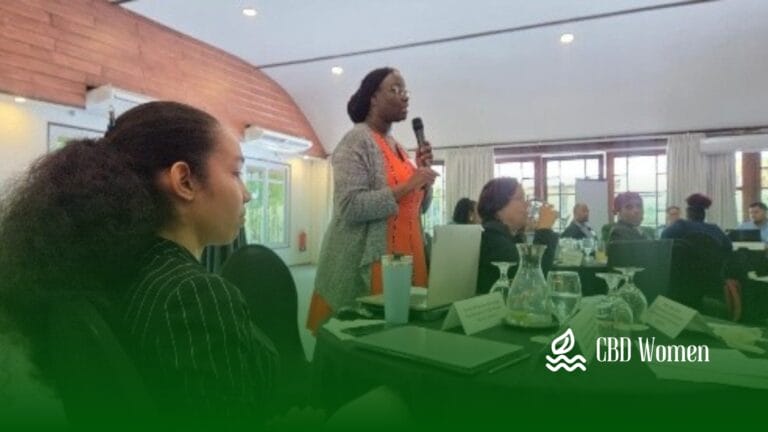
From November 17 to 21, 2025, in Bogotá, Colombia, the CBD Women’s Caucus (CBD WC) participated in the Subregional Dialogue for Latin American countries on monitoring and reporting on biological diversity, with a special focus on ecosystem restoration (Target 2 of the Kunming-Montreal Global Biodiversity Framework). The Caucus was represented by Ms. Berta Gladys Medrano Mejía from El Salvador and Ms. Rosa Cecilia Durán from Colombia, who actively contributed throughout the event. The dialogue gathered the Latin American and Caribbean Group, supported by the Subregional Center for Technical and Scientific Support – CBD Alexander von Humboldt Biological Resources Research Institute, and the Regional Center for Biodiversity CCAD, representing the countries of the Central American Integration System (SICA).
This event was co-organized by the Alexander von Humboldt Biological Resources Research Institute, the Food and Agriculture Organization of the United Nations (FAO), the Regional Office for Latin America and the Caribbean of the United Nations Environment Programme (UNEP), and the Secretariat of the Convention on Biological Diversity (CBD), in close collaboration with other relevant partners and with the financial support of FAO, the UNEP China Trust Fund, and the Global Environment Facility (GEF).
The framework of this event served to bring together Latin American parties and representatives of technical and scientific cooperation support centers established under the CBD, Indigenous peoples, local communities, women, youth, and relevant organizations to engage in dialogue, strengthen capacities, and exchange knowledge and experiences for the implementation of the Kunming-Montreal Global Biodiversity Framework (KMGBF) monitoring framework. This included training on the preparation of the seventh national report and the use of the online reporting tool. Support for participating countries to accelerate monitoring and reporting on ecosystem restoration in the context of KMGBF Target 2 was also addressed. The agenda also included training-of-trainers for representatives of regional and subregional technical and scientific cooperation support centers (TSCCs) and a session on the progress of KMGBF implementation in Latin America.

Implementation of the Kunming-Montreal Global Biodiversity Framework (KMGBF) monitoring framework, preparation of the seventh national report
With regard to National Biodiversity Strategies and Action Plans (NBSAPs), countries or parties are at different stages of progress: most have NBSAPs, but there are still countries that have not updated and aligned their strategies and plans with the KMGB framework, and with the exception of four countries (Colombia, Mexico, Brazil, Paraguay, and Chile), they have not integrated non-state actors into their updating process. In addition, most parties, with the exception of two countries, one of which is in the process of doing so, have not integrated target 23 and, consequently, no indicator that allows for monitoring and collecting disaggregated data through which it is possible to obtain specific information on the participation and contribution of Indigenous people, local communities women, youth and other non-state actors.
Regarding the preparation of the national report, most countries acknowledge that their action plans for the preparation of the seventh report have not considered non-state actors for various reasons, including a lack of knowledge about the mechanisms and processes for integrating these actors and their contributions. As a result, only intersectoral institutional sectors are participating in the preparation of the report, including the environment, agriculture, housing, and planning, among others.
With regard to biodiversity monitoring and restoration systems, most countries do not have robust, standardized monitoring systems, agreed methodologies, or compatible systems, and there is a lack of integration of the contributions of non-state actors and sectors such as indigenous peoples, local communities, women, youth, NGOs, and the private sector.
The CBD Women’s Caucus repeatedly insisted and emphasized that the integration and participation of Indigenous peoples, local communities, women, and youth—is essential and indispensable in planning, monitoring, and reporting, as it is part of the mandate and objectives of the CBD, the gender action plan approved by the parties, and the KMGBF, whose target 23 cuts across all 23 KMGBF targets.
Planning, monitoring, and reporting on ecosystem restoration in the context of KMGBF Target 2
The target 2, which is aligned with the United Nations Decade on Ecosystem Restoration, the parties are at different stages: Most do not have a baseline, plan, and/or strategy, and their respective monitoring system focus on restoration. Rather, what predominates in this area are scattered interventions by NGOs and cooperation projects, with the exception of four countries that have more cohesive plans, but whose focus is solely on the recovery of ecosystem services, with one exception, and do not integrate the other three outcomes, which are biodiversity, ecological integrity, and connectivity.
In the framework presented by the parties on restoration, there is no integration of a goal, indicator, and/or at least a gender responsich approach, with the exception of four countries that integrate gender responsiveness into the construction of strategies but not into their monitoring system, making it impossible to know exactly how women, youth, Indigenous peoples, local communities are participating, contributing, and monitoring restoration. Despite progress in relation to indigenous peoples and local communities, significant gaps remain in effectively integrating their ancestral and traditional knowledge. Indigenous and rural women are the custodians of ancestral knowledge about caring for nature, ecosystems, and biodiversity, as restoration is about care, and women are experts in this area, thanks to their ancestral knowledge.
Openness and sensitivity to integrating the socio-cultural dimension
Representatives of countries, multilateral agencies, relevant organizations, and subregional scientific and technical support centers showed sensitivity and openness to the repeated calls from the representatives of the CBD Women’s Caucus for the integration of women, youth, indigenous peoples, and local communities in the planning, monitoring and implementations processes of NBSAPs and restoration plans and strategies and their respective monitoring systems, with clear goals and indicators that allow us to know how they are participating and contributing to the KMGBF, Gender Action Plan, and CBD objectives.
A notable achievement is that, as a result of advocacy within the framework of the dialogue, it was possible to gain recognition from the parties and other relevant actors involved that there is a need to systematically integrate the socio-cultural dimension into all NBSAP processes, monitoring systems, and restoration plans, To this end, we request the support of the parties so that one of the outcomes of the subregional workshop is a recommendation to all parties in Latin America and the Caribbean to integrate the socio-cultural dimension into their NBSAPs, restoration plans, and monitoring systems, with explicit reference to the integration and active and substantive participation of women, Indigenous Peoples, local communities, youth, and children, and that allows for the visibility and recognition of their contributions to the achievement of the KMGBF and the objectives of the CBD.
We also reiterate to the subregional centers, parties, multilateral agencies, and relevant organizations our willingness to support capacity building in all matters related to gender, women, and girls, and we urge them to take advantage of our proven capacity and experience.