
By Ms. Amelia Arreguin Prado, CBD Women’s Caucus coordinator
Disclaimer: The views expressed in this blog are those of the author and do not necessarily reflect the official position or opinions of the CBD Women’s Caucus
As the financial mechanism of the Convention on Biological Diversity (CBD) and several other multilateral environmental agreements, the Global Environment Facility (GEF) plays a pivotal role in translating global commitments into action on the ground. While Parties negotiate biodiversity targets, adopt Gender Plans of Action, and agree on rights-based approaches under the CBD, it is through the GEF that many of these commitments are ultimately financed and implemented.
For the CBD Women’s Caucus, engaging in GEF processes is therefore a natural extension of our advocacy under the Convention. The principles we work to advance within CBD negotiations—including the implementation of Target 23, the CBD Gender Plan of Action, meaningful participation, human rights, and equitable access to finance—must also shape the governance, policies, and funding modalities of the GEF. This understanding guided our engagement at the 8th GEF Assembly in Samarkand, Uzbekistan, where we participated as active members of the newly established GEF Women and Gender Caucus.
Building a collective voice for gender-responsive environmental finance
The creation of the GEF Women and Gender Caucus marks an important step towards strengthening the participation of women’s rights and gender equality advocates within GEF processes. Bringing together organisations engaged across the CBD, UNFCCC, UNCCD, chemicals conventions and broader environmental movements, the Caucus seeks to ensure that environmental finance contributes to advancing gender equality rather than reinforcing existing inequalities.
Throughout the Assembly, members of the GEF Women and Gender Caucus worked collaboratively to promote a shared vision of environmental finance that is rights-based, inclusive, transparent and accountable, while recognising women and girls in all their diversity as rights holders, knowledge holders, environmental defenders and leaders.
Bringing CBD commitments into GEF implementation
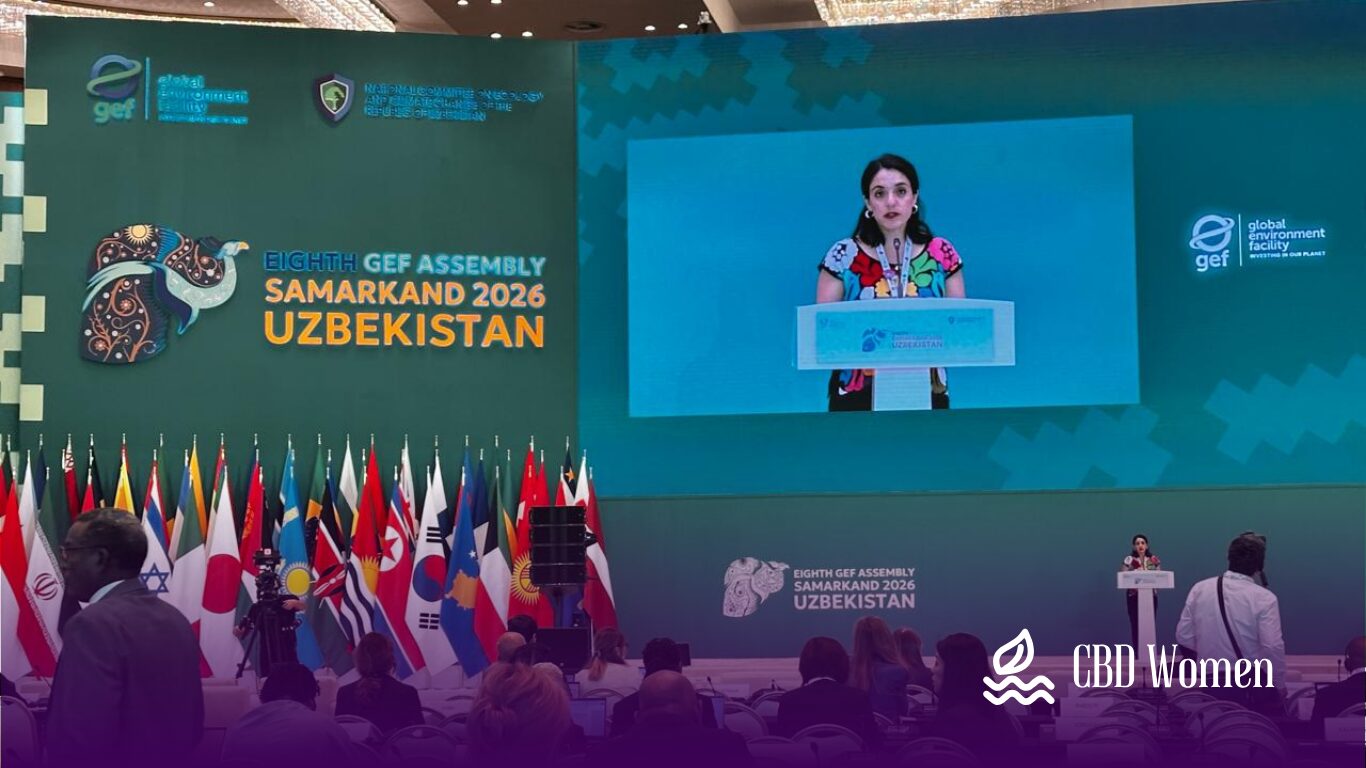
The Assembly officially opened with a statement delivered by Amelia Arreguín Prado, Coordinator of the CBD Women’s Caucus, on behalf of the GEF Women and Gender Caucus.
The statement reminded delegates that women and girls are not merely beneficiaries of environmental action but central actors in delivering biodiversity conservation, climate resilience and sustainable development. It called for adequate and predictable public finance, direct access to resources for women-led organisations, meaningful participation in decision-making, and the formal recognition of the GEF Women and Gender Caucus as a permanent stakeholder in GEF governance.
These messages closely reflect commitments already adopted under the Convention on Biological Diversity, particularly the Kunming-Montreal Global Biodiversity Framework and the CBD Gender Plan of Action. Our engagement at the Assembly therefore sought to ensure that these commitments are not only negotiated within CBD spaces, but also embedded in the financial mechanisms responsible for supporting their implementation.
From Gender Action Plans to financed implementation
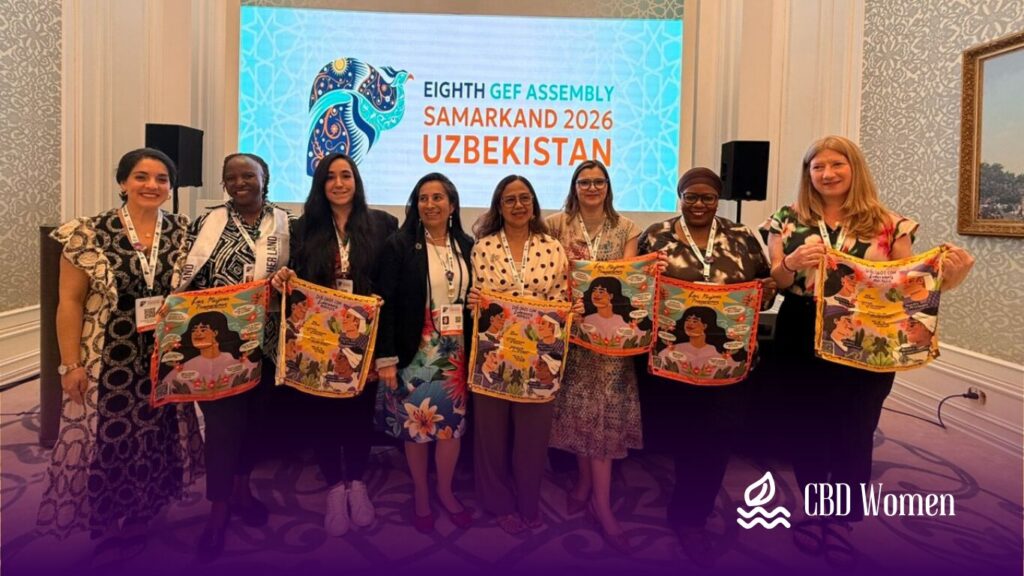
Together with partners from the UNFCCC Women and Gender Constituency, civil society engaged in the UNCCD Gender Caucus, the Women’s Major Group at UNEP and other allies, the GEF Women and Gender Caucus organised the official side event «Financing Gender Action Plans: From Commitments to Implementation.»
The discussion explored how the GEF can better support the implementation of the Gender Action Plans adopted across the CBD, UNCCD, UNFCCC, CITES, Minamata and Stockholm Conventions. Rather than treating gender equality as an additional consideration, participants highlighted that these Gender Plans provide clear mandates for gender-responsive implementation across environmental sectors.
Speakers from governments, conventions, the GEF Secretariat, implementing agencies and civil society examined how GEF-8 programming—and the transition towards GEF-9—can strengthen alignment between convention-level commitments and financing on the ground. Discussions, moderated by Laura Bermudez, emphasised the importance of improving the tracking of gender results, strengthening support for country-driven priorities, expanding access for women-led and community-based organisations, and recognising women as implementers and partners in achieving environmental outcomes.
Strengthening the Global Biodiversity Framework Fund
The CBD Women’s Caucus also organised a second official side event, «Strengthening Inclusive Biodiversity Finance: Early Lessons from the Global Biodiversity Framework Fund (GBFF),» in collaboration with the Global Youth Biodiversity Network (GYBN) and the International Indigenous Forum on Biodiversity (IIFB).
The session, with participation of Minnie Degawan and Priyanka Pandey, focused on one fundamental question: how can the GBFF fully deliver on the commitments adopted under the Kunming-Montreal Global Biodiversity Framework?
Bringing together GBFF Council observers representing women, Indigenous Peoples and local communities, and youth, alongside Council members and implementing agencies, the discussion explored early lessons emerging from the first years of the Fund’s implementation. Participants reflected on the need to strengthen meaningful participation of observers within GBFF governance, improve financing modalities so that resources reach nature stewards on the ground, and reinforce transparency, accountability and long-term impact assessment.
Throughout the discussion, speakers stressed that the effectiveness of biodiversity finance cannot be measured solely by the volume of funding approved, but also by whether investments contribute to equitable, rights-based and transformative biodiversity outcomes for the communities who are conserving nature every day.
Contributing across the Assembly
Beyond the official programme organised by the GEF Women and Gender Caucus, members of the CBD Women’s Caucus contributed to discussions across the Assembly.
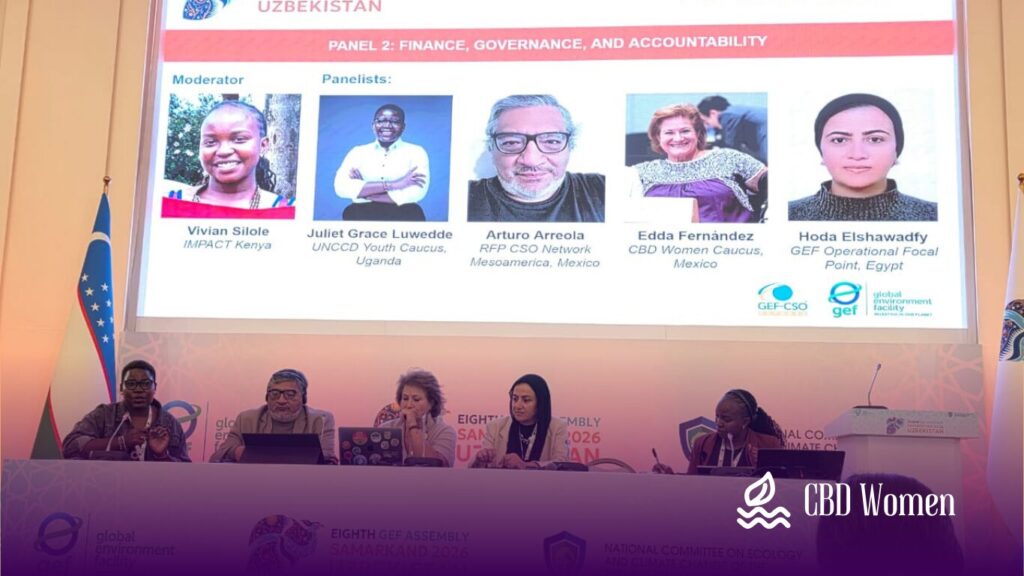
At the Civil Society Forum, Edda Fernández highlighted the importance of ensuring that GEF-9 demonstrates not only environmental results but also meaningful participation, direct access to finance, and tangible benefits for communities implementing environmental action on the ground. She also underscored the importance of aligning GEF investments with the commitments contained in the CBD Gender Plan of Action.
Ana Di Pangracio also participated in a high-level roundtable on biodiversity finance, emphasising that projects financed through the GEF should be co-created with Indigenous Peoples, local communities and civil society, while integrating human rights, environmental justice and accountability from project design through implementation.
Together, these contributions reinforced a consistent message across the Assembly: achieving the objectives of the Convention on Biological Diversity requires financing mechanisms that are as ambitious and transformative as the commitments they are intended to support.
Looking ahead
The 8th GEF Assembly confirmed that there is growing recognition of the importance of gender equality, human rights and community leadership in environmental action. Yet recognition alone is not enough.
For the CBD Women’s Caucus, engaging with the GEF is not about attending another international meeting. It is about ensuring that the commitments negotiated under the Convention do not stop on paper, but are translated into investments that empower women and girls in all their diversity, uphold human rights, and support those who are conserving biodiversity on the ground. Because the future of biodiversity will not be determined only by the commitments we negotiate—but by the choices we make about what, who and how we finance.