
By Edda Fernandez Luiselli, member of the Board of Directors, CBD Women’s Caucus
Disclaimer: The views expressed in this blog are those of the author and do not necessarily reflect the official position or opinions of the CBD Women’s Caucus
The Third International Conference on Health and Biodiversity (Cohab3) took place from September 14 to September 17, 2026, in Galway City, Ireland
The overarching theme was: “Partnerships for People and Planet”, and its primary focus was exploring the interlinkages between global health and biodiversity crises, alongside related challenges like climate change, food and water security, and human rights.
The CBD Women’s Caucus was firstly invited to address the role of women in biodiversity and health as a parallel session of the Conference. However, during the previous preparations, we commented on how gender and women’s roles and rights are a crosscutting issue of the topics that the Conference would address, including “Biodiversity for Food and Nutrition”, which was the session led by FAO and where the CBD Women’s Caucus participated.
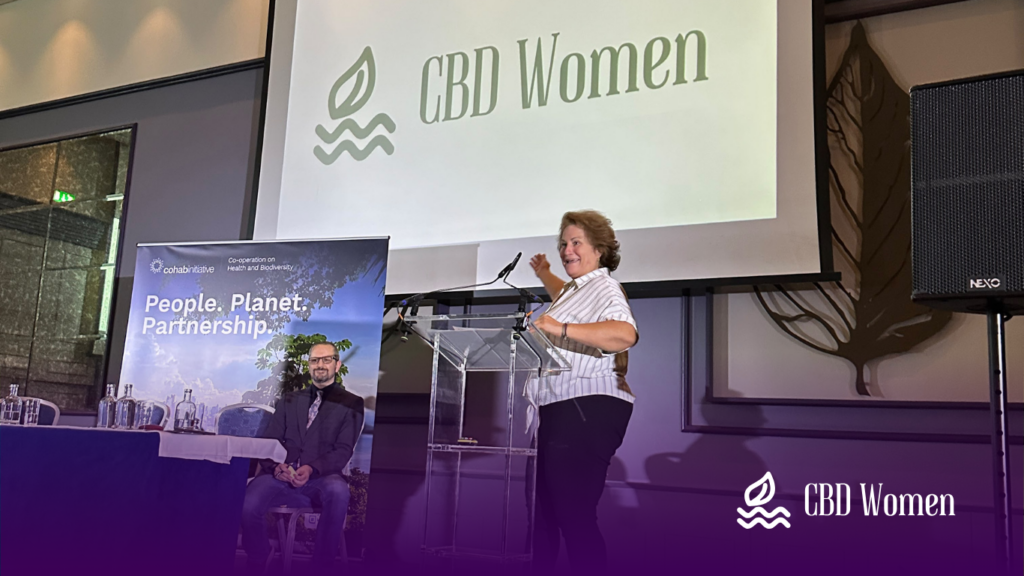
I had the honor of representing the Caucus, and the main messages I presented were focused on the following:
The latest World Economic Forum global risks report lists inequality, erosion of human rights, extreme weather events, critical change in planetary systems, natural resources shortage, biodiversity loss and ecosystem collapse, pollution, and decline in health and well-being, among other risks expected for the second half of this turbulent decade.
Gender-based discrimination linked to the erosion of human rights and gender-based violence, linked to intra-state violence and geopolitical turmoil, are also listed.
At the national level, the decline in health and well-being is listed within the first 5 risks in countries as different as the US, Colombia, France, Mexico, New Zealand, Norway, Switzerland, Zimbabwe, and many others.
Physical and mental health and well-being are linked to environmental impacts, as the One Health approach recognizes in its quest to optimize the health and resilience of people.
However, there is still work to be done to integrate gender considerations into One Health research and interventions, as they are essential for advancing women’s empowerment, gender equality, and broader health equity.
This is important because a biodiversity-and-health approach that does not examine who has access to resources, who makes decisions, who bears risks, and who benefits can miss major pathways between biodiversity and health.
Women are one of the nine Major Groups recognized in international sustainable development governance since the adoption of Agenda 21 at the 1992 Earth Summit in Rio.
However, the role of women in all our diversity, as actors sustaining life on our planet has yet to be known, learned, supported and valued… which is far more concrete than just being recognized – if at all.
Three blueprints for people and planet
The world has now three main adopted blueprints to design, decide and implement the commitments we are all placing in so many different fora.
Firstly, I highlight the gender action plans from the environmental conventions, referring in particular about the CBD Gender Plan of Action adopted by COP15 in 2022, and one of the few internationally agreed documents that cover from vision to expected results and how to achieve them.
The CBD Gender Plan of Action addresses women’s health primarily through a rights-based and environmental lens, identifying that women’s equal access to land, water, natural resources, services, and decision-making is fundamental to health, well-being, and broader health equity.
The second blueprint, also adopted by COP15, is the Kunming-Montreal Global Biodiversity Framework, which explicitly recognizes that biodiversity is fundamental to human health and well-being, embedding health considerations across its preamble, goals, and specific targets.
And the third blueprint is the Global Action Plan on Biodiversity and Health, adopted by COP16, which encourages governments and other actors to address biodiversity conservation and health policy interactions jointly.
These documents set our shared responsibilities for people and planet, and are especially relevant now that CBD COP17 is about to happen.
Looking ahead to CBD COP17
One of the agenda items of the upcoming COP is focused on the implementation, mainstreaming, and measurement of progress of the adopted Global Action Plan on Biodiversity and Health.
This next stage is expected to focus on demonstrating how biodiversity conservation can simultaneously deliver benefits for health, food, water, and climate, while ensuring that these benefits are equitable and reach those most affected by biodiversity loss and environmental change.
In this context, women and gender require particular attention as the Global Action Plan on Biodiversity and Health invites women, children, and youth to contribute to its implementation by participating in regional workshops and dialogues, while the KMGBF and the Gender Plan of Action provide a stronger foundation for addressing gender equality and women’s rights.
Our shared ambition in the CBD Women’s Caucus is to move beyond viewing women primarily as participants or beneficiaries and instead recognize us as rights-holders, actors, decision-makers, and partners in biodiversity and health governance.
This is particularly important as the midterm review of the Gender Plan of Action is also on the agenda of COP17. We want this review to be critical, useful for policy and planning at all levels, and politically meaningful, particularly in the actual context where human rights, Indigenous Peoples’ rights, and women’s rights are increasingly being disregarded and even erased from negotiation texts.
We therefore advocate for health and gender to be recognized as cross-cutting considerations and integral to decision-making, rather than treated as a standalone set of health- and gender-related actions.
In this way, the Gender Plan of Action can become a meaningful mechanism for embedding women’s rights, gender equality, health, and broader health equity across biodiversity policy and implementation.
As for now, the recommended decision on Health and Biodiversity for COP17 to consider is heavily bracketed as agreement was not reached during SUBSTTA 27. Cooperation and partnerships -the main framework for discussions during CoHab3- should reflect on the national and regional positions that Parties will bring to COP negotiations.
At a time when cooperation is weakening, governments are retreating from multilateralism, and global risks are growing in scale, speed, and interconnection, the CBD Women’s Caucus urged participants to build the needed partnerships to open the door to gender justice, equality, inclusivity and mutual respect.