
Conserving agrobiodiversity requires more than protecting genetic resources. It also requires sustaining the knowledge, rights, cultural practices and collective institutions through which agricultural diversity is maintained, used and transmitted across generations.
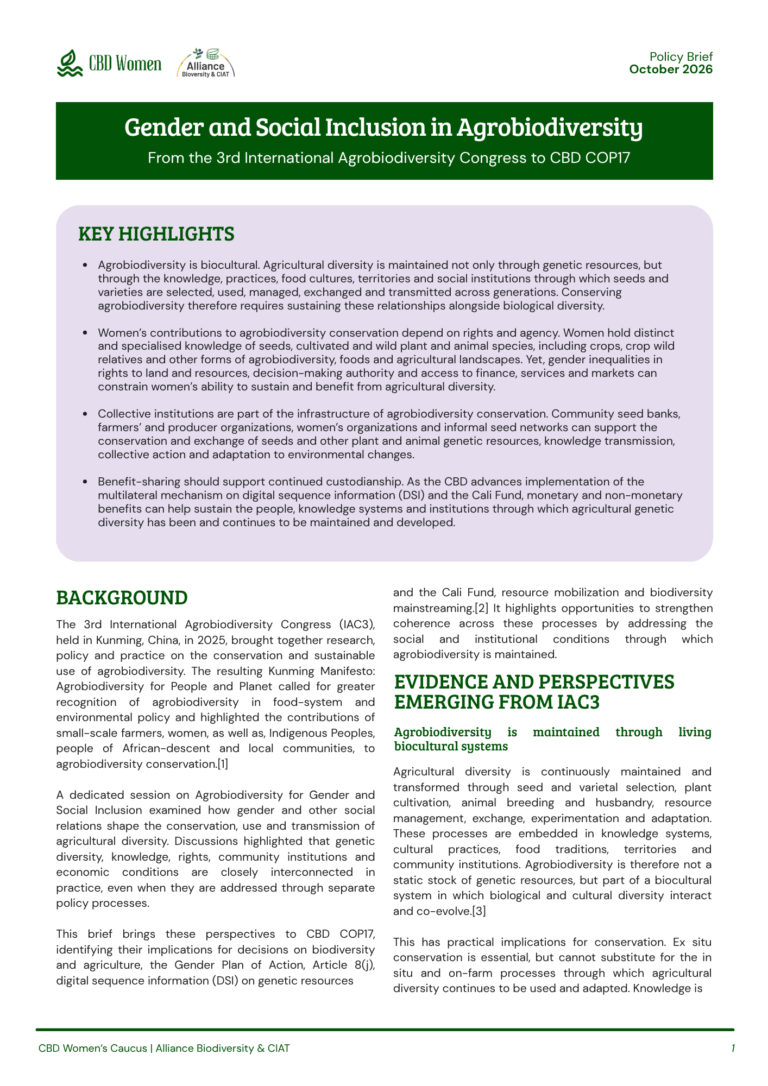
Developed by the CBD Women’s Caucus and the Alliance Biodiversity International and CIAT, this policy brief brings evidence and perspectives from the 3rd International Agrobiodiversity Congress (IAC3), held in Kunming, China, in 2025, into the policy discussions at CBD COP17.
The brief examines agrobiodiversity as a living biocultural system and highlights women’s contributions as knowledge holders, farmers, innovators and custodians of agricultural diversity. It explores how inequalities in land and resource rights, decision-making authority, finance and access to markets constrain women’s ability to sustain and benefit from agrobiodiversity.
It also highlights the importance of community seed banks, farmers’ organizations, women’s networks and other collective institutions in conserving genetic diversity, maintaining knowledge systems and supporting adaptation.
Building on these findings, the brief presents six policy recommendations for CBD COP17, covering biodiversity and agriculture, the CBD Gender Plan of Action, Article 8(j), digital sequence information (DSI) and the Cali Fund, resource mobilization, and biodiversity mainstreaming.
The central message is clear: effective agrobiodiversity conservation depends not only on protecting genetic diversity, but also on securing the rights, resources and institutions that enable the people and communities sustaining it to continue doing so.
Conserving agrobiodiversity means sustaining the people, knowledge and institutions behind it.
Explore six policy recommendations to strengthen women’s rights, community-led conservation, traditional knowledge systems and equitable benefit-sharing across the CBD COP17 agenda.
Year: 2026
Type: Policy Brief
Authors: CBD Women’s Caucus | Alliance Biodiversity & CIAT
Themes: Agrobiodiversity conservation, Gender equality and social inclusion, DSI, Traditional knowledge, biocultural diversity