
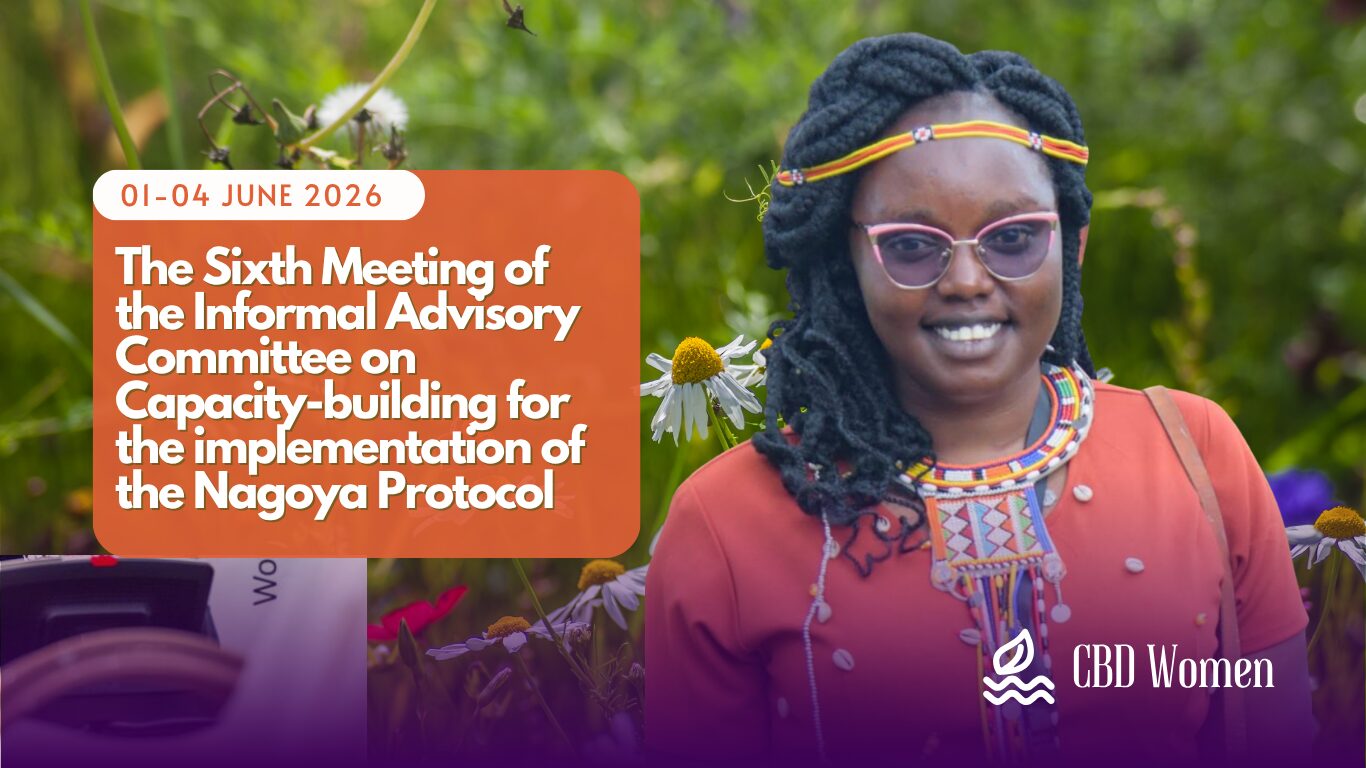
By Ms. Gladys Kiplagat, CBD Women’s Caucus member
Disclaimer: The views expressed in this blog are those of the author and do not necessarily reflect the official position or opinions of the CBD Women’s Caucus
About the Event
The Sixth Meeting of the Informal Advisory Committee on Capacity-building for the implementation of the Nagoya Protocol, held in Montreal from 1–4 June 2026, was an important moment for shaping how the Protocol’s effectiveness will be assessed in practice. For the CBD Women’s Caucus, participation in this meeting mattered because the review of the Nagoya Protocol cannot be credible if it measures laws and procedures without also examining who is able to participate, who influences decisions, and who actually receives benefits. The CBD Women’s Caucus representation helped ensure that gender justice, women’s leadership, and the knowledge and rights of Indigenous Peoples and local communities remained visible in highly technical discussions on access and benefit-sharing (ABS).
Inside the Meeting: Scope and Participation
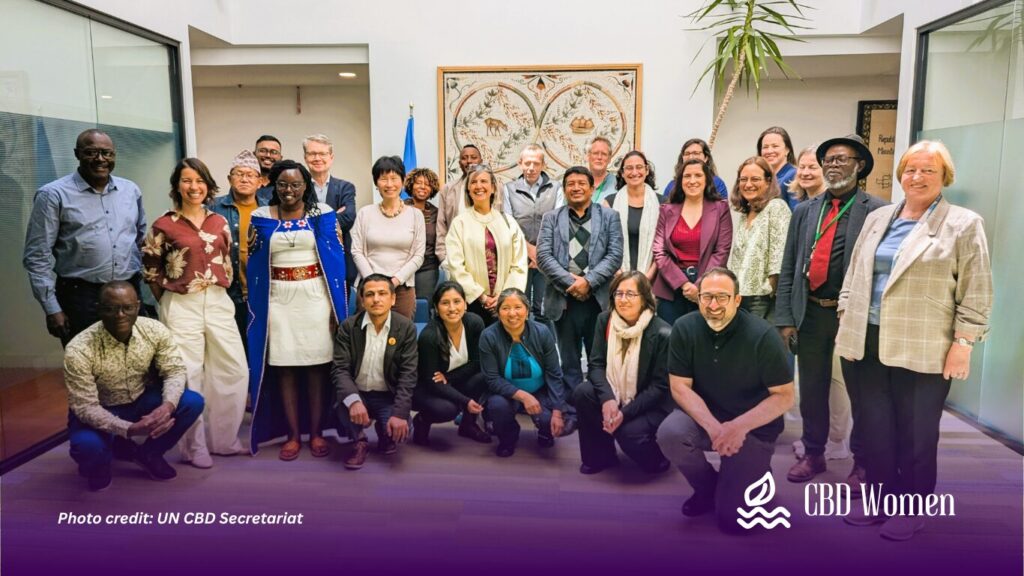
The event was the Informal Advisory Committee on Capacity-building to support the implementation of the Nagoya Protocol, convened in Montreal, Canada, from 1 to 4 June 2026. The meeting brought together experts nominated by Parties, representatives of Indigenous Peoples and local communities, women’s groups, business and research actors, and relevant international organizations to provide input to the second assessment and review of the effectiveness of the Nagoya Protocol. Discussions focused on implementation gaps and practical solutions across key areas, including Article 8 special considerations, benefit-sharing, capacity-building, Article 18 on compliance with mutually agreed terms, community protocols, the Access and Benefit-Sharing (ABS) Clearing-House, and technology transfer. The meeting was closely aligned with the mission of the CBD Women’s Caucus because it addressed biodiversity governance, equitable benefit-sharing, the role of traditional knowledge, and the conditions needed for women and communities to participate meaningfully in ABS processes.
CBD Women's Caucus Representation and Key Messages
Ms. Gladys Kiplagat from Kenya represented the CBD Women’s Caucus at the meeting. Drawing on the Caucus’s long-standing advocacy for gender-responsive biodiversity governance, she intervened to emphasize that assessing the Nagoya Protocol requires more than counting whether measures exist on paper. Her contribution highlighted the need to examine whether Article 8 special considerations are being implemented in ways that create a real balance between expeditious access and proper Access and Benefit-Sharing (ABS) compliance, and whether women, including women from Indigenous Peoples and local communities (IPLCs), are genuinely recognized, consulted, and able to influence ABS decisions in practice. She also called for assessment methodologies that go beyond Party-level quantitative reporting to include sex-disaggregated and qualitative evidence on participation, access to remedy, negotiation power, and the actual receipt, use, and control of benefits.
As Ms.Gladys Kiplagat noted in her intervention: “A credible review of effectiveness must look not only at whether measures exist, but at who participates, who decides, and who benefits in practice.” This perspective helped connect technical implementation debates to the lived realities of Indigenous Peoples and local communities, women, and youth
Key Findings: Progress and Gaps in Nagoya Protocol Implementation
A central focus of the meeting was the Committee’s input into the second assessment and review of the effectiveness of the Nagoya Protocol. The presentations and discussions showed that implementation has advanced in several areas, but important operational gaps remain. Meeting materials indicated that the number of Parties to the Protocol had increased to 142. They also showed progress on Article 8 special considerations, with 57 per cent of Parties reporting conditions to promote research contributing to biodiversity conservation and sustainable use, and 60 per cent reporting that they had taken into account the importance of genetic resources for food and agriculture. At the same time, only 30 per cent of Parties reported taking into consideration the need for expeditious access and expeditious fair and equitable benefit-sharing in emergencies, illustrating that implementation remains uneven.
The Committee also examined benefit-sharing trends and support needs. The meeting materials highlighted that non-monetary benefits are more commonly reported than monetary ones, and that monetary benefits remain concentrated in a small number of countries. Capacity-building, therefore, emerged as a cross-cutting priority. Discussions stressed that one-off training and short-term project funding are not enough; implementation requires long-term institutional capacity, predictable resources, stronger national coordination, and better systems to monitor whether benefits are actually reaching intended rightsholders and stakeholders.
Gender Justice in Access and Benefit-Sharing
Within these discussions, the CBD Women’s Caucus perspective was especially relevant. Ms.Gladys Kiplagat drew attention to the fact that gender responsiveness still tends to be treated as secondary, even though implementation outcomes are shaped by power, access to information, legal literacy, negotiation capacity, and access to justice. She emphasized that women, including women from indigenous peoples and local communities, often face the greatest barriers in access and benefit-Sharing (ABS) processes, including limited access to technical documentation, legal support, institutional channels, and remedies when mutually agreed terms are not respected. She further underscored the value of community protocols as practical tools for documenting traditional knowledge, clarifying governance systems, and supporting prior informed consent in ways that also recognize women’s roles within communities.
Outcomes and Next Steps
The meeting adopted its report and agreed on key messages, possible national actions, and possible global or regional actions to enhance implementation of the Nagoya Protocol. Among the important outcomes were recognition that Article 8 implementation has progressed but still needs stronger operational guidance; that awareness-raising and strategic communication should target different actors, including indigenous people, local communities, women, and youth; that community protocols require greater support; and that long-term capacity-building and more predictable financing are essential for effective implementation. The adopted messages also reaffirmed that the Access and Benefit-Sharing (ABS) Clearing-House should be strengthened as a practical platform for information exchange and capacity support.
From the perspective of the CBD Women’s Caucus, the next step is to keep pushing for a truly gender-responsive assessment of the Protocol’s effectiveness. This means ensuring that future reporting and review processes capture not only formal measures but also women’s actual leadership, safety, participation, access to information, access to remedy, and equitable benefit-sharing outcomes. The CBD WC will continue to advocate for indicators and implementation approaches that recognize women, including Indigenous women and women in local communities, as knowledge holders, rights holders, and decision-makers in biodiversity governance. Supporters and partners are encouraged to follow and strengthen this work as the Nagoya Protocol review process moves forward.