

On 11 March 2026, the Global Environment Facility (GEF) Secretariat hosted a dedicated learning session to commemorate International Women’s Day, bringing together staff and partners to reflect on progress and future opportunities for advancing gender equality within environmental finance.
Opening remarks from Verona Collantes-Lebale, Senior Gender Specialist at the GEF Secretariat, and Adriana Moreira, Lead of the Partnership Division, highlighted key achievements in integrating gender equality across GEF policies, programming, and results frameworks.
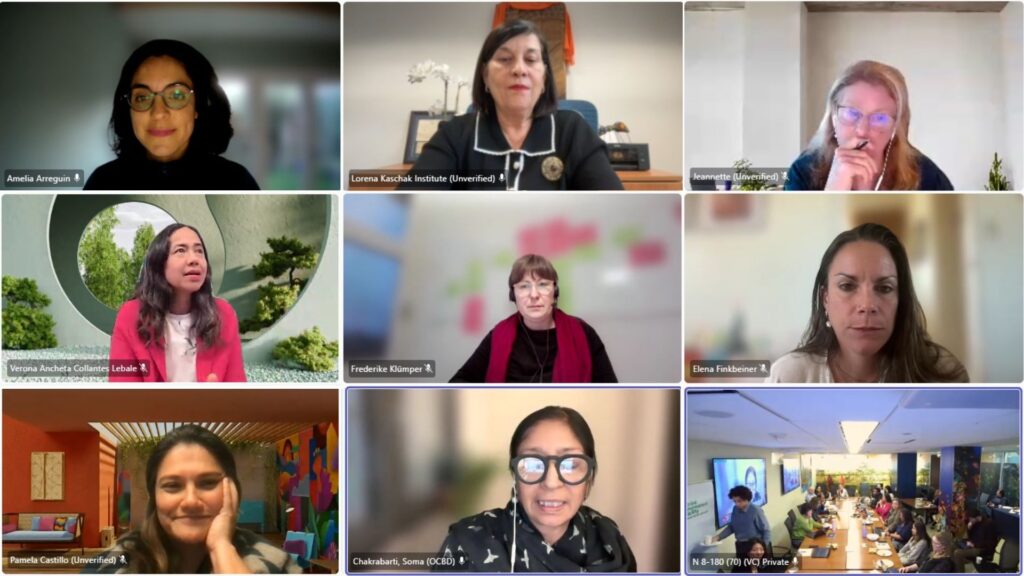
The session followed with the presentation of progress of two ongoing projects that demonstrate how gender-responsive approaches can strengthen environmental outcomes.
First, Pamela Castillo, Director, World Conservation Society and Elena Finkbeiner, Director, Coastal Community Fisheries, Conservation International presented the Women Ocean Guardians: Empowering Women for the Conservation and Sustainable Use of Large Marine Ecosystems project (GEF ID 11933), which promotes women’s leadership in the conservation and sustainable management of large marine ecosystems.
After, Frederike Klümper, Programme Director, Land Governance, TMG introduced the project Addressing Tenure Governance and Gender Equality in Land Rights to Strengthen Land Degradation Neutrality Initiatives (GEF ID 11501), highlighting concrete actions needed to secure women’s tenure rights and support sustainable land management.
During the expert panel, leading voices in gender and environment shared reflections on how the GEF can further strengthen gender-responsive environmental action. Lorena Aguilar, Executive Director, Kaschak Institute for Social Justice for Women and Girls, Binghamton University, emphasized the importance of ensuring that gender equality is integrated as a central element of environmental governance and sustainable development, rather than treated as an add-on.
Jeannette Gurung, Executive Director, WOCAN (Women Organizing for Change in Agriculture and Natural Resource Management), highlighted the importance of strengthening women’s economic empowerment within environmental initiatives and ensuring that environmental financing mechanisms effectively reach women’s organizations and community-level initiatives.
Bridging the “last-mile implementation gap”
Speaking on behalf of the CBD Women’s Caucus, Amelia Arreguín Prado reflected on the broader governance context shaping gender equality in environmental finance. As the financial mechanism supporting implementation of the Convention on Biological Diversity, the GEF plays a critical role in delivering on the commitments adopted under the Kunming-Montreal Global Biodiversity Framework, particularly Target 23 on gender equality and the CBD Gender Plan of Action.
Ms Arreguin, highlighted the importance of bridging what development practitioners often refer to as the “last-mile implementation gap” — the distance between global environmental finance frameworks and the realities faced by women leading environmental stewardship on the ground.
To help strengthen this connection, she introduced the idea of establishing a GEF Women’s Caucus: a collaborative platform that could bring together women’s organizations, gender experts, and environmental practitioners to support knowledge exchange, provide implementation feedback, and strengthen dialogue between the GEF partnership and women’s environmental leadership worldwide.