
A Turning Point for Gender Action Plans
On 25 March, the CBD Women’s Caucus and the UNFCCC Women and Gender Constituency convened a cross-learning session to exchange lessons between the midterm review of the CBD Gender Plan of Action (2023–2030) and the newly adopted UNFCCC Belem Gender Action Plan (GAP).
Together, these processes present a key opportunity to move beyond exchanges focused on negotiations and towards greater alignment in implementation. This shift is essential to ensure that both Gender Action Plans are not addressed in isolation, but rather as complementary and mutually reinforcing frameworks that can drive gender-transformative environmental governance.
While both plans offer strong guiding frameworks, their effectiveness will ultimately depend on how they are translated into action at the national level—through coherent policies, adequate financing, and robust accountability mechanisms.
Shifting from Commitments to Implementation
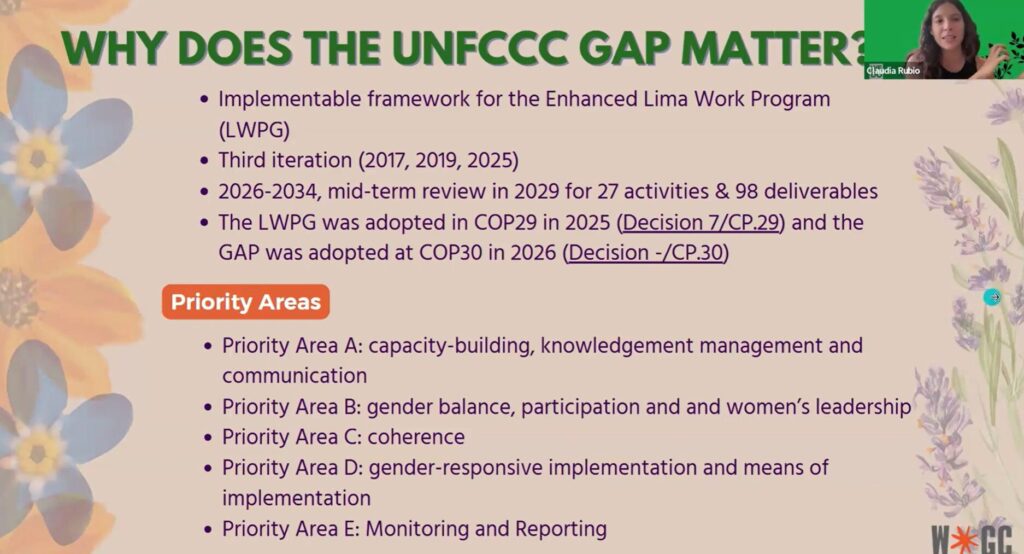
The session opened with Ms. Claudia Rubio, Coordinator for Policy and Programmes at Women’s Environment and Development Organization, who presented the key features of the adopted Belem Gender Action Plan (GAP) for UNFCCC and its five priority areas. She emphasized the plan’s implementation-oriented nature, highlighting in particular Priority Area C, which calls for stronger synergies across conventions, and Priority Area E on monitoring and reporting. The discussion also reflected on key gains and trade-offs: progress included the explicit recognition of structurally excluded groups and the integration of sex- and age-disaggregated data, while notable gaps remain, such as the absence of clear indicators and the loss of strong human rights language.
On the other side , Amelia Arreguín Prado, Coordinator of the CBD Women’s Caucus, presented reflections from the mid term review of the CBD Gender Plan of Action as a powerful tool to advance the implementation of Target 23. The current plan improves on previous iterations by identifying concrete actions, timelines, objectives, and responsible actors. Key achievements include the establishment of Gender Focal Points—although only 59 countries currently have them—as well as progressive elements such as the eradication of violence and explicit protections for women environmental defenders. To date, the CBD’s Gender Plan of Action has undergone its mid-term review, though participation has been limited, with only 20 Parties and 14 observers contributing, indicating the need for a more robust and inclusive review process.
National Experiences and Dialogue
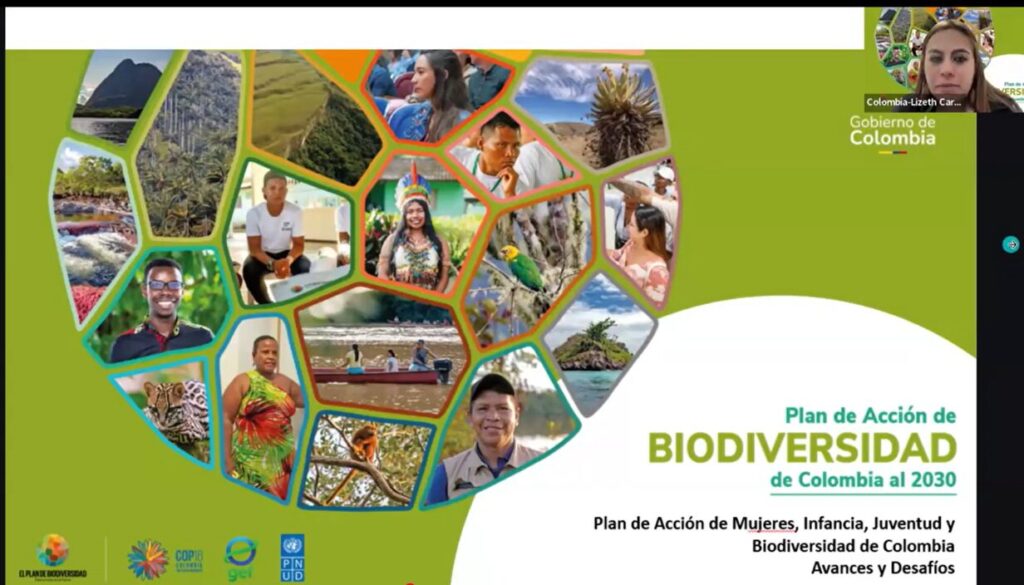
The session featured the participation of Ms Lizeth Quiroga, from theVice Ministry for Environmental Policy and Regulation of Colombia who shared Colombia’s experience in implementing their Action Plan on Women, Children, and Youth. She highlighted the differentiated pathway for women and the strategy to mainstream a gender perspective. Among the most successful implementation experiences were regional dialogues, the Inírida law initiative, regional gatherings, and the Global Summit of Women Caregivers of Biodiversity.
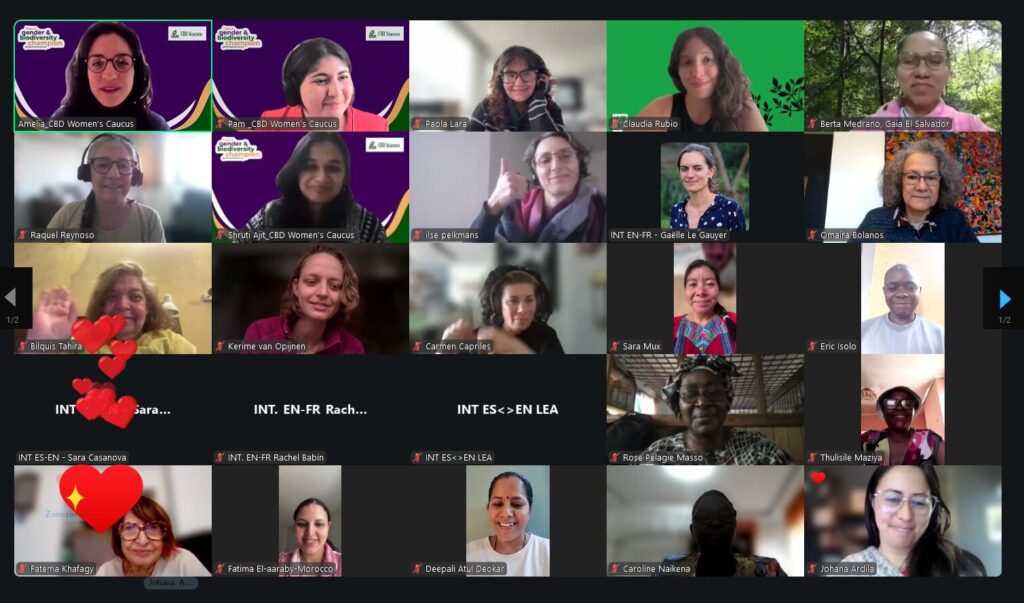
During the event, participants engaged in an interactive dialogue to identify concrete entry points for advancing the implementation of both the UNFCCC Gender Action Plan and the CBD Gender Plan of Action, as well as mechanisms to strengthen monitoring and accountability. Contributions from members of both constituencies—many of whom are working directly at local and national levels—highlighted that they are already actively implementing gender-responsive environmental actions across diverse contexts.
Their experiences underscored that women’s organisations and community actors are not only key stakeholders, but the backbone of implementation, offering practical, grounded pathways for translating global commitments into action. Despite persistent challenges, including limited funding and the absence of formal mandates or structured support, their work continues to drive progress, demonstrating strong commitment and leadership in advancing both gender equality and environmental agendas.
Key Takeaways
This space was presented as an opportunity to learn from parallel processes.The Gender Plan of Action under the CBD and the experience of the CBD Women’s Caucus offer valuable insights to exchange lessons learned and anticipate potential challenges, especially in relation to monitoring and reporting.
Recent developments under the UNFCCC Gender Action Plan also point to growing momentum for implementation. With its recent adoption, there is clear engagement, alongside a strengthened mandate for dialogue, workshops, and concrete activities. Importantly, the plan explicitly calls for enhanced synergies across conventions, creating timely opportunities to align efforts with the CBD Gender Plan of Action and advance more coherent, gender-responsive implementation across biodiversity and climate agendas.
The experience of the National governments reinforces the importance of creating enabling environments for the fair and effective participation of women and girls, as well as the recognition and protection of their knowledge and traditional practices.
It was also acknowledged that global circumstances four years ago were different, enabling the inclusion of stronger language on human rights, the eradication of violence, and the creation of enabling environments. In the current context, a key priority is to retain this human rights and gender language, while also addressing ongoing challenges related to financing and the weakening of negotiated language.