
By Berta Medrano, member of the CBD Women’s Caucus, Founder and Director of GAIA El Salvador.
Disclaimer: The views expressed in this blog are those of the author and do not necessarily reflect the official position or opinions of the CBD Women’s Caucus
Across Latin America and the Caribbean, women are at the forefront of defending forests, rivers, land and territories, often while facing serious risks. Their knowledge and leadership are essential to protecting biodiversity, yet their voices are still too rarely heard where global decisions are made. In late September, women defenders from across the region came together in Antigua Guatemala to share their struggles, learn from one another and plan how to bring their priorities into international negotiations, including the upcoming COP17 on biodiversity.
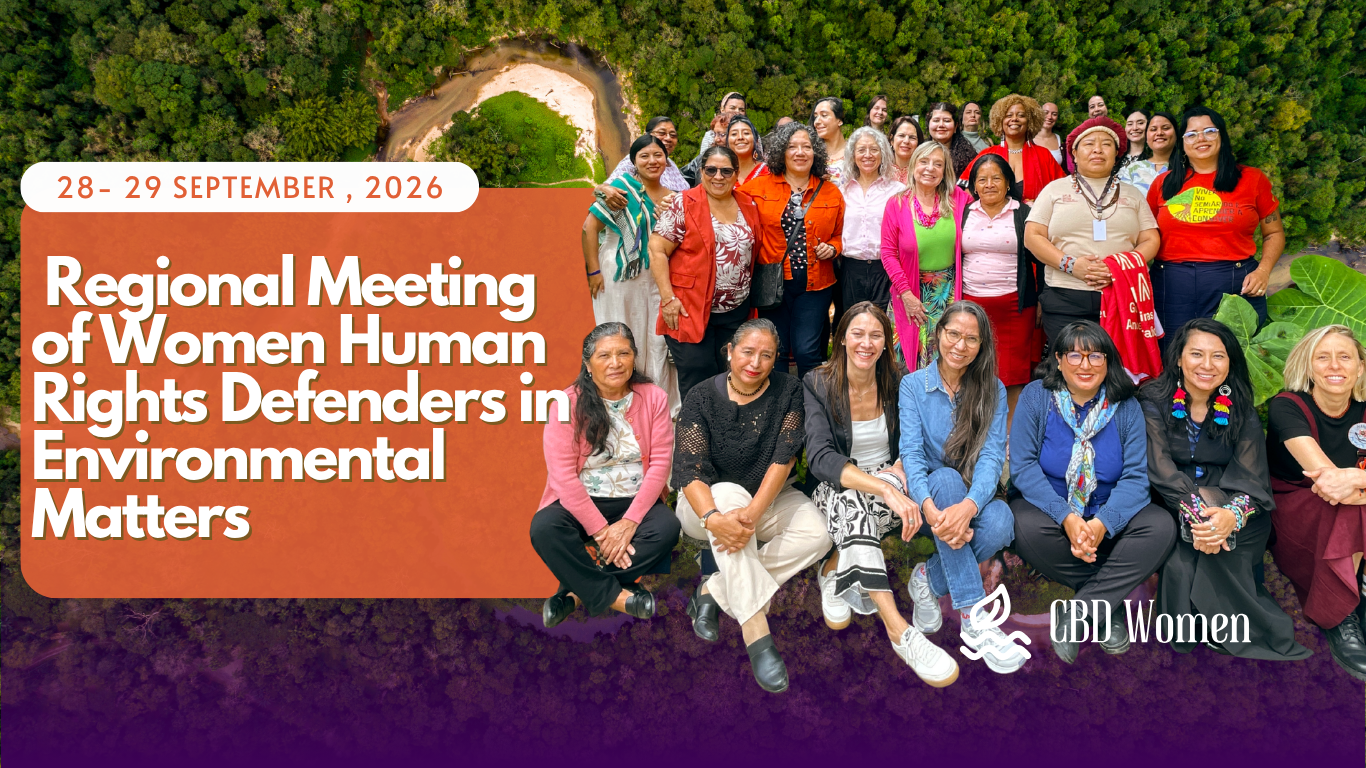
On September 28 and 29, 2026, in Antigua Guatemala, Guatemala, the “Regional Meeting of Women Human Rights Defenders in Environmental Matters” took place, in which women leaders and organizations from the CBD Women’s Caucus participated: Berta Medrano, María José Lubertino, and Olimpia Castillo Blanco.
The Meeting was convened and organized by UN Women, Regional Office for the Americas and the Caribbean, with the support of the Government of Luxembourg, and allied organizations such as ECLAC, OHCHR and UNEP.
Among the participants of the Meeting were leaders and organizations that make up the CBD Women’s Caucus: Berta Medrano from the GAIA Association El Salvador, María José Lubertino from the Eco-feminist Network of Latin America and the Caribbean, and Olimpia Castillo Blanco from the Escazú Defenders Network.
A regional space for women environmental defenders
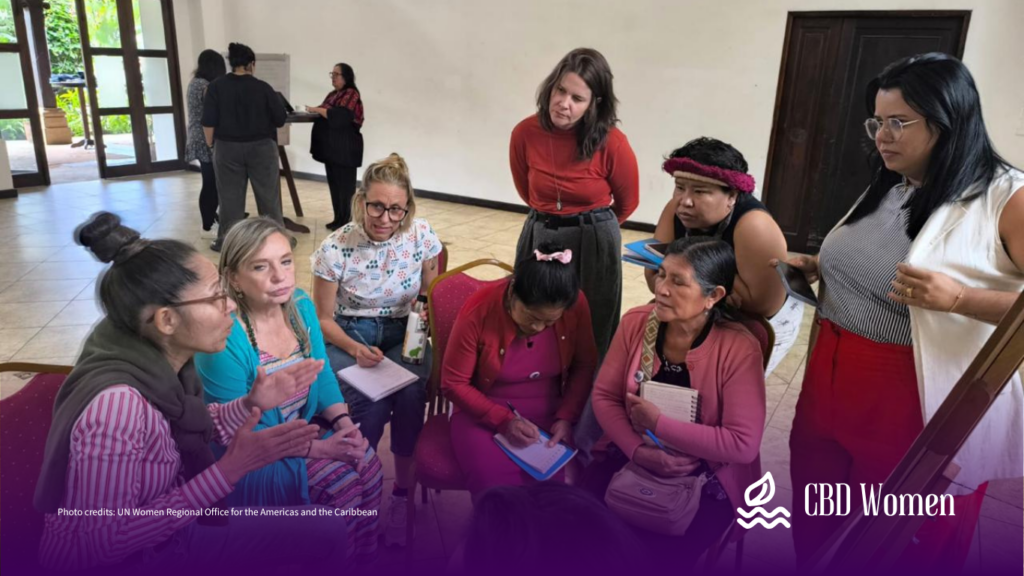
The overall objective of the Women Defenders Meeting was to generate a regional space for exchange, learning, and collective construction among women human rights defenders in environmental matters in order to identify opportunities for advocacy, strengthen the strategic use of international and regional frameworks of environmental governance, human rights and gender justice, and define common priorities for action at the national, regional and international levels.
Sharing the CBD Women’s Caucus journey
In the first session of “Experiences from the Territories,” focused on participation in international processes, women human rights defenders shared their experiences of advocacy in multilateral processes (UNFCCC, CBD, UNCCD, CSW, CEDAW, among others). Among these was a presentation on the CBD Women’s Caucus by Berta Medrano, who shared with the participants the following topics: what the CBD Women’s Caucus is, its background and history, objectives, mission, vision, its members, governance, initiatives, alliances, and strategic focus areas: policy advocacy, capacity building, community building, knowledge production, awareness-raising, and dissemination. She also shared information on the Gender Plan of Action and the Kunming-Montreal Global Biodiversity Framework, with an emphasis on Targets 22 and 23. Continuing along these lines, the current advocacy and preparation work that the CBD Women’s Caucus is undertaking for COP17, to be held from October 19 to 30 in Yerevan, Armenia, was shared with them. This work focuses on the collective development of key messages, positions, and proposals across the diverse topics on the COP17 agenda. The presentation concluded by highlighting the experiences, lessons learned, and insights gained from the advocacy processes, and by inviting the participants to join our large CBD Women’s Caucus community.
From shared experiences to advocacy priorities for COP17
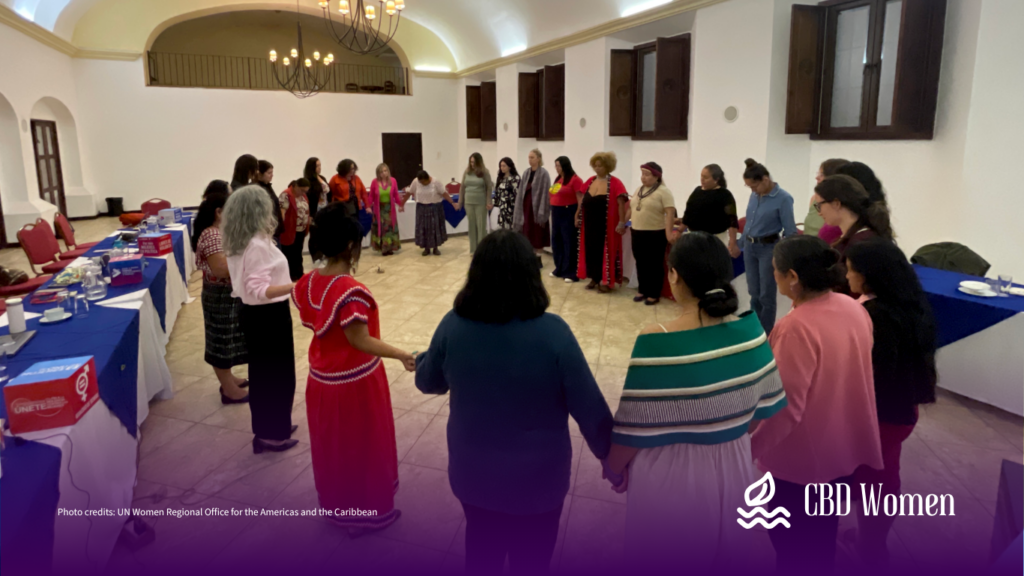
Likewise, on day 2, under the agenda item “Collective work on building advocacy priorities, Advocacy Lab I: Identifying opportunities and challenges,” participants organized themselves into thematic working groups (Escazú, UNFCCC, CBD, UNCCD, and CSW/CEDAW). Berta Medrano, along with the UNEP representative, facilitated the CBD working group, reinforcing and expanding upon the presentation topics to help participants identify key advocacy opportunities, experiences, challenges, and lessons learned to strengthen the participation of women human rights defenders in each process. It is worth noting that the current advocacy process for CBD COP17, and how to join and participate in it, took on particular importance during this process.
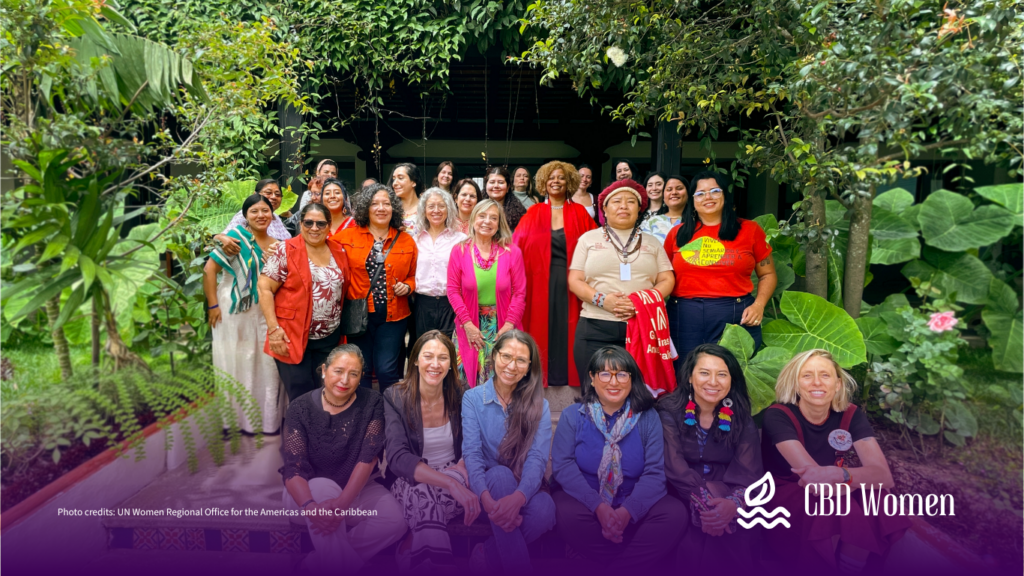
The meeting was an opportunity to raise the profile of the CBD Women’s Caucus and its agenda. The diversity of women leaders present highlighted the Caucus’s level of organization and capacity for influence, which inspires us, as environmental rights defenders, to engage and to find new ways to strengthen our struggles in the territories where we work, defend and advocate.